On this page
In brief: Milo is an open-source research platform investigating robotic guidance for blind and low-vision people. Its researchers describe navigation with onboard computing and no prior map, but also report collisions, restricted terrain assumptions and an inability to cross streets. It should not be presented as a proven replacement for a trained guide dog or an established mobility aid.
A robot can find a clear path for itself and still lead the person beside it into an obstacle. That is the engineering problem that makes Milo interesting. Guiding someone is not simply autonomous driving with a handle attached: the route must account for both bodies and the interaction between them.
What the researchers built
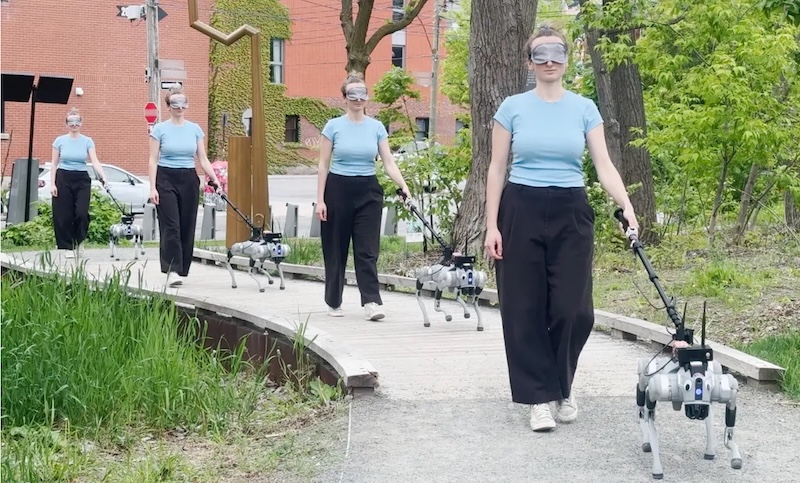
Florian Golemo, Joanna Wolski, Joel Ruben Antony Moniz and Christopher Pal describe Milo in a preprint posted on 21 July 2026. The system uses a modified Unitree Go2 with additional computing, sensors and a handle. Perception feeds a learned navigation policy trained in a simulator; the robot processes its navigation onboard rather than depending on a cloud connection or a prior three-dimensional survey.
The authors present the hardware instructions and software as open source through the Milo project. Open availability can help other researchers inspect and reproduce a design. It is not a certification of its safety or evidence that every released configuration has been independently validated.
The person is part of the navigation problem
The distinctive idea is to consider the handler’s position, not just the robot’s collision clearance. A path wide enough for a quadruped may be too narrow for the person holding its handle. Turns, passing pedestrians and changing walking speed make that relationship dynamic.
That leads to an important evaluation principle: reaching a destination is not enough. Researchers also need to measure clearance around the handler, interventions, uncomfortable movements and the consequences of losing confidence. A fast route is not an improvement if the person must repeatedly compensate for it.
What the experiments do—and do not—show
The paper’s experiment and limitations sections describe comparisons with a costmap-based navigation baseline. The authors report improved protection of the handler in their test scenarios, alongside collisions between the robot and its surroundings. They also describe difficulty with overtaking pedestrians and limited repeatability in the pedestrian experiment.
Those qualifications matter more than a broad claim that the robot “avoids obstacles.” Results from selected courses cannot establish reliable independent travel across unfamiliar streets, weather, crowds and daily routines. This article has not verified peer-reviewed publication, long-term user trials or independent safety validation.
Street crossings and terrain remain boundaries
The authors explicitly state that the current framework cannot cross streets. Their ground-projection method assumes flat terrain, with slopes and ramps left for future work. The walkable-surface detector also assumes the robot starts on and facing a traversable surface.
These are operating boundaries, not minor missing conveniences. They influence where a prototype can be studied and how a trial must be supervised. A demonstration on a suitable path must not become advice to use the device independently on public roads.
Why the low-cost claim needs context
The paper describes an approximately US$2,000 platform cost. Treat that as an author-reported research cost claim, not a verified retail price for a supported, delivered mobility product. The prototype configuration, sourcing, maintenance, training, repairs and service arrangements all matter to an eventual user.
Comparing a hardware estimate with the total cost of training and supporting a guide dog does not establish equivalent capability or lifetime value. Accessibility depends on reliable support and usable behavior as well as purchase price. An inexpensive device that needs frequent expert intervention may still be inaccessible in practice.
What a meaningful next evaluation should establish
- Which environments and situations the system is allowed to handle, and which it must refuse.
- How representative users influence the design and evaluation, rather than appearing only in a demonstration.
- How failures, interventions, contact events and discomfort are recorded, not just completed routes.
- What happens when sensing, computing, power or the robot’s understanding of the path fails.
- Who provides training, maintenance and support for any proposed use beyond research.
These are questions for a properly supervised research and validation program involving relevant mobility expertise. They are not a do-it-yourself deployment checklist for a person who depends on safe guidance.
A useful contribution without a premature product claim
Milo contributes an inspectable approach to a difficult problem: planning movement for a robot and its handler together. Its most useful feature as a research publication is not a dramatic promise, but the combination of a working approach and clearly documented limitations that others can investigate.
This is research-based reporting, not an AYXWORKS hands-on test or medical recommendation. Do not replace established mobility support on the basis of this article. For further technical context, explore the AYXWORKS robotics guides; for Milo’s evidence, start with the authors’ paper and project materials.