On this page
In brief: NVIDIA’s 2026 announcements describe tools for simulating robots, generating training data and training robot models. They are vendor announcements: they do not show that any factory is running a production-ready autonomous cell.
As of October 2026. The product statements below come from two NVIDIA press releases, dated 16 March 2026 and 31 May 2026, and were re-read on 12 October 2026; names, versions and availability may have changed since.
What NVIDIA announced
In the release of 16 March 2026, NVIDIA announced Cosmos 3, which it describes as a world foundation model for synthetic world generation, vision reasoning and action simulation; Isaac Lab 3.0, a robot-learning framework, in early access; and GR00T N1.7, a robot foundation model, in early access with commercial licensing. It also previewed a later model, GR00T N2, which it says is slated to be available by the end of the year. On 31 May 2026 it announced the Isaac GR00T Reference Humanoid Robot, an open reference design for academic research that combines a Unitree H2 Plus humanoid with Jetson Thor onboard compute; according to the release, it will be available from Unitree in late 2026.
An announcement is not a deployment
The March release lists many partners, but its wording matters. It says FANUC, ABB Robotics, YASKAWA and KUKA are integrating NVIDIA Omniverse libraries and Isaac simulation frameworks into virtual commissioning, and Jetson modules into controllers. That is NVIDIA’s account of work by manufacturers. It gives no count of factories, cycle times or failure rates, and does not establish that a particular robot bought today includes those functions. Check current release status and the offered configuration separately from application validation: general availability does not prove suitability for your process, and a successful demonstration does not change a product’s official release status.
A development pipeline, not a robot controller
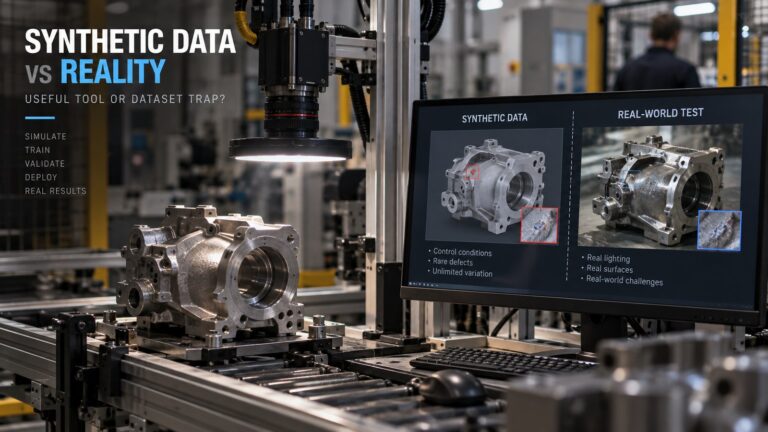
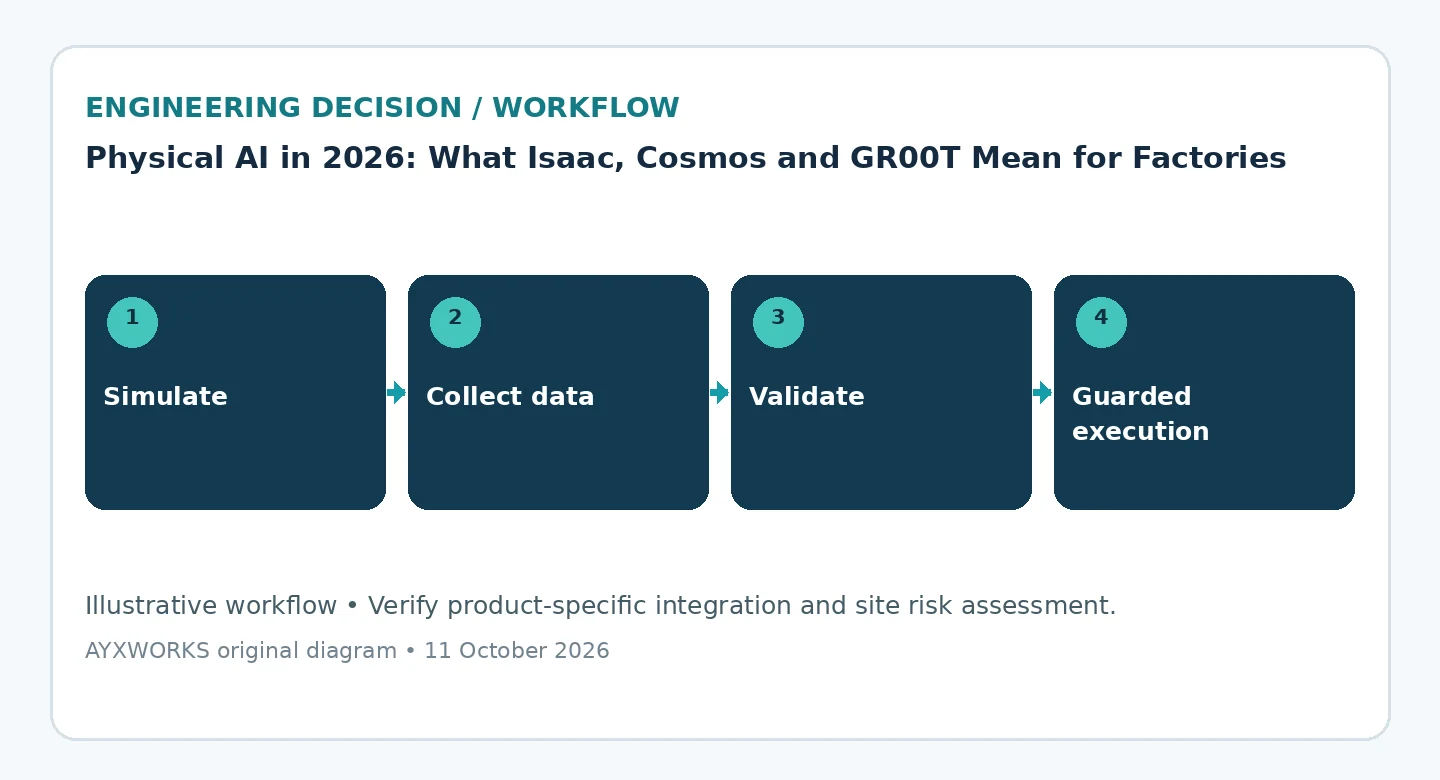
These tools address the stages before a robot moves in a plant: build a simulated cell, generate synthetic data or collect demonstrations, train a policy, evaluate it in simulation, then transfer it to hardware. Each transfer adds uncertainty, because simulated friction, contact, lighting and part variation differ from the real ones, so validation data from the real process is still needed. On the machine, the learned policy remains one component among others: sequencing, interlocks and safety functions stay with the PLC, the robot controller and the safety system, as defined by the risk assessment.
Where it may help, and what to ask for in a pilot
For repetitive parts and good fixtures, conventional programming is often the easier baseline to inspect and maintain; measure any benefit of a learned policy against it. Plausible opportunities include mixed or deformable parts and unstructured presentation. Virtual commissioning can reveal layout and reach problems before hardware is built. Ask a pilot to demonstrate success rates on unfamiliar parts, recovery after failed attempts, cycle-time variation, controlled model release and rollback, and ownership of data and model maintenance.
Checklist before committing budget or scope
- For each product named in an offer, its status: announced, early access or generally available, with the date.
- Evidence from the supplier’s own comparable application, kept separate from vendor press material.
- A real-world validation set that covers your parts, lighting and tolerances, not only simulation results.
- A learned policy bounded by the PLC, the robot controller and independent safety functions.
- Defined recovery, operator override and a procedure for updates and rollback.
- A named owner for data, model and maintenance after the pilot.
What this guide does not establish
This article summarises vendor announcements as of October 2026. It does not test, benchmark or endorse any NVIDIA product, and AYXWORKS has not verified any partner deployment mentioned in the releases. Performance claims in the releases are NVIDIA’s own. Nothing here replaces the risk assessment, the functional safety design or the acceptance testing of a real cell.
Sources and further verification
- NVIDIA — NVIDIA and Global Robotics Leaders Take Physical AI to the Real World (press release; 2026-03-16; accessed 2026-10-12).
- NVIDIA — NVIDIA Announces NVIDIA Isaac GR00T Reference Humanoid Robot for Academic Research (press release; 2026-05-31; accessed 2026-10-12).
Next useful step
Turn the announcement into an engineering question: name one task in your plant where part variation defeats conventional programming. Then compare your requirements with the application areas on the Robotics & Automation page. Projects that start there are scoped and delivered through Eurobots/ReBots, and they begin with feasibility, not with an assumed turnkey installation. The AYXWORKS portfolio shows the engineering background behind these guides.
Image credit: Prototyperspective — Wikimedia Commons (CC0; cropped to 16:9).