On this page
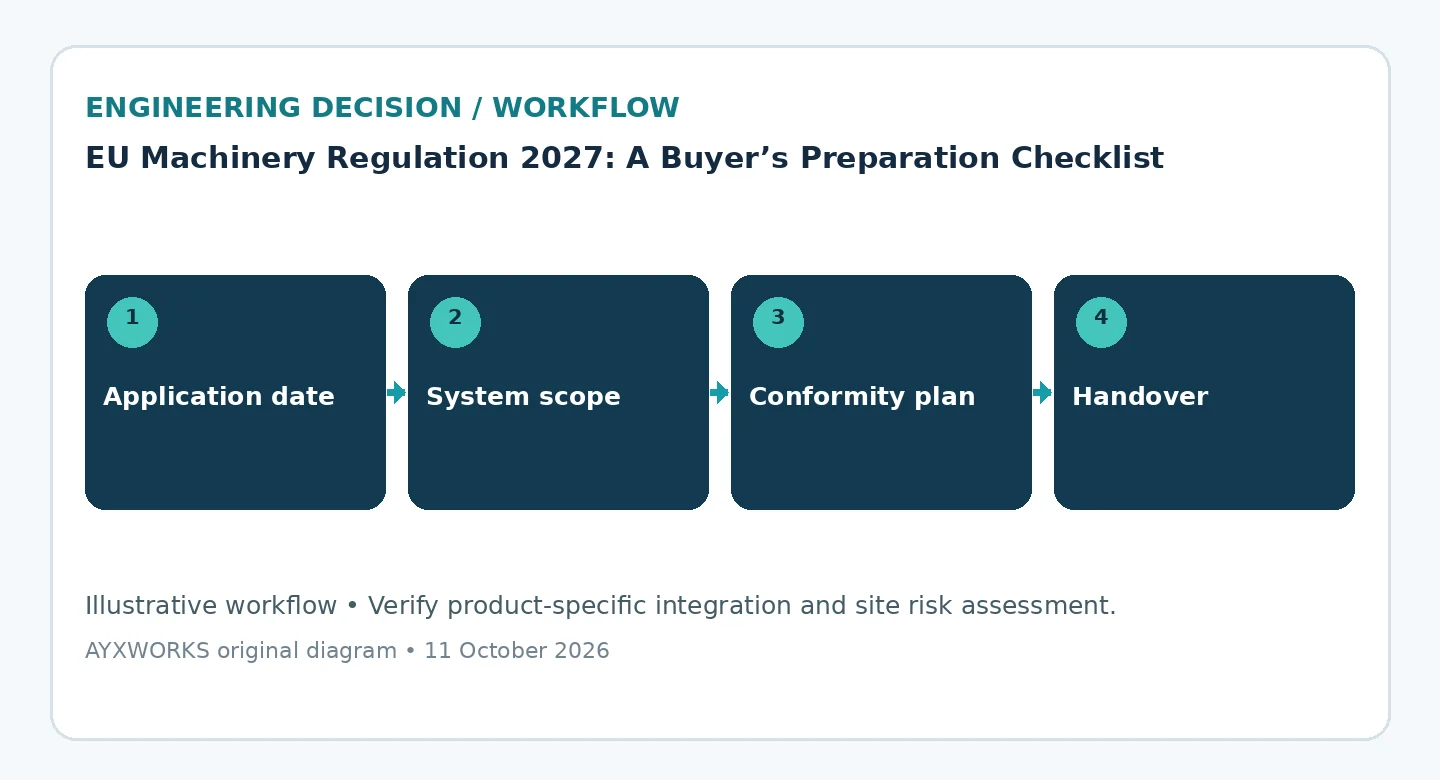
In brief: Regulation (EU) 2023/1230 on machinery applies from 20 January 2027, the date on which Directive 2006/42/EC is repealed. For a robot cell bought around that date, the useful work is to settle in writing who is the manufacturer of the complete cell and what evidence will be handed over.
Legal texts read on 2026-10-12 in the copies served by the Publications Office of the EU: the Official Journal text, its corrigendum and the consolidated version dated 2026-07-27. This guide is not legal advice.
The dates, as the text gives them
Article 54, as corrected, says the Regulation applies from 20 January 2027. The text first printed in the Official Journal said 14 January 2027; a corrigendum published days later replaced that date and several others, so older summaries may show the wrong day. Article 51 repeals Directive 2006/42/EC with effect from the same 20 January 2027, and Article 52 says Member States shall not impede the making available of products placed on the market in conformity with the Directive before that date.
Article 54 also lists provisions that apply earlier: Articles 26 to 42, on the notification of conformity assessment bodies, from 20 January 2024; Article 50(1), on national penalty rules, from 20 October 2026; Article 6(7) and Articles 48 and 52 from 19 July 2023; and Article 6(2) to (6), (8) and (11) with Articles 47 and 53(3) from 20 July 2024. Check the current consolidated text on EUR-Lex before relying on any date.
An order date is not a legal classification
The Regulation attaches obligations to placing on the market, defined as the first making available of a product on the Union market, and to putting into service, defined as its first use for its intended purpose in the Union. Neither is the date of the purchase order. A cell ordered in 2026 and first used in 2027 raises a question this guide cannot answer: which act counts, when it happens and under which text. Ask the supplier to state its position in the offer, and have it reviewed.
Who is the manufacturer of the cell
The definition of machinery includes assemblies of machinery or of partly completed machinery that are “arranged and controlled so that they function as an integral whole”. A robot with its gripper, guarding and process equipment will usually have to be assessed against that definition, and someone must then take the manufacturer’s obligations for the whole, including the technical documentation, the EU declaration of conformity and the CE marking. The definition of manufacturer also covers a person who manufactures a product and puts it into service for its own use, so a factory that integrates its own cell can find itself in that role. Under Article 18, so can whoever carries out a “substantial modification”, a defined term that covers physical and digital changes.
Standards are not the law
ISO 10218-1:2025 covers industrial robots and ISO 10218-2:2025 covers robot applications and cells. Under Article 20, a presumption of conformity attaches to harmonised standards whose references have been published in the Official Journal, for the requirements they cover. Whether a given edition has that status on the date that matters to you has to be checked; a statement that a cell “follows ISO 10218” is useful information, not proof of legal conformity.
Checklist before committing budget or scope
- The legal entity that will act as manufacturer of the complete cell, named in the contract.
- The supplier’s written position on which text applies and on when the cell is placed on the market or put into service.
- The intended use and the boundary of the machinery, including every interface to existing equipment.
- For each bought-in item, whether it comes with an EU declaration of conformity or, as partly completed machinery, with an EU declaration of incorporation.
- The handover package: instructions, EU declaration of conformity and the risk-assessment evidence the supplier agrees to share.
- A rule for later changes: who assesses whether a modification is substantial.
What this guide does not establish
This guide is a reading aid for buyers. It is not legal advice and not a conformity assessment. AYXWORKS and its author do not certify, approve or guarantee the compliance of any machine, and no article can. Conformity is the manufacturer’s responsibility under the Regulation; have your actual case reviewed by a suitably qualified machinery-compliance specialist.
Sources and further verification
- EUR-Lex — Regulation (EU) 2023/1230 on machinery, Official Journal text (2023-06-29; accessed 2026-10-12).
- EUR-Lex — Corrigendum to Regulation (EU) 2023/1230 (2023-07-04; accessed 2026-10-12).
- EUR-Lex — Regulation (EU) 2023/1230, consolidated text (2026-07-27; accessed 2026-10-12).
- ISO — ISO 10218-1:2025, Robotics — Safety requirements — Part 1: Industrial robots (2025-02; accessed 2026-10-11).
- ISO — ISO 10218-2:2025, Robotics — Safety requirements — Part 2: Industrial robot applications and robot cells (2025-02; accessed 2026-10-11).
Next useful step
If you are buying a robot cell for delivery around January 2027, put the manufacturer question and the handover list into the request for quotation, then see the Robotics & Automation page. Projects that start there are scoped and delivered through Eurobots/ReBots, and an evaluation begins with feasibility and responsibility boundaries rather than an assumed turnkey installation. The engineering background behind these guides is in the AYXWORKS portfolio.
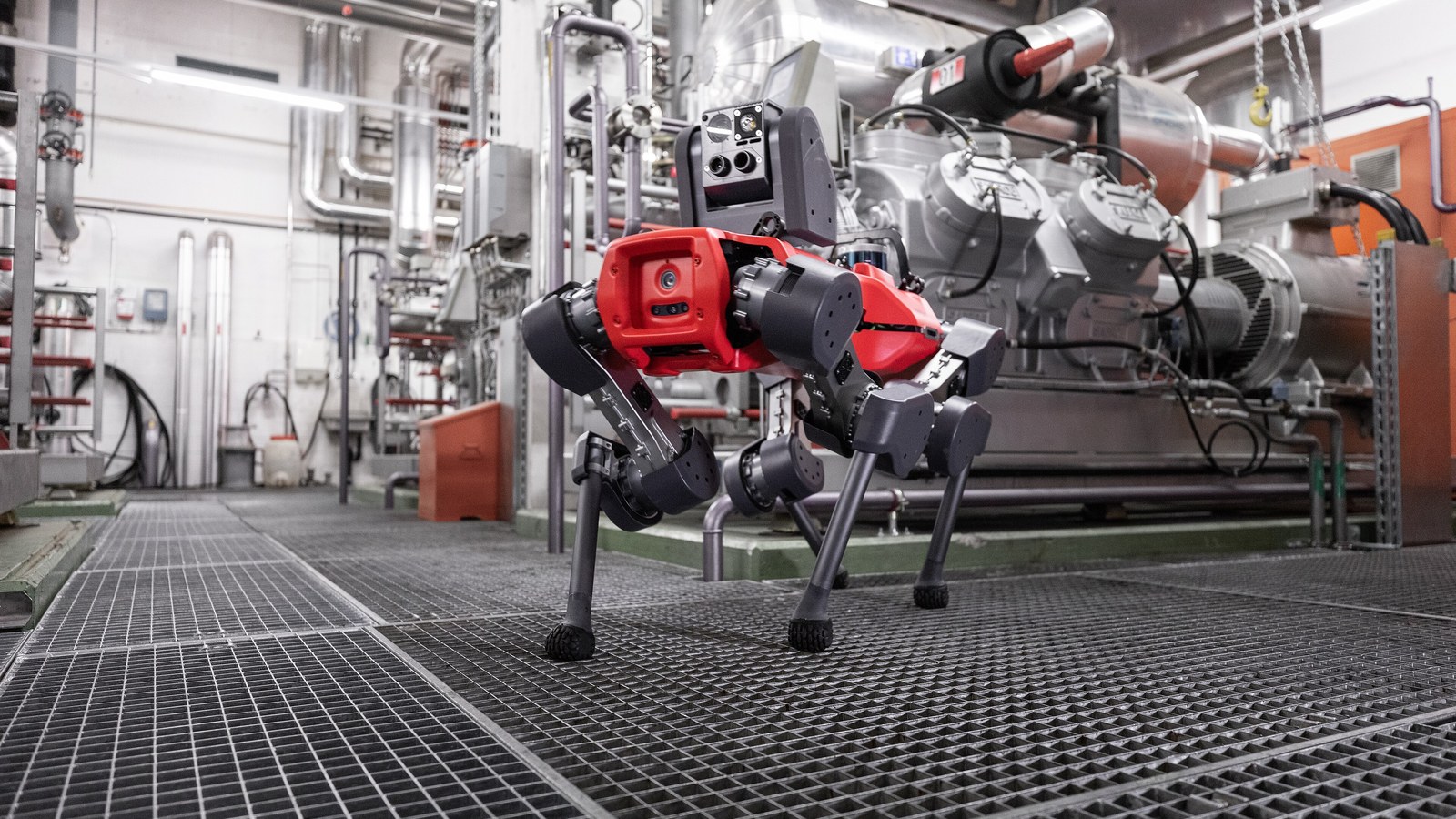
Image credit: ANYbotics — Wikimedia Commons (CC BY-SA 4.0; cropped to 16:9).