On this page
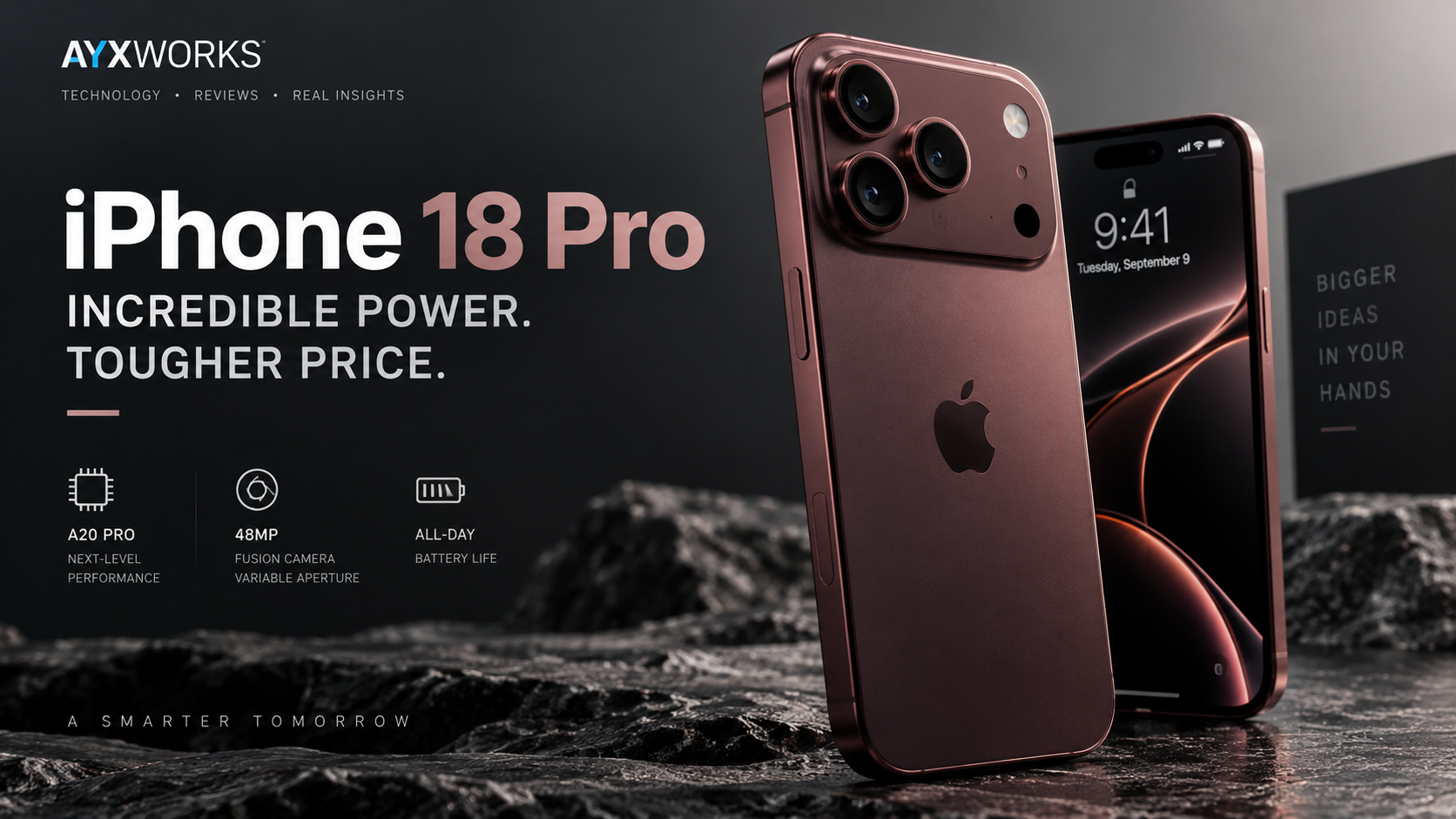
Apple’s iPhone 18 Pro is a strange kind of upgrade: it looks reassuringly familiar, costs more than last year’s model, and brings one of the most interesting camera changes Apple has made in years. Its 48MP main camera can now physically change aperture, the A20 Pro chip is exceptionally fast, and battery endurance improves without making the phone much larger. But if the iPhone 17 Pro already takes excellent photographs, who really needs to spend €1,469 on the new one?
That is the question behind this research-based review. We cross-checked Apple’s official Spanish specifications with independent battery and camera measurements from GSMArena and Tom’s Guide, detailed reporting from The Guardian and DPReview, and creator coverage from MKBHD and Mrwhosetheboss. The result is a practical assessment of what has actually improved, what hasn’t, and whether the iPhone 18 Pro—or the less expensive iPhone 17 Pro—makes more sense in October 2026.
Editorial disclosure — October 9, 2026: AYXWORKS has not physically tested or owned this handset for this article. Measurements and observations below belong to the named independent reviewers. Official specifications, regional battery claims and release prices come from Apple. This is an evidence-based buying guide, not a first-hand lab review; no invented numerical AYXWORKS review score or affiliate offer is presented.

iPhone 18 Pro review: the short buying verdict
The iPhone 18 Pro is a refinement, not a reinvention. Its strongest improvements are the A20 Pro silicon, better sustained performance, battery efficiency, faster charging and a physically adjustable main-camera aperture. Its less exciting facts are equally important: a 6.3-inch screen with familiar resolution, mostly unchanged ultrawide and telephoto hardware, and a weight increase to 211g.
Who should buy it: iPhone 13–15 owners ready to replace an aging phone; people who shoot a lot of video; mobile creators who want finer aperture and exposure control; and users who value performance and battery life in a smaller device than the Pro Max.
Who should wait: Most iPhone 17 Pro users, price-sensitive buyers who can find a discounted 17 Pro, and people whose main priority is a lightweight phone rather than an advanced camera rig.
Biggest strengths
- Very fast A20 Pro chip, with excellent scores in demanding CPU and GPU benchmarks.
- 48MP main camera with genuine optical aperture control, not simulated portrait blur alone.
- 48MP ultrawide and dedicated 48MP 4x telephoto, plus versatile professional video recording.
- Improved measured battery endurance compared with the iPhone 17 Pro.
- High-quality 120Hz OLED screen, useful anti-reflective treatment and smaller Dynamic Island.
- USB 3 transfers up to 10Gb/s and external-recording options that are useful to professionals.
Biggest compromises
- €1,469 starting price in Spain, €100 more in the US than the predecessor’s launch price.
- Variable aperture makes a smaller everyday difference than the specification suggests.
- Heavier than the previous model, at 211g; Pro Max reaches 249g.
- The 17 Pro retains many similar camera and video capabilities.
- Charging is quicker, but regional adapters and USB Power Delivery AVS support matter.
iPhone 18 Pro: confirmed specifications and Spanish price
These are the principal iPhone 18 Pro specifications, not a blend of the regular Pro and Pro Max. Where battery information differs between Spain and US versions, that distinction is noted below.
| Release | September 18, 2026 |
|---|---|
| Starting price in Spain | €1,469, 256GB, Apple launch pricing |
| Display | 6.3-inch Super Retina XDR OLED, 2622 × 1206, 120Hz ProMotion, Always-On |
| Processor | Apple A20 Pro, six-core CPU, seven-core GPU |
| Main camera | 48MP, 24mm equivalent, true variable aperture f/1.48 / f/1.8 / f/2.8 / f/4.0 |
| Ultrawide | 48MP, 13mm equivalent |
| Telephoto | 48MP, dedicated 4x optical lens (100mm equivalent); 8x optical-quality crop |
| Front camera | 18MP Center Stage with autofocus |
| Storage | 256GB, 512GB, 1TB, 2TB |
| Dimensions | 150.0 × 71.9 × 8.75mm |
| Weight | 211g |
| Durability | IP68; Ceramic Shield 2 front |
| Connectivity | Wi-Fi 7, Bluetooth 6, Apple C2 modem, USB-C with USB 3 up to 10Gb/s |
| Wireless charging | MagSafe and compatible Qi2 up to 25W |
| Software at launch | iOS 27 |
Source: Apple Spain official technical specifications and Apple’s Spanish announcement. Regional model, SIM configuration and battery claims vary.
Design and display: polished, brighter to use, and a little heavier
The standard Pro retains a 6.3-inch display instead of chasing the huge footprint of an Ultra-class Android device. That makes it comfortable for reading, navigation and capturing video without moving to a 6.9-inch Pro Max. Its 211g mass, however, means it is not a featherweight. The larger 18 Pro Max weighs 249g, so the regular Pro remains the more manageable device of the pair.
Apple’s aluminum unibody and glass construction feel familiar in published reviews. This is deliberate refinement rather than a dramatic redesign. The color choices are black, silver, glacier and burgundy. The smaller Dynamic Island returns a little usable screen area; the new anti-reflective treatment is more important in direct light than another round of marketing about peak nits.
Apple rates its OLED for adaptive ProMotion up to 120Hz and 3,000-nit peak outdoor brightness, but this is a condition-specific specification. Tom’s Guide measured approximately 2,314 nits using its 25% brightness window, while GSMArena reported more than 2,700 nits on a 10% white patch in auto mode. These are not contradictory: test pattern size, picture modes and protocols change the result.
For a buying decision, check readability outdoors, minimum brightness at night, reflections under office lighting and PWM sensitivity where relevant. Screen quality is already so good in recent Pro iPhones that it is rarely a compelling standalone reason to upgrade from a 17 Pro.
The variable-aperture camera: real engineering, modest everyday benefit
The headline upgrade is not simply another 48MP sensor. Apple has put a mechanical iris inside the main 24mm-equivalent camera, letting it select four true apertures: f/1.48, f/1.8, f/2.8 and f/4.0. The older iPhone 17 Pro used a fixed f/1.78 aperture on its main lens.
In plain language, aperture is the size of the opening through which light enters the camera. Wider apertures such as f/1.48 admit more light and can blur backgrounds more naturally at close range. Narrower apertures such as f/4.0 reduce the light reaching the sensor but can keep more of a scene acceptably sharp when subject distance and composition make depth of field important.
Where variable aperture can matter
- Close-up products and food: stopping down can help keep more of a small subject in focus without relying solely on computational effects.
- Low-light scenes: f/1.48 can gather more light than f/1.8, although exposure time, noise reduction and scene processing still determine image quality.
- People and environmental portraits: some real optical background separation can complement Apple’s software portrait processing.
- Creative photography: manual aperture controls make the phone more engaging to people who already understand exposure and depth of field.
What independent camera tests found
GSMArena’s testing provides the necessary reality check: in many normal scenes, the visible difference between f/1.48 and the older approximately f/1.8 setting is small. The publication concluded that this particular implementation brings limited practical benefit for average users. By contrast, Tom’s Guide and T3 welcomed the additional creative control and low-light flexibility.
Both observations can be true. This is a meaningful piece of camera hardware, but it is not a guarantee that every daylight photograph will look dramatically better. If you shoot on automatic and share mainly to social media, the improvement may be subtle. If you shoot carefully composed close-ups, work with exposure controls or use specialist camera apps, it can be genuinely useful.
For an especially clear comparison, 9to5Mac photographed the same scene at f/1.8 and f/1.48, keeping composition and camera distance as consistent as possible. It is a better demonstration than a stylized advertisement.
48MP ultrawide, 4x optical telephoto and the 8x crop explained
The iPhone 18 Pro has three distinct rear camera focal lengths: a 24mm-equivalent main lens, a 13mm-equivalent ultrawide and a dedicated 100mm-equivalent 4x telephoto. All three use 48MP sensors, but those numbers should not be confused with identical image quality at every distance.
The 4x telephoto is genuine optical magnification. Apple’s 8x optical-quality option is a higher-resolution crop from that telephoto sensor, not another dedicated 8x optical lens. This distinction matters when comparing long-distance detail with Samsung’s Galaxy S26 Ultra and other camera-first flagships.
TechRadar’s direct camera comparison found that the iPhone produced a more restrained, realistic-looking color palette in several scenes, while Samsung’s S26 Ultra offered broader optical zoom flexibility and sometimes more dramatic processing. Neither approach is always right: the preferred photograph depends on subject, lighting and personal style.
For travel, verify the camera you use most. Architecture and landscapes benefit from consistency between main and ultrawide lenses. Children and pets benefit from focus speed and shutter decisions. Wildlife and distant performers need real optical reach. The iPhone excels at a balanced combination, but buyers who prioritize extreme zoom should compare actual matched samples rather than headline sensor resolution.

Video creators have a stronger reason to care than casual photographers
The iPhone 18 Pro is particularly persuasive for people who use their phone as a serious video production tool. Apple’s official specification includes 4K Dolby Vision recording up to 120fps on the main camera, ProRes up to 4K/120fps with external recording, ProRes RAW, Apple Log 2 and genlock support for compatible workflows.
Those are specialized capabilities, not features everyone needs. ProRes and RAW can create very large files, and recording formats, frame rates and external storage requirements need to be planned before a shoot. The fast USB-C port matters here: USB 3 up to 10Gb/s helps offload large assets, provided the cable, drive and receiving device support the required transfer standard.
Also consider microphones, stabilization and color consistency when moving between lenses. Apple lists four studio-quality microphones, spatial and stereo recording, wind noise reduction and Audio Mix processing. These make the phone useful for interviews, travel vlogs and smaller productions, but external audio still matters more than microphone marketing in difficult locations.
For someone upgrading from a recent 17 Pro, a dedicated audio setup, tripod, compact light or better editing workflow may deliver more visible improvement for less money. The new phone is the right expense when its performance and camera controls solve an actual production bottleneck.
A20 Pro: how fast is it, really?
Apple’s A20 Pro is manufactured using a 2nm-class process and combines a six-core CPU with a seven-core GPU, hardware ray tracing and updated neural acceleration. What matters to users is not the process label but how quickly it completes real tasks, how much heat it produces and how well performance holds during long sessions.
Tom’s Guide reported major benchmark gains over the iPhone 17 Pro generation—approximately a quarter higher single-core CPU results, a meaningful multi-core improvement and faster graphics in its measured tests. The gains are real, particularly in demanding gaming and rendering workloads. Benchmarks, however, should not be turned into a promise that a messaging app will feel 25% faster.
Thermal design becomes important during 4K recording, navigation in the sun and sustained high-frame-rate gaming. Independent tests showed solid results for the 18 Pro, but the larger Pro Max can sustain some graphics workloads better because it has more room to dissipate heat. If maximum sustained performance is critical, compare both sizes instead of assuming identical chips mean identical thermal behavior.
For most people who already own an iPhone 16 Pro or 17 Pro, the apps they use every day are not limited by CPU performance. The A20 Pro’s biggest practical value emerges in heavy creative work, intensive games, some on-device AI processing and the useful years of headroom it provides to a phone purchased today.
Battery life: the independent numbers, without the hype
Battery life is a genuine improvement, but different test methods must never be mixed as if they represent one universal score. Tom’s Guide ran continuous web browsing over cellular at a standardized brightness and measured an average of 16 hours 17 minutes for the iPhone 18 Pro, against 15 hours 21 minutes for the iPhone 17 Pro. That is a useful improvement of just under one hour in this protocol.
GSMArena tested a physical-SIM-slot iPhone 18 Pro with a 4,056mAh battery and reported a 16-hour 43-minute Active Use Score, using its own blend of workloads. The numbers are not directly comparable with Tom’s Guide’s 16:17 because the tests are different.
| Source and test | iPhone 18 Pro | Comparison / context |
|---|---|---|
| Tom’s Guide, 5G web browsing | 16h 17m | iPhone 17 Pro: 15h 21m |
| GSMArena, Active Use Score | 16h 43m | Physical-SIM review device, 4,056mAh |
| Apple Spain, video playback claim | Up to 34 hours | Manufacturer estimate; not a browsing or Active Use test |
Sources: Tom’s Guide’s method and results; GSMArena lab testing; Apple Spain battery claims.
A surprising regional detail: two battery capacities
GSMArena identified 4,056mAh and 4,288mAh configurations of the iPhone 18 Pro. The version with a physical SIM tray has the smaller battery, while the eSIM-only variant uses the larger battery arrangement. Apple’s own video-playback claims likewise differ by market: the Spanish specifications list up to 34 hours for the Pro, versus 36 hours on the US website.
This does not establish exactly how many extra minutes a specific imported handset will deliver in your usage. It does mean you should not quote a US review’s battery capacity as though it applies automatically to a Spanish retail device. If buying abroad, verify the exact SKU, SIM support, warranty and network compatibility.
Charging: faster, but don’t confuse charger rating with phone draw
Apple advertises up to 50% in about 15 minutes under specified conditions using a compatible 60W-capable power adapter with Adjustable Voltage Supply (AVS). That does not mean the phone continuously draws 60W. Charger output rating and actual phone power are separate values.
GSMArena’s tested European unit reached approximately 42% after 15 minutes, 74% after 30 minutes and a full charge in around 62 minutes using a compatible USB Power Delivery setup. Tom’s Guide reported 53% after 15 minutes and 80% after 30 minutes in its test. Different configurations and protocols explain why real results can diverge from the manufacturer’s best-case estimate.
Wireless charging supports up to 25W with suitable MagSafe or Qi2 hardware. For a practical purchase, use a reputable USB-C charger that meets the correct AVS charging profile. A nominally high-wattage adapter without compatible negotiation may not achieve the advertised peak charging behavior.
iOS 27, Siri AI and everyday usability
The iPhone 18 Pro launches with iOS 27 and Apple’s expanded AI experience. The ability to edit images, summarize information, interact with apps and receive more context-sensitive assistance can be useful, particularly if you already work across iPhone, Mac and iPad. But AI features vary by language, region, application and availability, and not every announced capability is equally helpful in real workflows.
Tom’s Guide viewed Siri AI as improved while still finding room for competing assistants and dedicated AI products. For buyers, the best test is to define three actions you actually need—summarizing a message thread, searching personal content, and moving information between apps—and check whether the phone completes them accurately and reliably.
The mature Apple ecosystem remains a major advantage for existing owners: AirDrop, Continuity, iCloud, Apple Watch and compatible accessories keep daily friction low. Those conveniences can be worth more than a synthetic benchmark lead. They also create switching costs, so buyers comparing Android alternatives should consider what they will lose as well as what they gain.
iPhone 18 Pro vs 17 Pro, 16 Pro, 18 Pro Max and iPhone Duo
The most useful comparison is with the phone you already own, not only the most expensive model currently on sale.
| Current phone / alternative | What 18 Pro adds | Buying recommendation |
|---|---|---|
| iPhone 17 Pro | Variable main aperture, A20 Pro, battery and charging refinements | Usually keep the 17 Pro unless camera controls or sustained performance are essential. |
| iPhone 16 Pro | Faster chip, stronger measured endurance, camera upgrades and newer processing | Consider if battery health is poor or your photography and video needs have grown. |
| iPhone 15 Pro or older | Multiple generations of screen, performance, imaging and battery improvements | More persuasive upgrade, particularly if replacing an aging battery or low-storage device. |
| iPhone 18 Pro Max | Same general pro camera concept but larger 6.9-inch screen, longer battery life and greater mass | Choose Max for endurance and workspace; regular Pro for portability. |
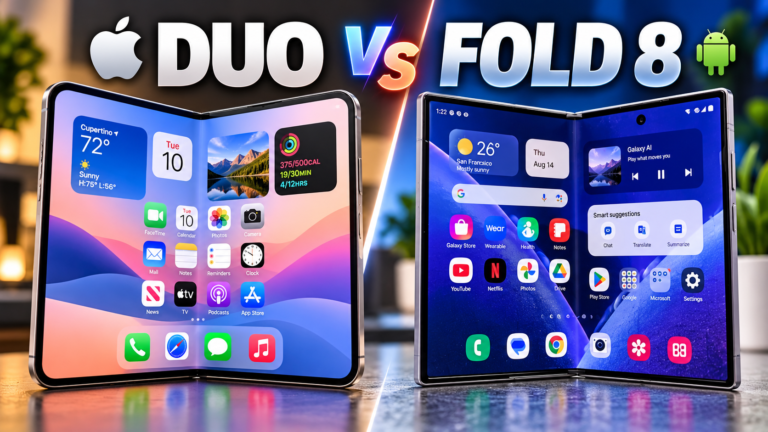
| iPhone Duo | Duo offers a folding 7.6-inch workspace; 18 Pro retains dedicated 4x optical zoom and familiar durability profile | Choose Pro for conventional photography/video; choose Duo for the unfolding screen if you accept first-generation risks. |
Should you buy the iPhone 17 Pro on sale instead?
Very possibly. DPReview and GSMArena both underline how much camera hardware the two generations share: the 18 Pro’s most important optical change is the main lens’s aperture. If you can buy a legitimate, properly warranted 17 Pro at a meaningful discount, it may represent a better deal for people who are not specifically seeking the new camera controls.
Always compare the same storage capacity and include warranty, battery condition (for refurbished units), trade-in credit, and retailer returns. Do not accept vague “from” prices that hide a different storage tier.
iPhone 18 Pro vs Galaxy S26 Ultra and Pixel: where Android still wins
The Samsung Galaxy S26 Ultra remains worth considering if maximum zoom flexibility, an expansive display or Samsung’s distinct Android productivity features matter more than iOS continuity. TechRadar’s camera tests found meaningful differences in color treatment and optical zoom behavior rather than one universal winner. Android models may also offer features and form factors Apple has not prioritized.
Google’s Pixel line is compelling for users who prefer Google’s approach to computational photography and AI services. But buying decisions should be based on current local prices, test conditions and long-term support rather than a leaderboard that mixes differently measured battery, brightness or camera scores.
People committed to Apple Watch, FaceTime, iCloud workflows and Mac continuity may rightly assign a high value to staying with Apple. That is a software and ecosystem decision; it should be identified honestly instead of described as a pure camera benchmark advantage.
What independent creators and professional reviewers say
Creator videos are especially useful for ergonomics, camera handling, interface friction and everyday impressions. Written lab reports are stronger for comparable measurements. Combining them gives a more complete picture than copying one review score.
| Reviewer | Coverage | Best use |
|---|---|---|
| MKBHD | iPhone 18 Pro: All About that Chip | Hardware strengths and why this feels like an iterative upgrade |
| Mrwhosetheboss | iPhone 18 Pro full review | Creator perspective on product direction and trade-offs |
| Tom’s Guide video | Performance and battery tested | Controlled battery tests and benchmarks |
| GSMArena | Full multi-page lab review | Display, battery, camera and charging methodology |
| DPReview | Camera generations compared | Distinguishing new aperture from unchanged camera hardware |
| The Guardian | Daily use and ownership review | Design, battery, repair and overall value |
One lesson emerges across the coverage: the A20 Pro performance gains are difficult to dispute, while the value of variable aperture depends strongly on the photographer. The camera upgrade is meaningful in the right scene, but it should not be sold as though the iPhone 17 Pro suddenly takes poor photographs.
Five questions to ask before spending €1,469
- Is your existing battery actually worn out? Check battery health and charging habits. A battery replacement may cost far less than a new flagship.
- Do you need manual aperture or pro video formats? If you never use RAW, Log, external storage or detailed camera controls, the everyday improvement will be smaller.
- Will you notice the A20 Pro performance? Games, extended capture, editing and computational workloads benefit; simple messaging rarely does.
- Would a 17 Pro at a discount solve your needs? Compare equivalent storage, authentic warranty and total ownership cost.
- Is the standard Pro the right size? Try the 211g Pro and 249g Pro Max in person before deciding that a bigger screen is better.
iPhone 18 Pro FAQ
How much does the iPhone 18 Pro cost in Spain?
Apple’s Spanish launch price is €1,469 for the 256GB iPhone 18 Pro. The Pro Max starts at €1,619. Retail promotions, storage tiers and trade-in offers can change the amount you pay.
Does the iPhone 18 Pro have a real variable aperture?
Yes. Its main 48MP camera uses a physical adjustable iris with four Apple camera-app settings: f/1.48, f/1.8, f/2.8 and f/4.0. This is genuine optical control, although its visible advantage is small in many everyday scenes.
Does the iPhone 18 Pro have 5x optical zoom?
No. Apple specifies a dedicated 4x optical telephoto lens with a 100mm-equivalent focal length, plus an 8x optical-quality crop. Optical-quality crop does not mean a separate 8x optical lens.
What battery life did independent testers measure?
Tom’s Guide measured an average of 16 hours 17 minutes in its 5G web-browsing test. GSMArena recorded a 16-hour 43-minute Active Use Score on its physical-SIM-slot review unit. These are different testing protocols and should not be compared directly.
Is the iPhone 18 Pro battery different in Europe and the US?
Some regional configurations differ. GSMArena identified a 4,056mAh physical-SIM variant and a 4,288mAh eSIM-only variant. Apple’s published video-playback claims also vary by region. Check the exact model and its SIM support rather than assuming every 18 Pro is identical.
Does it support USB 3 and external ProRes recording?
Yes. Apple’s specifications list USB 3 up to 10Gb/s and advanced external video recording options, including ProRes workflows. Actual transfer speed and recording capability depend on the connected cable, media, storage device and chosen format.
Should I upgrade from iPhone 17 Pro?
Usually not. The 18 Pro adds useful performance, battery and main-lens improvements, but the existing 17 Pro already handles most daily tasks and captures excellent photos and video. Consider an upgrade only if the new controls, sustained performance or battery are worth the extra expenditure to you.
Is the iPhone 18 Pro better than the iPhone Duo?
They serve different needs. The 18 Pro is a traditional high-end iPhone with a dedicated telephoto camera and a proven non-folding design. The Duo opens into a much larger screen and enables different multitasking scenarios, but its first-generation folding hardware requires a different assessment of weight, durability and repairs.
Final verdict: an exceptional phone, not an automatic upgrade
The iPhone 18 Pro is one of the strongest conventional smartphones Apple has produced. Its A20 Pro chip, reliable processing, attractive display, useful camera system, thoughtful video features and improved battery life make it an excellent phone to buy when your current device is genuinely due for replacement.
Its best innovation—the mechanical variable aperture—is simultaneously the reason enthusiasts should pay attention and the reason casual buyers should remain skeptical. It offers more photographic control, not a dramatic improvement in every picture. And with a higher starting price, the iPhone 17 Pro can be the smarter financial choice when discounted.
AYXWORKS buying recommendation: Buy the iPhone 18 Pro if you want a premium iPhone for the next several years, particularly when upgrading from an iPhone 15 Pro or older device. Keep a healthy iPhone 17 Pro unless you specifically need the new aperture system, A20 Pro headroom or endurance improvement. Choose the Pro Max only if larger-screen productivity and battery life justify its added weight and cost.
Compare before you buy: Check current official Spain pricing for the iPhone 18 Pro, read our iPhone 17 buying guide, and browse AYXWORKS Reviews for more source-based comparisons. We do not claim to track live retailer prices on this page.
Sources, methodology and image credits
- Apple Spain — iPhone 18 Pro technical specifications
- Apple Spain — launch announcement and Spanish prices
- GSMArena — full independent iPhone 18 Pro review
- GSMArena — display, charging and battery measurements
- GSMArena — variable-aperture photo analysis
- Tom’s Guide — standardized battery testing
- Tom’s Guide — iPhone 18 Pro and Pro Max review
- DPReview — iPhone Pro camera hardware comparisons
- TechRadar — iPhone 18 Pro vs Galaxy S26 Ultra camera comparison
- MKBHD — iPhone 18 Pro video review
- Mrwhosetheboss — iPhone 18 Pro review
Image licensing: Two unmodified, CC BY-SA 4.0 photographs from Wikimedia Commons are linked with photographer credits in their captions. If locally rehosted, preserve creator attribution, license links and modification disclosures. These photographs are illustrative of the device; they are not AYXWORKS test samples. Apple, iPhone and related marks belong to their respective owners.
Which feature would actually make you upgrade: the new camera aperture, a longer battery life, faster performance, or a better trade-in price? Let us know in the comments.