On this page
In brief: AGV and AMR describe different approaches to mobile automation, but the label does not guarantee whether a vehicle waits, reroutes or needs help when an aisle is blocked. Compare the actual route-planning behavior, traffic rules and transfer interfaces on your site. Navigation technology alone does not decide whether the transport service will work.
What the two labels actually describe
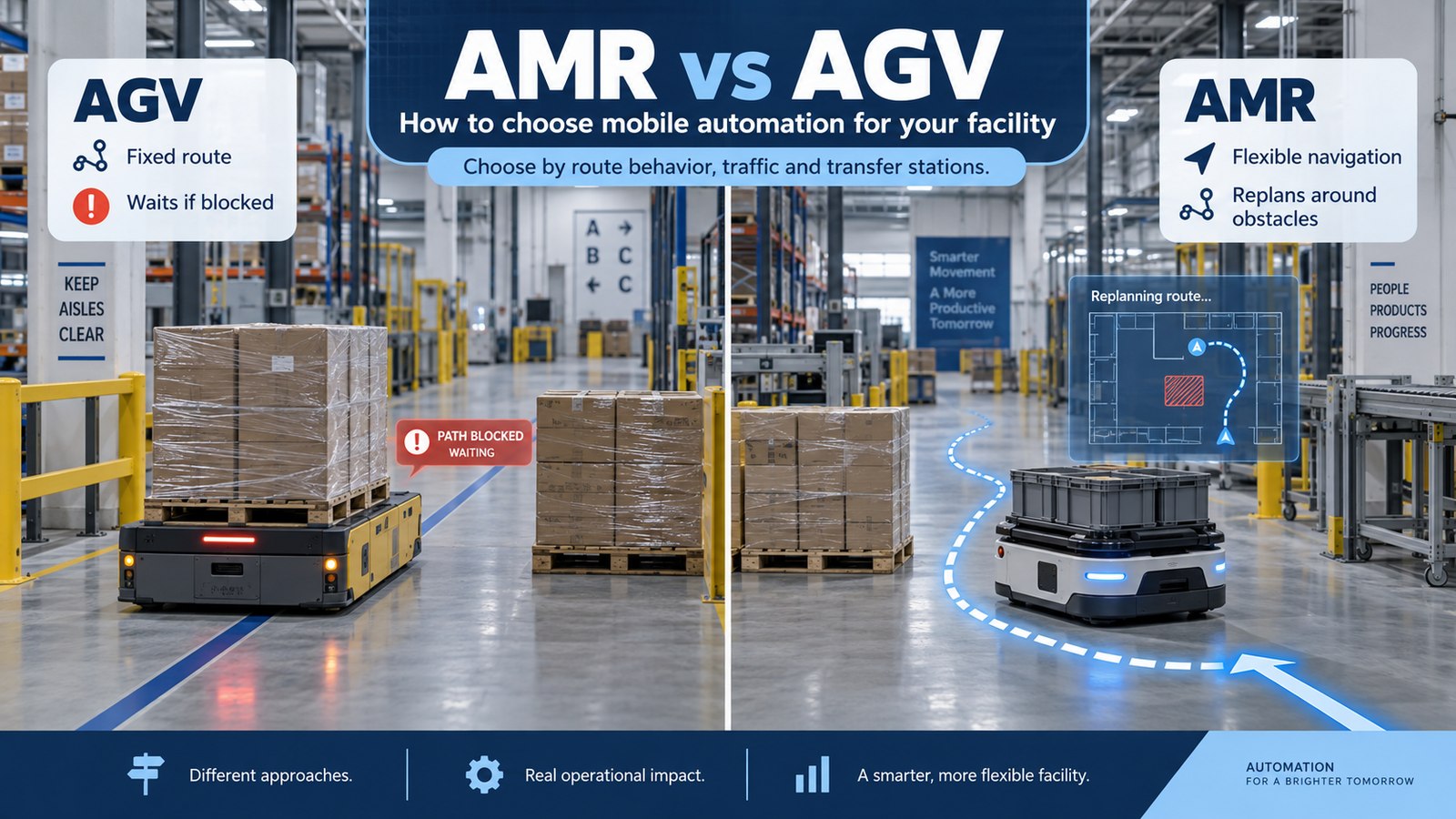
An automated guided vehicle (AGV) commonly follows a predefined route network, while an autonomous mobile robot (AMR) commonly adds more flexible local path planning. Real products overlap: guided systems can use natural-feature localization, and an AMR may deliberately be constrained to fixed lanes or instructed to wait rather than detour. Do not classify a vehicle by its lidar, magnetic strip or marketing name alone. Ask the supplier to demonstrate the permitted behavior, including what changes when an approved route is obstructed.
Many AGVs now navigate without floor infrastructure, and many AMR fleets are deliberately restricted to defined lanes and one-way rules. Ask each supplier how the vehicle localizes, what it does when it is blocked and which of those behaviours you can configure, instead of relying on the label.
Why predictability and flexibility pull in opposite directions
Fixed routes make arrival planning, right-of-way rules and docking positions easier to repeat. The tradeoff is less freedom to deviate: where no approved alternative exists, a pallet left in the route may stop the service until the obstruction is removed.
Flexible navigation can accommodate obstacles and layout changes within its permitted operating conditions. The detour is not free: travel times vary, a newly selected path may enter an area the site does not want to use, and major environmental changes can affect natural-feature localization.
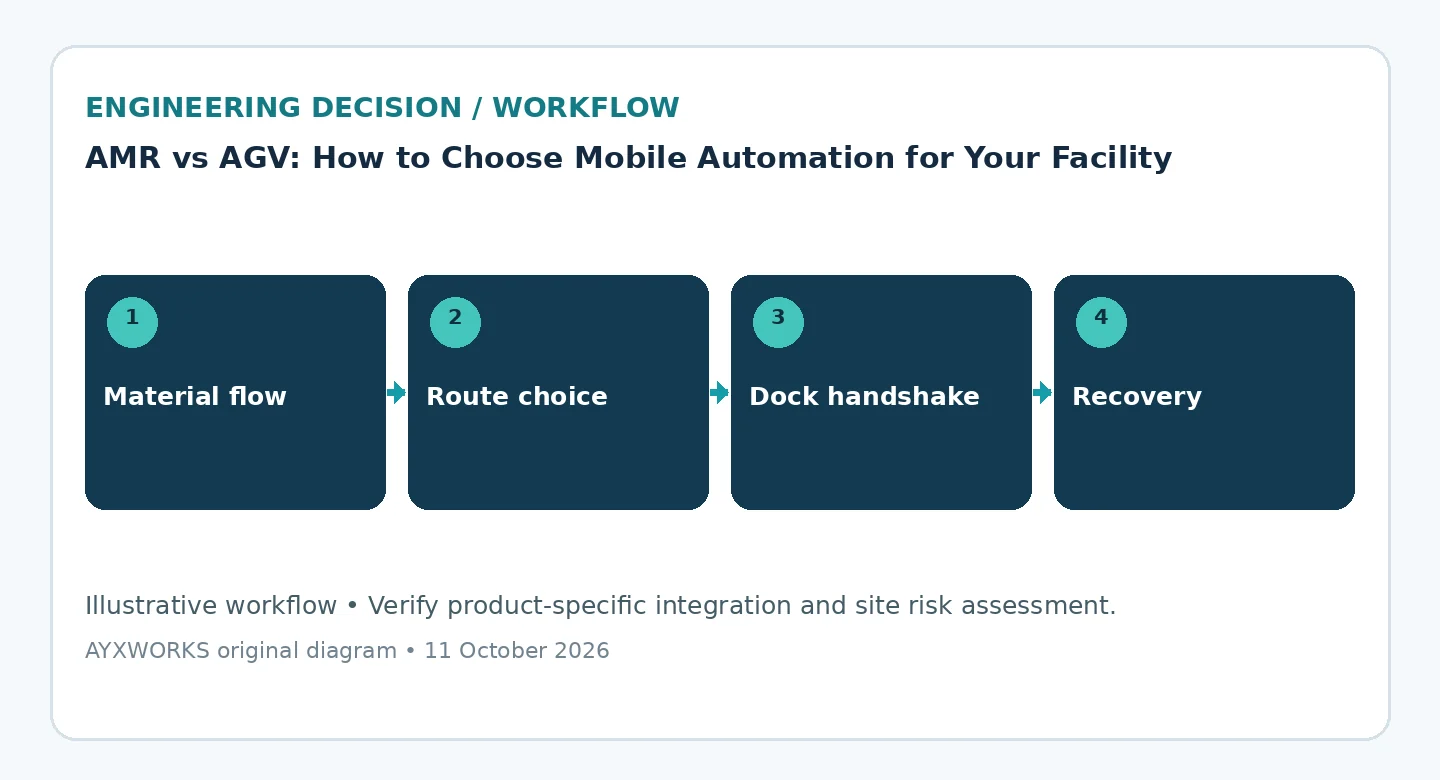
Map flows and crossing points before comparing vehicles
List every origin and destination pair with its peak number of transports per hour, the load type and the transfer height. A map without traffic timing is not a fleet model: two vehicles that meet in a single-width aisle create a deadlock that neither navigation method resolves by itself.
Integration and safety do not depend on the acronym
Much of the project effort lies around the vehicle rather than in it: transport orders from the WMS or MES, the signal exchange (handshake) with conveyors and transfer stations, automatic doors, lifts, fire doors, the charging and battery strategy, and the procedure for a stranded vehicle.
ISO 3691-4:2023 sets safety requirements and their verification for driverless industrial trucks and their systems, and its scope names automated guided vehicles and autonomous mobile robots alike as examples. Obstacle avoidance used for navigation is not automatically a function that protects people. Which functions are safety-rated, and in which zones, has to come from the supplier’s documentation and from the risk assessment of your site.
Market context, as of October 2026
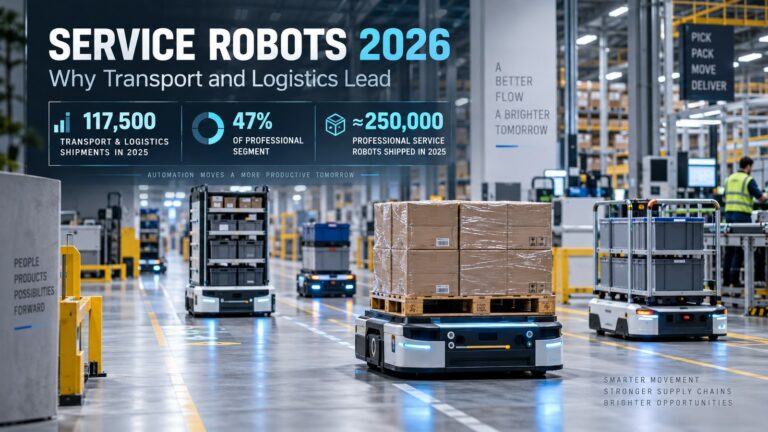
On 30 September 2026, the International Federation of Robotics (IFR) reported that its figures for professional service robot sales rose 24% to almost 250,000 units in 2025. Transport and logistics was the largest application, at approximately 117,000 units. These are survey-based reported figures, not a complete industry census; the release does not divide that total into AMRs and AGVs.
Checklist before committing budget or scope
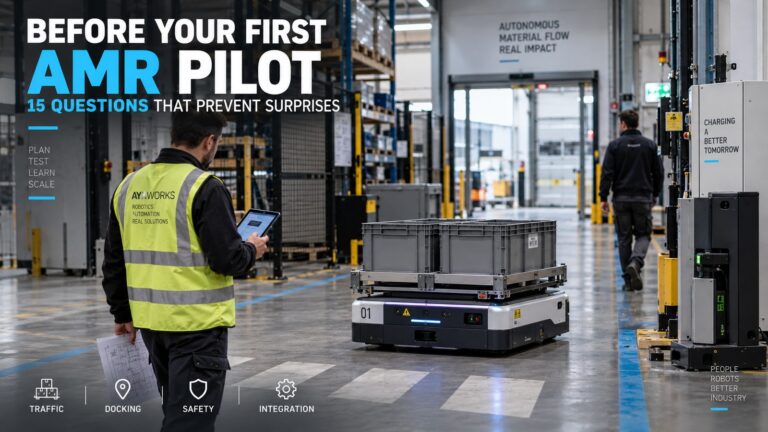
Run the pilot on difficult days as well as tidy ones, and first have the following in writing:
- A material-flow matrix: origin, destination, load and peak transports per hour for every route.
- A traffic map with aisle widths, crossings, one-way sections and waiting places.
- Load dimensions, mass, centre of gravity and docking tolerance at each transfer station.
- A named owner for each interface: WMS or MES, doors, lifts, conveyors, fire alarm and wireless network.
- A charging concept checked against the real duty cycle, including the busiest shift.
- Blocked-route and stranded-vehicle trials carried out with the people who will work beside the vehicles.
What this guide does not establish
This guide is a planning aid. It does not rank products, report test results or assess compliance, and it does not replace the risk assessment of your application. Navigation performance, safety functions and interfaces must be verified on the actual vehicles, in your building, by suitably qualified parties.
Sources and further verification
- IFR — Global Sales of Professional Service Robots Surge 24% (press release, 2026-09-30; figures for 2025; accessed 2026-10-12).
- ISO — ISO 3691-4:2023, Industrial trucks — Safety requirements and verification — Part 4: Driverless industrial trucks and their systems (published 2023-06; catalogue page, the full text is paywalled; accessed 2026-10-11).
- IFR — World Robotics 2026 public presentation: survey methodology (page 28) (2026-10-14).
Next useful step
Bring your material-flow matrix, a floor plan with aisle widths, the load data and the list of interfaces to the Robotics & Automation page. The AYXWORKS portfolio shows the engineering approach behind these guides. Any project that follows is scoped and delivered through Eurobots/ReBots, and it starts with feasibility and responsibility boundaries, not with an assumed turnkey installation.
Image credit: ayxworks — Original / rights held.