On this page
Editorial note (October 2026): This is a reproducible evaluation method, not an AYXWORKS 30-day experiment or benchmark. Any reported benefits must be measured independently before being claimed.
Quick answer
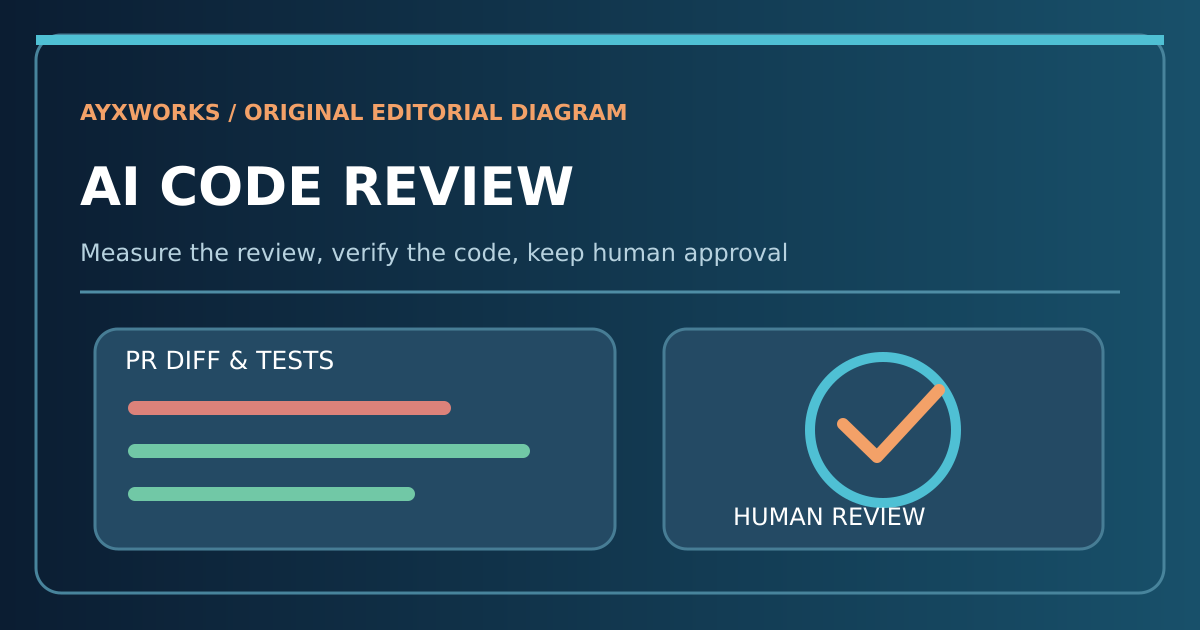
AI-assisted code review can be useful for preparing a review checklist, finding missing edge cases and improving documentation. Its output is a hypothesis for a human reviewer to verify, not proof that code is secure or correct.
Prepare a fair baseline
Pick one repository and define the categories of pull requests to be included. Record your normal review turnaround time, review-rework count, defect escapes and reviewer effort before introducing an assistant. Avoid drawing conclusions from cherry-picked easy changes. Establish a policy for secrets, proprietary code, prompt retention and acceptable external services.
Define what the reviewer is permitted to see
Before connecting an assistant to a repository, classify the code and data it may access. Exclude passwords, personal information and client assets unless the approved tool, retention configuration and contract allow them. A code-review assistant can ingest adversarial text from diffs or issue descriptions: treat these as untrusted inputs, never instructions authorizing tool calls, credentials or deployment. The OWASP GenAI security project discusses prompt injection, sensitive-information disclosure and unsafe output handling.
Suggested four-week process
In week one, use the assistant only to summarize changes and generate a checklist. In week two, request concrete negative tests and compare them with human expectations. In week three, examine repeated or hallucinated comments and measure reviewer burden. In week four, evaluate whether review quality, speed and maintainability improved relative to baseline.
An example of a useful 30-day evidence table
| Measurement | Baseline | AI-assisted period | Decision rule |
|---|---|---|---|
| Review lead time | Prior comparable PRs | Same-size PRs | Faster only if quality does not fall |
| Confirmed findings | Independently reproduced defects | Verified AI suggestions | Counts only after engineer confirms |
| False-positive effort | Typical unproductive comments | Minutes spent checking AI errors | Excess noise erases potential savings |
| Security coverage | Existing scanners and specialist review | Same controls plus assistant | AI cannot replace mandatory scanners |
| Defects after merge | Existing post-merge tracking | Same window and definition | Compare comparable risk and scope |
Avoid calculating a “percentage improved” from one or two small PRs. Include language, codebase age, risk classification and repository size when interpreting the results.
Measure more than activity
Count confirmed actionable suggestions, false positives, defects missed by the assistant, review time saved or added, and post-merge problems. Keep evidence connected to a particular pull request and independently validated test. A comment’s existence is not a successful bug discovery. Use a consistent definition of “useful” across the evaluation period.
Where AI feedback fits in GitHub
GitHub’s pull request code-review guidance describes early draft reviews, re-reviews after substantial changes and human decisions before merging. In a self-hosted or other-provider workflow, use equivalent controls: record the assistant version, review prompt, exact commit, evidence and the developer decision. A model pointing to a line is not the same as a reproduced failing test.
Keep humans accountable
Require human acceptance for security-sensitive recommendations, migrations and production changes. Never allow a model response alone to waive tests or approve its own patch. If the assistant repeats unreliable advice, tune or remove the workflow rather than treating volume as value.
Bottom line: A transparent, measured pilot is more useful than a dramatic “30 days changed everything” testimonial without reproducible records.