On this page
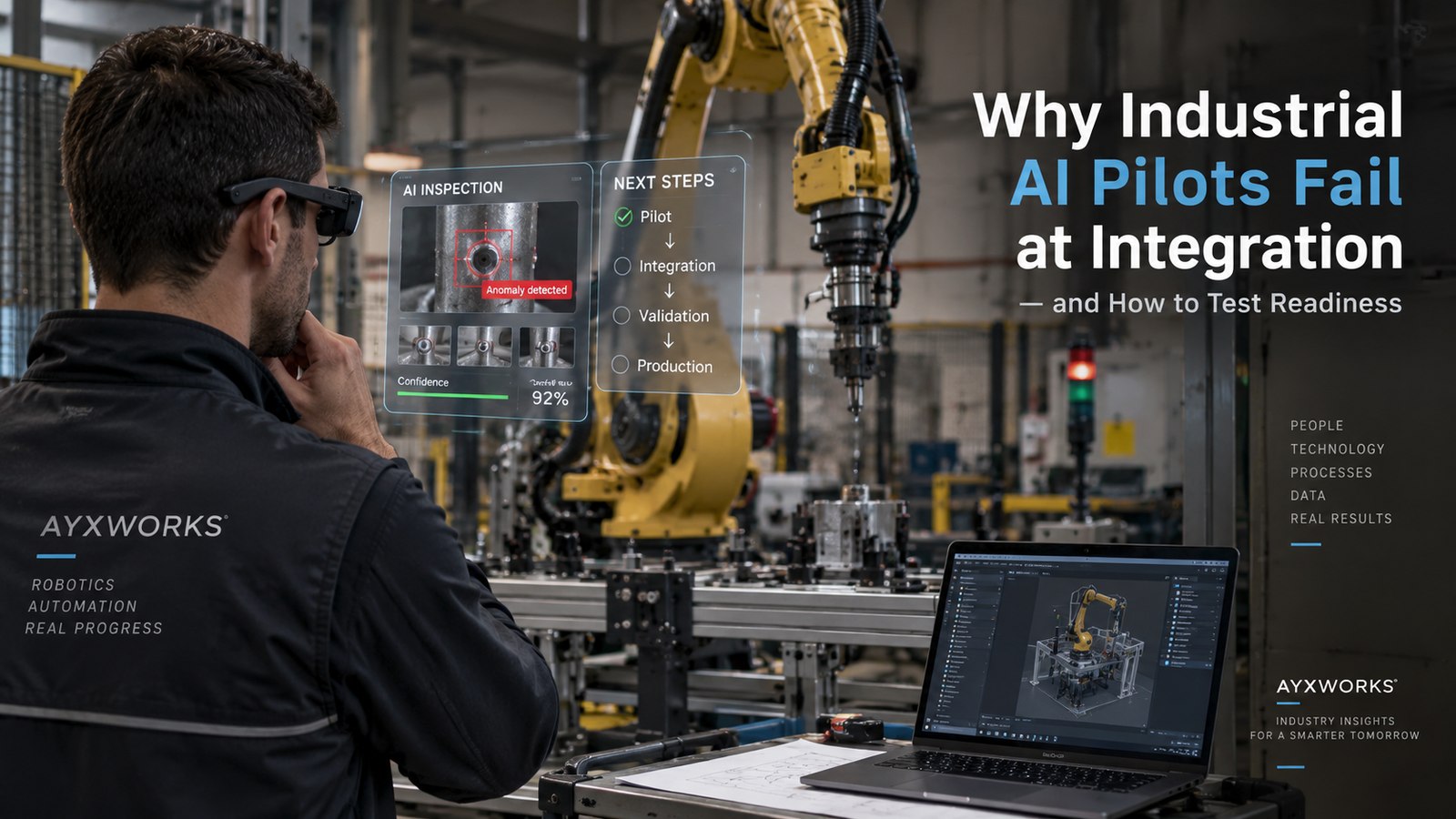
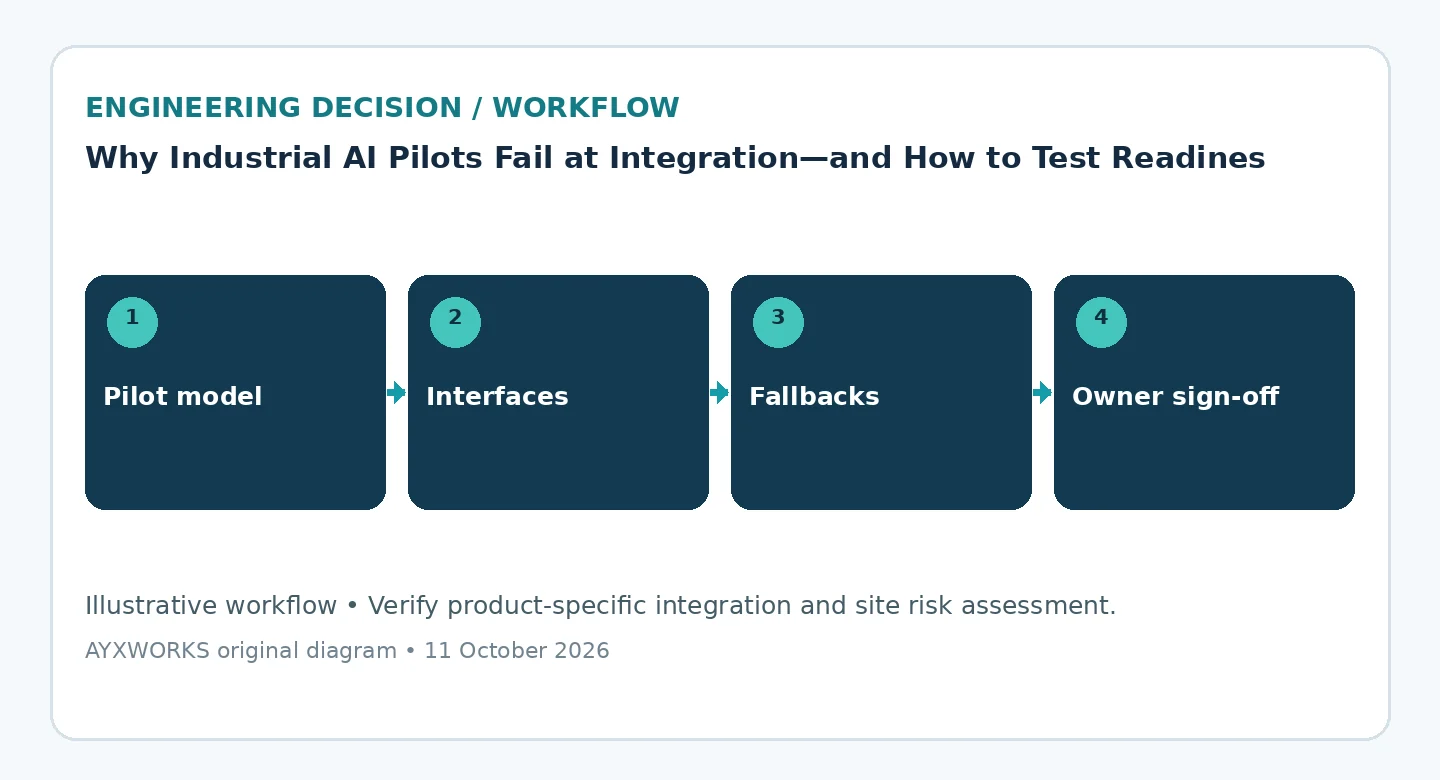
In brief: An AI pilot in a factory can fail at the integration boundary, not only at the model. Before training anything, ask whether the data are trustworthy, the machine interfaces are documented, the permitted actions are bounded, and responsibility for validation and maintenance is assigned.
Why good offline accuracy is not readiness
Offline accuracy answers one question: did the model match the labels in a dataset that someone had already collected and cleaned? Production asks different ones. Does the data arrive on time and in the same form from the camera, the sensor or the plant database? What does the line do when the answer is late or missing? Who is called at night when a result looks wrong? A pilot, meaning a trial project of limited scope, usually fails at integration because these questions were postponed, not because the model was weak.
Define what the model is allowed to decide
Write down the decision boundary before the pilot starts: an advisory alert, a recommendation to reject a part, a proposed process parameter, or an approved action within fixed limits. For every step that changes the state of the process, name who or what has final authority: the PLC, an operator or a higher-level system. This matters because scope tends to creep; a pilot that began as a dashboard should not quietly start writing set-points. Safety functions stay outside the model and are governed by the machine risk assessment.
Measure under representative production conditions
One clean week of data can miss exactly what makes production hard: other shifts, product changeovers, rework, a new material supplier, changes in lighting, sensor drift and ageing equipment. Evaluate over a period long enough to include those conditions, and compare the model with the decision process it would replace, on the same parts and the same time windows. Count false alarms as well as misses, and record how long each operator intervention takes. An alert that is ignored, or that stops the line too often, has a cost that offline metrics do not show.
Engineer for unavailable AI and for ownership
Decide what the line does when inference is slow, the inference computer restarts, an input is missing or the model receives something unlike its training data. A simple fallback with clear limits, such as routing parts to manual inspection, and readable logs are often worth more than the last fraction of accuracy. Then treat ownership as a deliverable: who owns the model, who approves retraining and rollback, who patches the software, who is responsible for network security and incident response, and who pays for maintenance. The interface to MES or ERP should be specified like any other; the ISA-95 series is the usual reference for integration between enterprise and control systems. Accept the pilot only when the people named can explain how they will run it after the original developers have left.
Checklist before committing budget or scope
- Acceptance metrics agreed in advance and measured over real shifts and product variants.
- A written decision boundary: what the model may recommend, what it may change, and who has final authority.
- Data interfaces specified and tested with the real PLC, MES and sensors, not with exported files.
- A tested fallback for slow, missing or out-of-range results.
- Change control: versioned models, approval for retraining and a rollback plan.
- Named owners for data, model, software patching, cybersecurity and the maintenance budget.
What this guide does not establish
This checklist is a planning aid, not an audit, a test report or a guarantee that a pilot will scale. It gives no accuracy thresholds, because an acceptable error rate depends on the process and on the cost of each kind of error. The NIST AI Risk Management Framework and the ENISA guidance listed below are reference material; whether any of it is a legal obligation for your plant depends on your sector and jurisdiction. Functional safety and machine compliance must be assessed for the real system by qualified people.
Sources and further verification
- NIST — AI Risk Management Framework (AI RMF 1.0), Core: Govern, Map, Measure, Manage (2023-01; accessed 2026-10-12).
- ENISA — Technical implementation guidance on cybersecurity risk management measures, version 1.0 (2025-06; accessed 2026-10-12).
- ISA — ISA-95 Standard: Enterprise-Control System Integration (undated; accessed 2026-10-12).
Next useful step
List the decisions your pilot model makes today, the interface each one uses and the person who owns it; the gaps in that table are your integration work. If the pilot involves a robot cell or machine vision, bring the table to the Robotics & Automation page. Projects that start there are scoped and delivered through Eurobots/ReBots, and they begin with feasibility and responsibility boundaries, not with an assumed turnkey installation. The AYXWORKS portfolio shows the engineering background behind these guides.
Image credit: ayxworks — Original / rights held.