On this page
German startup FMC³ Robotics has unveiled the Doceo series, a suite of hardware and cloud tools that lets industrial robots learn manufacturing tasks by watching human workers on the shop floor. The announcement, reported by Robotics & Automation News, frames the system as a response to the scarcity of qualified physical‑world data for embodied AI.
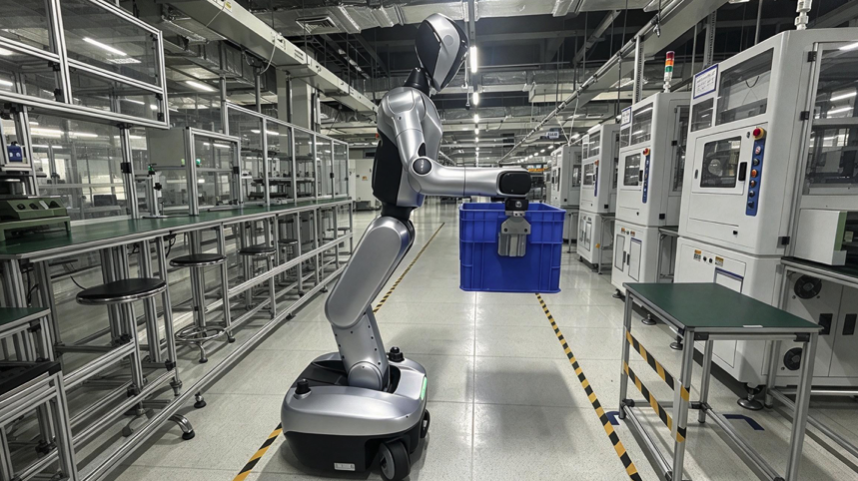
Industrial robotics has long struggled to acquire the nuanced physical data needed for complex tasks like handling varied objects or adapting to shifting production lines. FMC³’s Doceo system tackles this by capturing real worker demonstrations directly on the factory floor — using headsets, cameras, and gloves to record movement, touch, and corrections as they happen. This matters because it lets manufacturers train robots on actual process variability without building separate training cells, potentially accelerating automation in electronics and battery production where two proof-of-concept projects are already testing bin transport and electrode handling.
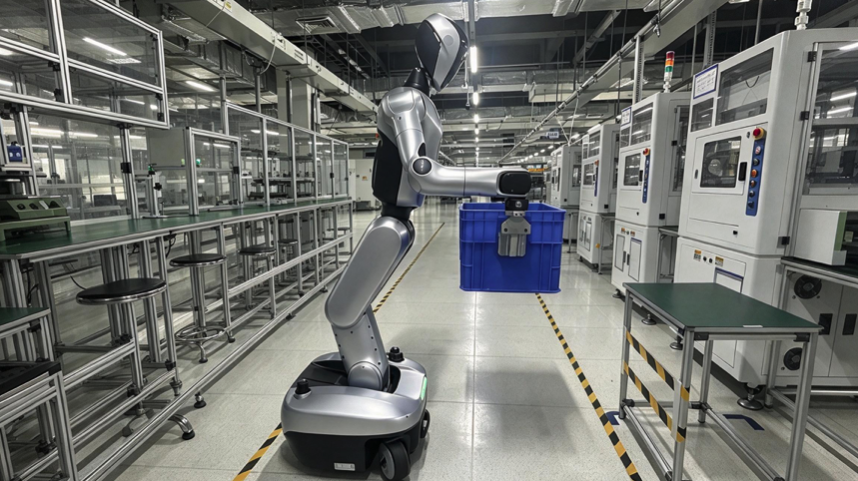
Overview of the Doceo System
Industrial robots have traditionally been programmed offline or trained in simulated environments, which often fail to capture the variability of real production lines. FMC³ positions Doceo as a way to gather qualified data directly from the factory floor while workers perform their normal duties, turning everyday activity into training material for AI models.
By integrating capture, synchronization, cloud‑based labeling, and a driver that connects to multiple robot platforms, the company hopes to create a continuous learning loop that reduces the engineering effort required when a task changes.
Four Components Explained
- Doceo RealCap – smart camera headsets, external cameras, and optional tactile gloves record visual, depth, motion, and force data during human demonstrations.
- Doceo Hub – synchronizes the multimodal streams, offers recording, playback, annotation, and data‑management tools.
- Doceo Cloud – ingests the data, applies automatic labeling, curates datasets, and runs model training, simulation, and testing on infrastructure supplied by Vector Informatik.
- Doceo Driver – deploys the resulting capabilities onto heterogeneous robotic platforms and control systems.
Together these modules form what FMC³ calls an industrial learning loop, linking real‑world demonstrations to model development, validation, and subsequent robot operation.
Real‑World Factory Trials
Two proof‑of‑concept projects are underway. At a consumer‑electronics plant a wheeled robot picks up bins of varying sizes, transports them through the facility, and places them at multiple workstations without major layout changes. The test measures cycle time, positioning accuracy, and continuous operating time.
A second trial at a battery‑cell production site focuses on handling delicate electrode sheets. The robot must pick up sheets, transfer them to trays, and position them accurately within an existing line. Both projects remain at the proof‑of‑concept stage, and FMC³ has not yet published final performance numbers.
Note: The trial results described above come from the source article’s reporting on FMC³’s own statements; independent verification has not been provided.
Building a Shared Data Infrastructure
FMC³ is also collaborating with Vector Informatik and PEM Motion on a planned German joint venture. The partnership would combine FMC³’s robotics and data‑acquisition technology, PEM Motion’s production‑engineering expertise, and Vector’s data‑management and cloud stack to create standardized, traceable, and reusable training datasets across factories.
If successful, this infrastructure could lower the barrier for smaller manufacturers to adopt embodied AI by providing a common data format and cloud pipeline that works with multiple robot brands.
Why This Matters
The shortage of high‑fidelity physical data is widely cited as a bottleneck for deploying adaptive robots in unstructured environments. By turning human work into labeled training sets on the fly, Doceo addresses the core data‑quality problem rather than merely adding more simulated data.
For plant managers, the promise is a shorter path from a new product variant to a robot that can handle it, potentially cutting re‑programming time from weeks to days.
What to Do Next
Engineers evaluating the platform should first identify a repetitive handling task where human demonstration data is easy to collect, such as bin picking or sheet handling. Next, engage with FMC³ or a system integrator to run a pilot using RealCap and Hub on a single workstation.
In parallel, review your existing data‑management policies to ensure they can accommodate the multimodal streams that Doceo Cloud will generate, especially regarding data sovereignty and traceability requirements.
Tip: Start with a low‑risk task that has clear quality metrics; this makes it easier to measure the impact of the learned model against the current manual process.
Want more practical guides? Explore more Ayxworks insights and save this article for later.
FAQ
What is the Doceo system?
Doceo is a four‑part hardware and software suite from FMC³ Robotics that captures human manufacturing demonstrations, processes the data in the cloud, trains embodied‑AI models, and deploys them to industrial robots via a universal driver.
How does Doceo RealCap capture data?
RealCap uses smart camera headsets, external cameras, and optional tactile gloves to record visual, depth, motion, and force information while a worker performs a task.
What are the current proof‑of‑concept projects?
FMC³ is testing a bin‑transport robot at a consumer‑electronics plant and an electrode‑sheet handling robot at a battery‑cell facility; both are at the proof‑of‑concept stage.
Who are the partners in the planned joint venture?
The joint venture involves FMC³ Robotics, Vector Informatik, and PEM Motion, aiming to standardize industrial embodied‑AI training data.
When will the technology be commercially available?
FMC³ has not announced a commercial release date; the system is still being validated through factory trials.
External Sources and Further Reading
- FMC³ Robotics introduces Doceo system to help industrial robots learn from factory workers – Robotics & Automation News
- Lincoln Electric introduces XpertLINC to bring physical AI to robotic welding – Robotics & Automation News