On this page
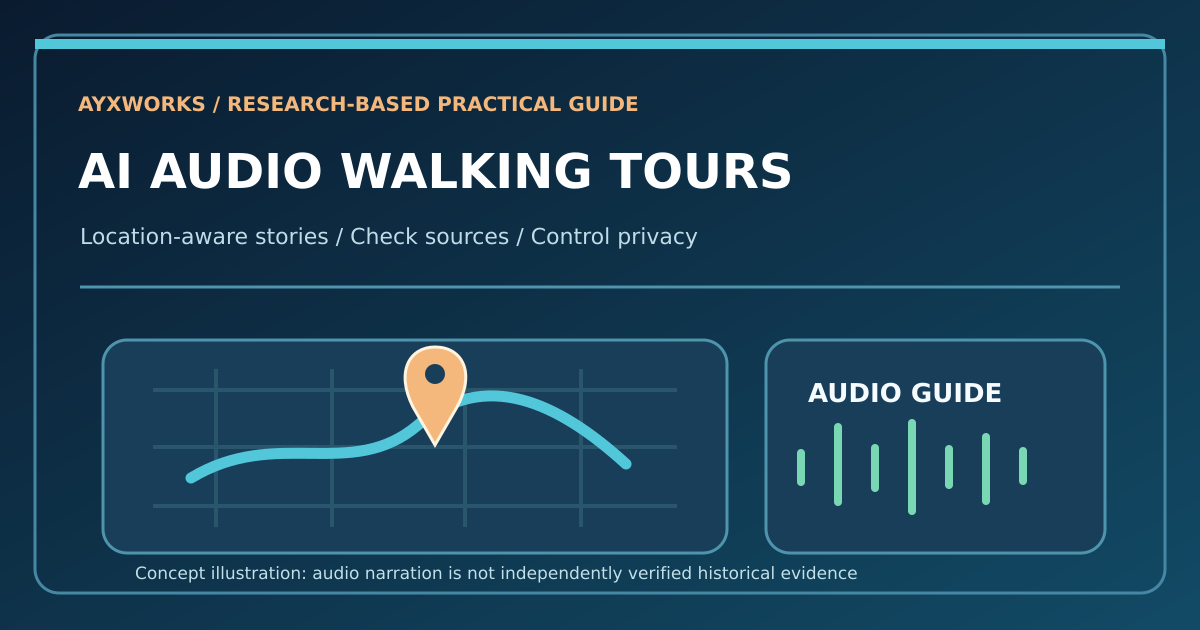
A walking tour is more engaging when you can look at a building instead of staring at a list of numbered stops. Wrinkles is a location-aware audio guide app designed around that idea: as you explore a city or neighborhood, it presents narrated stories associated with nearby landmarks and allows follow-up questions.
The concept is appealing, but a good location-aware travel app needs more than an impressive map. Accuracy, language availability, practical navigation and location-data controls determine whether it is worth using. This is a source-checked product explainer, not an AYXWORKS hands-on test of an actual tour.
Quick answer
Wrinkles offers narrated place-based discovery, AI follow-up questions and walking-tour creation for iPhone and Android users. The developer describes a large global collection of stories and free access with optional in-app upgrades. It could be useful for independent travelers and curious local residents, but historical claims should be checked, especially for obscure places, and location/privacy permissions deserve attention before turning on automatic narration.
What does Wrinkles actually do?
The official Wrinkles website describes a conversational travel app that connects stories to the physical surroundings. TechCrunch’s August 2026 launch report explains its core idea: instead of choosing each museum or landmark entry manually, location information helps surface relevant stories while the user explores.
The developer’s current Google Play listing describes several functions:
- Stories that find you: nearby narrated information may be offered automatically as you walk.
- Follow-up questions: ask for explanations about a landmark or local story.
- Custom walking routes: choose a location and a topic for a generated tour.
- Interactive place map: browse stories before a trip or discover nearby places.
- Saved and shared guides: organize memorable locations into guides for friends and family.
- Place-based personal memories: optionally attach your own story or media to a specific point on the map.
These are developer-described features. Their quality and availability can depend on app version, country, permissions, language and connectivity.
How much geographic coverage is available?
At the August launch, TechCrunch reported that the startup had assembled approximately 1.3 million points of interest across 177 countries. The Google Play listing also refers to more than 1.3 million stories. These are reported catalog figures, not an independent audit of the historical accuracy or quality of each entry.
A dense catalog does not mean every street or village has useful narration. Some locations may be represented by broad summaries while others have detailed contextual storytelling. When planning a trip, check the map for the actual city or neighborhood instead of relying on the headline count.
An example walking-tour workflow
Consider a visitor exploring the older districts of a city:
- Start by checking whether the app contains stories for the route you intend to walk.
- Allow location access at the level you are comfortable with and review device permissions.
- Choose a topic such as architecture, industrial heritage or neighborhood history.
- Use the generated route as a suggestion, not a substitute for live navigation or accessibility information.
- Listen while walking only where you can safely pay attention to traffic, crossings and surroundings.
- Check interesting factual claims against museum collections, city archives or other reliable historical sources afterward.
This is an illustrative workflow, not a claim that AYXWORKS personally walked or verified a particular city tour. Walking and cycling routes, museum opening hours, public-access restrictions and public transport need independent confirmation.
Can it replace a human guide?
Not completely. An AI-generated narrative can make self-guided discovery more accessible, but it may misunderstand dates, mix up similarly named people or locations, omit contested interpretations or overstate a local legend. A professionally guided tour can provide source expertise, local context, access and live responses to unexpected questions.
For educational use, an AI answer is a starting point. Ask what source supports a surprising claim and compare it with the original museum or public-history institution rather than copying the narration directly into schoolwork or a published article.
Location, privacy and sharing deserve a closer look
An app that knows where you are needs access to location information. The Google Play data-safety section identifies location and other data categories that the developer reports may be collected. Platform data-safety summaries are self-declared and can be updated; they are not independent guarantees about every server-side use.
Before using it regularly:
- Review location permission: consider whether “while using the app” meets your needs instead of granting unnecessary access.
- Check whether background audio/location tracking is necessary for the features you want.
- Read the privacy disclosures linked from the official app-store listing.
- Avoid publicly pinning family routines, children’s schools, home addresses or locations that would reveal sensitive personal information.
- Review which memories, photos, notes and guides are private, shared with friends or public before posting.
- Be cautious with third-party booking or purchase links associated with a place.
A location-based memory platform can be enjoyable without requiring you to publish a detailed personal trail.
Free access, paid features and device compatibility
At launch, the app was reported for iOS and Android. The Google Play listing advertises free installation with in-app purchases and an optional upgraded tier for deeper or unlimited usage. The Apple App Store listing also describes free access and optional purchases.
Pricing and feature restrictions can change. Do not treat a launch-era statement about a free tier as a permanent promise. Check the actual app-store page, supported country and required device permissions before subscribing.
The Google Play listing’s September 2026 update also describes additional language support. Availability of a translated interface does not imply that every historical story has undergone native-speaker or historian review.
Who could benefit—and who may prefer something else?
| Reader | Where Wrinkles might help | What to verify |
|---|---|---|
| Independent traveler | Discover nearby landmarks without a fixed guided-tour slot | Route coverage, offline behavior and data use |
| Local resident | Learn about overlooked buildings and neighborhood history | Accuracy and source attribution |
| Parent planning a family walk | Find short, interesting audio stops | Child suitability, safety and privacy |
| Museum visitor | Supplement labels with contextual stories | Whether the museum has its own authoritative guide |
| History teacher or researcher | Discover leads for further investigation | Primary-source accuracy and citation quality |
| Accessibility-focused traveler | Explore by listening instead of constantly reading | Voice clarity, headphones, safe navigation and accessibility support |
Wrinkles is not necessarily the best choice for every city or user. A museum’s own guide, a local heritage association or a well-researched written walking route may offer better evidence for a specialized topic.
Frequently asked questions
Is Wrinkles a map or a history app?
It combines map-based points of interest, narrated contextual stories, AI questions and route discovery. It is not simply a turn-by-turn navigation replacement.
Are all its historical stories fact-checked?
The public descriptions do not establish independent verification of every story. Treat surprising names, dates and claims as leads to check against reliable sources.
Does it need precise location access?
Location is central to the automatic nearby-story experience. Users should check current permission requirements and decide whether to enable automatic or background features.
Is it available outside the United States?
The launch coverage reports international coverage and the store descriptions show global use cases. Check the app’s current regional availability and actual city coverage rather than assuming all locations have equal content.
Can families save memories?
The app describes location-linked posts and personal histories. Be deliberate about privacy settings before sharing information about children, private homes or routines.
Sources and editorial method
- Wrinkles — official product website, developer-described purpose.
- Google Play — Wrinkles Audio Tour Guide, features, update notes and developer-provided data safety.
- Apple App Store — Wrinkles, platform and purchase context.
- TechCrunch — Aisha Malik, August 4, 2026, founder interview, launch story and reported coverage.
Takeaway: Wrinkles could make ordinary walks more informative by giving nearby places a voice. The best way to use it is with curiosity, location-awareness and independent fact checking—not blind trust in every narrated detail.