On this page
In brief: A robotics project is ready to quote only when the process, physical interfaces, exceptions and acceptance test are described—not when a robot model has been picked.
The engineering decision
A robotics project is ready to quote only when the process, physical interfaces, exceptions and acceptance test are described—not when a robot model has been picked. The useful decision is to specify what is known, name the uncertain interfaces and agree what evidence would change the recommendation. A demonstration, brochure or market statistic cannot replace an application-specific test.
Start with the process, not the arm
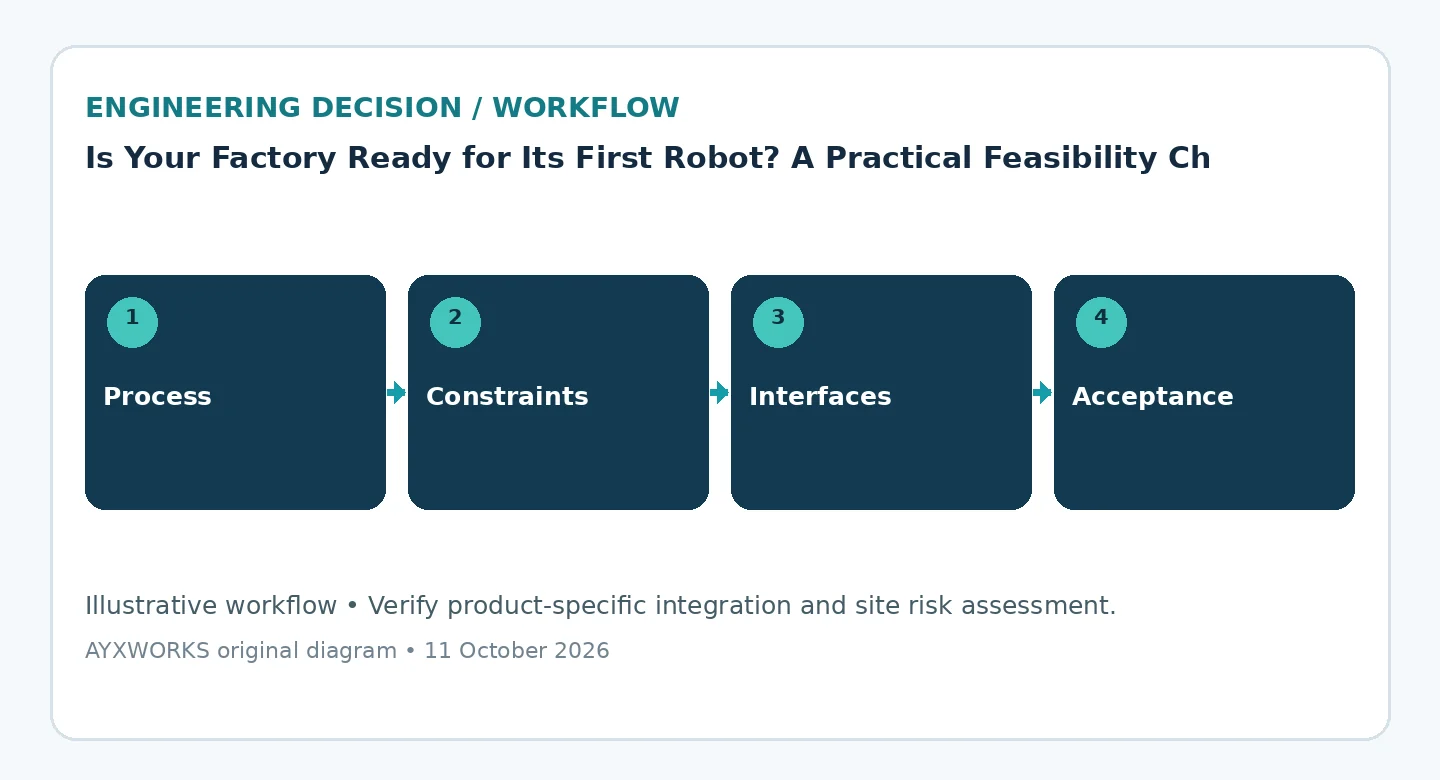
Choose one stable, bounded process. Record actual part variations, how components arrive, the number of operations per shift and the current bottleneck. A cell that can move a part cannot compensate for an upstream feeder that is empty every third cycle. Video of a representative shift and a small set of timestamped events are more useful than optimistic production averages.
Work through the physical constraints
Measure reach between every pickup, processing and discharge pose; include machine doors, gripper size, cable clearance and fence footprint. Establish the part and tool masses separately, including a center-of-gravity estimate. Capture the worst-case presentation and the least convenient changeover, not merely the easiest demonstration.
Own the interfaces and abnormal states
List who supplies machine-ready signals, fixture interlocks, process completion, part-presence feedback and controlled fault recovery. Non-routine access for cleaning, adjustments and maintenance changes the safety question; the arm specification does not complete an application-level risk assessment.
Define what makes the pilot a success
Write acceptance criteria before procurement: sustained output over a specified shift, acceptable scrap/reject levels, a controlled restart test, changeover duration and an agreed operator handoff. If no one can observe or measure success, the scope is still a discovery task.
Checklist before committing budget or scope
- Representative part family and reject boundaries.
- Takt-time distribution and real upstream availability.
- Robot/tool envelope and maintenance access.
- PLC, gripper, vision and safeguarding ownership.
- FAT/SAT criteria with controlled recovery tests.
What this guide does not establish
This analysis is a planning aid, not a test report, independent product certification, legal assessment or guarantee of performance. Final hardware selection, functional safety, machine compliance and commissioning must be verified for the real system by suitably qualified parties. Check exact controller options and supplier documentation before procurement.
Sources and further verification
- ISO — ISO 10218-2:2025 — industrial robot applications and cells (2025-02; accessed 2026-10-11).
- OSHA — Robotics — overview and hazards during non-routine activities (undated; accessed 2026-10-11).
Next useful step
Bring a representative part, process video, cycle-time target, floor constraints and an initial interface list to the Robotics & Automation page and solution finder. For the engineering approach behind these guides, see the AYXWORKS portfolio. A project evaluation should start with feasibility and responsibility boundaries, not an assumed turnkey installation.