On this page
In brief: A lunar occultation happens when the Moon passes in front of another object from an observer’s point of view. During an occultation of Venus, the planet is temporarily hidden behind the Moon’s apparent outline, even though the two bodies remain far apart in space. Location and timing determine whether you see a disappearance or merely a close-looking pair.
Cover a distant object with your thumb. You have not moved the object, dimmed it or touched it. You have changed what can reach your eye along one particular line of sight. The same basic geometry explains how the Moon can appear to make a planet vanish.
The real sky adds orbital motion, changing viewpoints and practical observing limits. Understanding those pieces makes an occultation more interesting than a momentary disappearing trick.
What NASA photographed
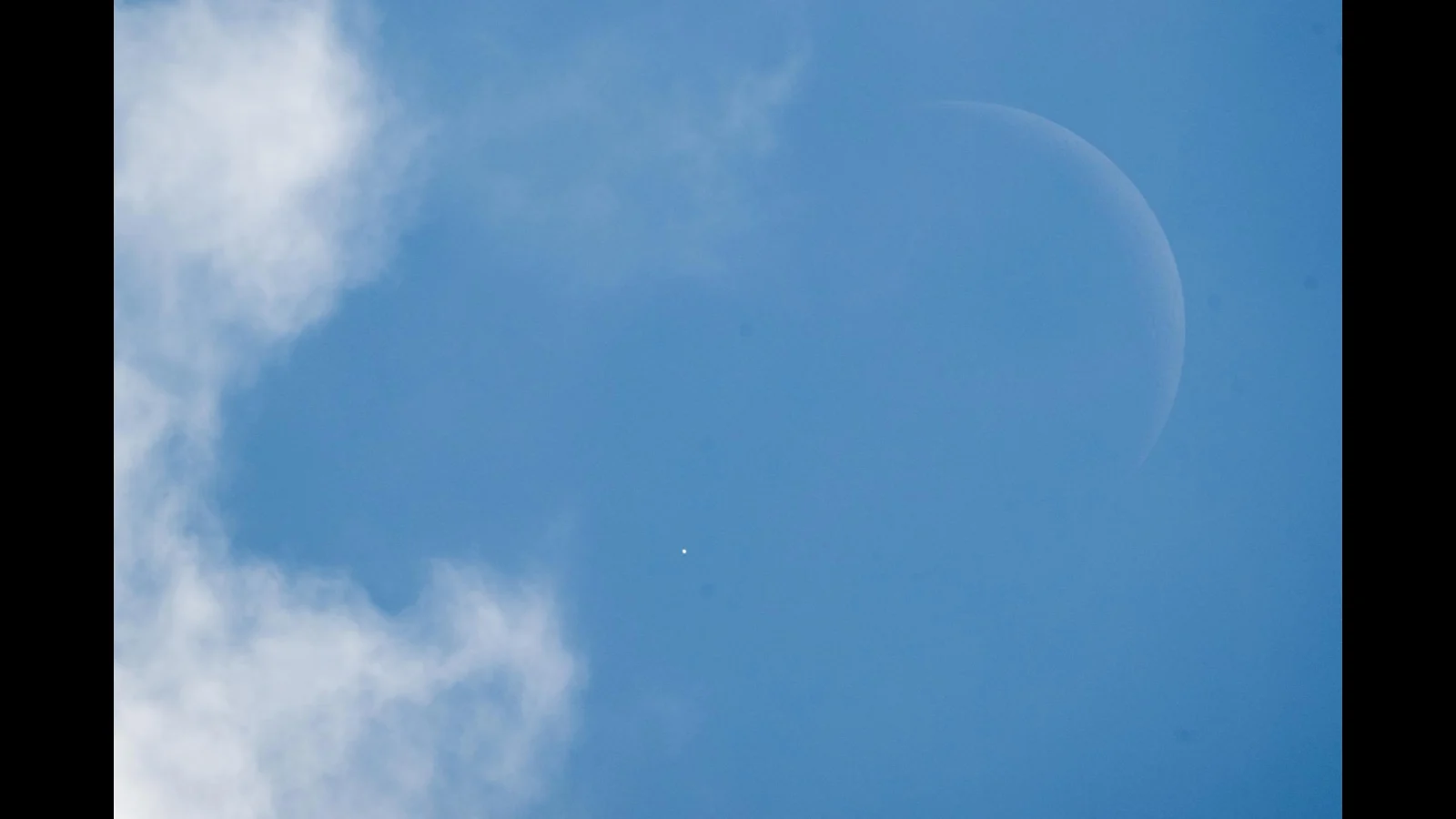
NASA’s Lunar Occultation of Venus image article, published on 4 September 2026, describes the event of 17 June 2026. Its photograph by Joel Kowsky was taken from the Mary W. Jackson NASA Headquarters building in Washington.
Keep those dates separate. September was the publication date of that page; June was the photographed event. The image is not a live view or evidence of a second event in September.
NASA describes the June event as a daytime occultation visible from parts of the United States and Canada. That regional qualification is essential. An alignment visible from one area does not mean that observers everywhere on Earth saw Venus disappear.
Why the nearer object can hide the larger one
What matters for an occultation is apparent size and direction, not which object has the larger physical diameter. Your thumb can block a building because it is close to your eye. The building does not have to shrink.
The Moon is much closer to Earth than Venus is. It therefore covers a larger angular area in our sky, despite Venus being physically larger. When the planet’s apparent position falls behind the Moon’s disk for your location, the Moon blocks the view.
Imagine drawing two lines outward from your eye to the edges of your thumb. Anything lying farther away between those lines can be obscured. Moving your thumb slightly changes the hidden region. Moving your head can reveal the object again without either the thumb or distant object changing its physical size.
This is why statements such as “the Moon swallowed Venus” belong to figurative language. The physical event is an interruption of a line of sight, not a collision between worlds.
The Moon really does move against the background sky
The sky appears to move across the day and night largely because Earth rotates. At the same time, the Moon orbits Earth and changes its position relative to more distant objects. Those two kinds of apparent motion should not be confused.
During a suitable alignment, the Moon’s edge moves across Venus’s apparent position. An observer sees the planet disappear behind one part of the limb and later reappear, depending on the geometry and visibility of the event.
The word limb simply means the apparent edge of a celestial body’s disk. You do not need to imagine an extra structure around the Moon. It is the boundary between the Moon and the background in the view.
NASA’s Moon facts guide provides the broader orbital context. An occultation is one particularly clear way to notice that the Moon is changing its position against the background, rather than being fixed among the stars and planets.
Why your location changes what happens
Two observers in different places view the nearby Moon from different angles. Against a much more distant background, that viewpoint difference can change whether the Moon covers Venus, passes close to it or misses it completely.
You can demonstrate the principle indoors. Hold a finger in front of an object across the room and alternate which eye is open. The finger appears to shift relative to the background. Neither object needs to move for your changed viewpoint to alter the alignment.
This is a demonstration of parallax, not a scale model of the Solar System. Your eyes are not separated by a continent, and the distances are vastly different. But the geometry explains why a global event description is not a local prediction.
An observing map must therefore specify where an occultation is visible. The disappearance and reappearance times also vary with location. A timetable copied from another city can be wrong for your circumstances even if the underlying event is genuine.
Occultation, conjunction and eclipse: what is different?
| Term | Basic idea | What not to assume |
|---|---|---|
| Conjunction | Objects have a specified apparent alignment in the sky | They do not necessarily overlap or hide one another |
| Occultation | A nearer object blocks the view of a more distant one | The objects are not necessarily close together in space |
| Lunar eclipse | The Moon passes into Earth’s shadow | This is not Venus disappearing behind the Moon |
These distinctions keep different physical arrangements from blending into one vague idea of “things lining up.” A lunar eclipse changes the sunlight reaching the Moon. An occultation of Venus changes whether the planet’s light can reach a particular observer.
A solar eclipse is a special familiar case involving the Moon passing in front of the Sun from the observer’s viewpoint. Its observing hazards are not a reason to treat other daytime alignments casually: any search close to the Sun requires appropriate expertise and precautions.
Why daytime makes the observation harder
A planet does not stop reflecting sunlight when the Sun rises at your location. The challenge is contrast: the daytime sky is bright, and finding a small object against it can be difficult.
Venus can be conspicuous under suitable conditions, but that does not make unplanned daytime searching a safe beginner activity. Its position in the sky relative to the Sun matters, as do the instrument, setup and observer’s experience.
Do not sweep the daytime sky with binoculars, a telescope or an optical camera viewfinder while looking for Venus. Accidentally directing optics toward the Sun can cause serious injury. An occultation explainer is not an observing-safety plan. Beginners can study the geometry using published images and indoor demonstrations without taking that risk.
A photograph can also make a daytime event look easier to see than it was with unaided eyes. Exposure, magnification and processing influence what stands out in the final image. A clear published picture is not a guarantee that the same detail was obvious to everyone standing nearby.
Does Venus vanish all at once?
A star generally appears as an unresolved point in ordinary observations, whereas Venus can show a small apparent disk through suitable equipment. Covering an extended disk is not geometrically identical to covering a point.
As the lunar edge moves across the apparent planet, the visible portion can shrink before disappearing. What an observer can actually resolve depends on the circumstances and equipment. A simple naked-eye description may still be “the bright point vanished.”
The Moon’s own illuminated fraction also affects the appearance. Part of its disk can be difficult to see against the sky, while still blocking light from objects behind it. The unlit portion does not become transparent.
That is a helpful distinction between not seeing the Moon’s surface clearly and the Moon not being there. Illumination controls the visible surface brightness; the physical body continues to obstruct the line of sight.
The 2026 dates need a date stamp too
In its September article, NASA listed two further Venus occultations for 2026: 14 September for parts of Asia, Africa, Europe and western Russia, and 7 November for southern South America.
As of this update on 14 October 2026, 14 September is already past. The November date remains a future event in that dated source, not a forecast of visibility for any particular reader’s location.
Before planning an observation, obtain a current, location-specific prediction from a suitable astronomy source or local observatory. Check the time zone, horizon, daylight conditions and safe observing arrangements. This article does not calculate an event path or provide exact local contact times.
The general lesson applies to astronomy calendars more broadly: a publication date, observation date and next-event date can all appear in one story. Reusing the story without updating its tense can turn correct historical information into misleading practical advice.
A safe indoor demonstration
- Choose a fixed object across a room. Use a picture, a toy or a mark on the wall, not the Sun or a bright light source.
- Hold up your thumb at a comfortable distance. Close one eye and move the thumb until it hides the object.
- Move the thumb sideways slowly. Notice the transition from visible to partly covered to hidden.
- Change your viewpoint. Move your head slightly and see whether the object becomes visible again.
- Name the roles. Your eye represents the observer, the thumb the nearer Moon and the room object the more distant target.
The demonstration does not reproduce orbital speeds, distances or sizes. Its purpose is to isolate the line-of-sight idea. Once that is clear, the real observing geometry becomes easier to discuss without assuming that the objects touch.
What the image can and cannot show
The featured photograph records a view associated with a specific place and event. It can illustrate the apparent relationship of the Moon and Venus. It cannot, by itself, supply the complete three-dimensional orbit or a timetable for another location.
Nor does an image of a close alignment establish that the objects have become physically close. Astronomy frequently compresses immense distances onto a two-dimensional view. The caption and observing context are part of the evidence, not optional decoration.
For another perspective on the Moon, read the lunar far-side explainer. It separates which hemisphere faces Earth from which hemisphere receives sunlight—a different geometry problem with an equally misleading everyday nickname.
The takeaway: the Moon can hide Venus because it is nearer and crosses the right line of sight. The planet remains in space, the Moon keeps moving, and the observer’s location determines the view. Which part of that geometry became clearer when you changed your viewpoint in the indoor demonstration?
Revised 14 October 2026. Event details are attributed to NASA’s dated image article. This is an explanation of the phenomenon, not a current local observing forecast or an instruction to conduct daytime telescopic observations.
Featured image: NASA/Joel Kowsky. Original image and context. Usage terms. Full source frame fitted within a 16:9 canvas without cropping; resized and converted to WebP.