On this page
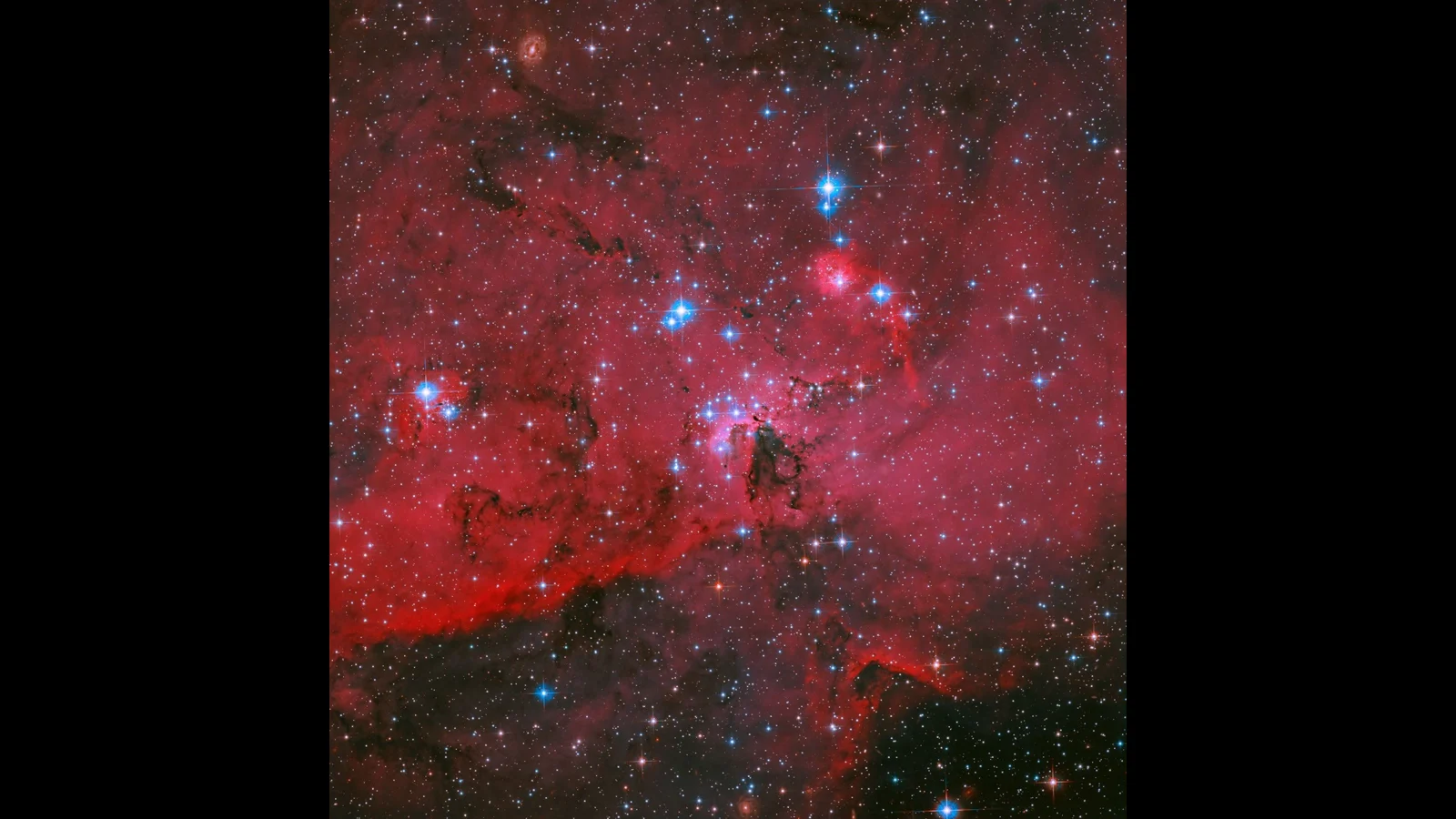
In brief: Hubble’s image of LH 95 shows young stars embedded in a cloud of gas and dust in the Large Magellanic Cloud. Hot stars supply energy that makes surrounding hydrogen glow, while dense dust hides some of the light behind it. The bright stars, crimson gas and dark lanes are clues to different physical processes—not three different kinds of empty space.
A photograph of a stellar nursery can resemble glitter scattered over red smoke. The more interesting view appears when you stop treating everything bright as a star and everything dark as a gap. Some of the cloud is producing light. Some is blocking it. The stars are changing the material from which stars themselves can form.
This is what makes LH 95 a useful introduction to astronomy: one image brings together gravity, radiation, dust and the early lives of stars without requiring a page of equations.
Where are we looking?
LH 95 is a stellar association in the Large Magellanic Cloud, a smaller neighboring galaxy of the Milky Way. A stellar association is a grouping of stars, not another name for an entire galaxy. The image is a detailed view of one region within that much larger system.
NASA’s July 2026 Hubble feature about LH 95 describes young, low-mass stars alongside massive blue stars. It identifies energetic radiation and stellar winds as important influences on the surrounding gas. Those details explain why a nursery is not simply a quiet cloud waiting for stars to appear.
The scale also matters. The image is not a close-up of a cloud inside our Solar System. It is a view across a large astronomical distance, assembled from light that traveled to the telescope. The apparent separation of two features on the screen is not, by itself, a measurement of how far apart they are in three dimensions.
How can a cloud become a star?
Stars begin in regions where gas can collect and collapse under gravity. As a dense concentration contracts, material heats up and forms a young stellar object. A star’s familiar, long-lived main-sequence phase begins when sustained hydrogen fusion in its core provides the energy that balances its tendency to contract.
That broad sequence is described in NASA’s guide to the birth and lives of stars. It is not a claim that every patch visible in this image is already becoming a star, or that the photograph shows all stages equally clearly.
Think of a nursery as an area where the ingredients and conditions for star formation exist, rather than a production line with identical objects leaving at regular intervals. Different concentrations of material can evolve differently. A young star can also remain surrounded by material after it has become visibly bright.
The everyday phrase “baby star” is helpful as a first impression, but it is not a complete scientific classification. Astronomers distinguish developmental stages using observations and models. A star does not arrive at adulthood simply because it looks bright in a picture.
Why does the hydrogen glow red?
The important starting point is energy. Ultraviolet light from hot stars can ionize hydrogen: it separates an electron from the atom. As electrons subsequently join atoms and change energy states, the gas can release light at particular wavelengths.
One important visible wavelength is the red hydrogen-alpha line, usually written H-alpha or Hα. It is a reason that many photographs of star-forming gas contain prominent red structures. A telescope can use filters to select that emission and distinguish it from other light in the scene.
A glowing sign is a useful analogy because energy enters gas and the gas emits characteristic light. But a nebula is not wired to an electrical supply like a shop sign. The energy source, density, scale and physical surroundings are entirely different. The analogy explains the distinction between emitting light and merely being painted red.
It also prevents a common mistake: the red cloud is not an ordinary fire consuming oxygen. Its glow does not mean that space is filled with flames. Light can be produced by several processes, and familiar colors do not guarantee familiar causes.
Why are the most conspicuous stars blue-white?
Stellar color carries information about temperature, although a processed astronomical image is not a simple thermometer. Hotter stellar surfaces generally emit a larger share of their light at shorter wavelengths than cooler surfaces do. Massive young stars can therefore stand out as blue-white sources.
Brightness and temperature should not be confused. A star can look brighter because it gives off more light, because it is nearer, because less dust lies in the way or because of the camera’s processing. Nor does a larger spot on the image necessarily show a larger physical stellar disk.
For a useful comparison, imagine two lamps photographed from different distances with different exposure settings. The larger-looking patch on the photograph would not be enough to tell you which lamp has the larger bulb. Astronomers need more than the apparent size of a bright dot to establish a star’s properties.
In LH 95, the hot stars are not merely decorations within the gas. Their radiation supplies energy to the cloud, and their outflows contribute to reshaping it. The stars and nebula are interacting parts of the same scene.
The dark lanes are material, not holes
Interstellar dust can absorb and scatter light. Where a denser lane lies in front of a luminous region, it can appear as a dark silhouette. The darkness can therefore indicate more obstructing material along the line of sight, not an absence of matter.
A distant streetlight behind a curtain offers a simple comparison. A dark section in the view could mean that no light exists there, but it could also mean that fabric is blocking the light. The photograph alone needs context before you decide which explanation applies.
The analogy stops at the geometry of obstruction. Interstellar dust is not household fabric, and its effect depends on wavelength. Observations made in different parts of the spectrum can reveal different aspects of the same region. A feature that is difficult to see in one band may be clearer in another.
That is one reason astronomers combine information from multiple filters and instruments. They are not just collecting prettier variations of the same photograph; they are asking different questions about material and radiation.
How stars reshape their own nursery
The phrase “stellar wind” describes an outflow of particles from a star. Together with radiation, these outflows can erode and redistribute surrounding material. The resulting scene can contain bright edges, cavities and dense structures that resist erosion differently.
Do not picture all of this changing at the pace of smoke from a candle. A still image compresses an enormous physical history into one view. Describing a structure as being shaped by stars does not mean Hubble watched the entire process unfold between two photographs.
It is also too simple to say that energetic stars always help or always stop new stars from forming. The outcome depends on the cloud’s structure and physical conditions. For this image, the reliable beginner’s lesson is that star formation happens within an evolving environment, not in isolation.
When a caption mentions radiation, winds and dust, each term adds a different mechanism. Radiation transfers energy. Particle outflows interact with the surroundings. Dust influences which light escapes toward the observer. Keeping those roles separate makes the picture easier to understand.
Are the colors what an astronaut would see?
Not necessarily. Hubble collects measurements through selected filters, and image processors combine those measurements into a view humans can read. Exposure, wavelength selection and display choices affect the final result.
That does not make the image fictitious. A weather map can use color to show a real quantity that your eye cannot directly see. Similarly, an astronomical image can represent real measured light without matching the experience of looking through a window with unaided eyes.
The right questions are: which wavelengths were observed, how were they mapped to display colors, and what does the caption say those colors reveal? Do not assume that every red pixel in every space image represents hydrogen. The mapping can differ between images.
The featured picture here is an actual Hubble observation of LH 95, not an AI illustration. Its source and full processing credit are provided with the image. Resizing it for a website does not turn it into a new observation.
Read the picture in three passes
- Separate the ingredients. Identify compact bright stars, diffuse glowing gas and dark dust lanes. Describe what you see before assigning a cause.
- Connect each ingredient to a process. Ask which material emits light, which blocks light and which objects supply energy.
- Mark what the photograph cannot settle. Exact ages, masses, velocities and three-dimensional separations need more information than an attractive color image alone.
This exercise is useful because it makes uncertainty specific. Instead of saying “we cannot know anything from a photograph,” you identify what the photograph measures and which additional observations would answer the remaining questions.
For a family or classroom discussion, ask someone to explain why a dark lane might contain substantial material. That single question often changes how they read every subsequent nebula image.
Three questions beginners often ask
Is a nebula the same thing as a galaxy?
No. A nebula is a cloud of interstellar material. A galaxy is a much larger gravitational system containing stars, gas, dust and other components. LH 95 is a region within the Large Magellanic Cloud.
Does every bright point belong to the nursery?
A two-dimensional view can include objects along different lines of sight and at different distances. Membership and stellar properties are scientific questions, not something to infer solely from a point’s position on the screen.
What is the one idea worth remembering?
A stellar nursery is not just where stars are born. It is also where the stars already present change the light, shape and conditions of the remaining gas. The beautiful pattern is evidence of physical interaction.
Keep exploring: compare this nursery with the Sharpless catalog explainer. Look for the same distinction between glowing gas and obscuring dust, without assuming that every nebula has the same origin.
Revised 14 October 2026 using the NASA resources linked above. This is an explanation of published observations, not a new astronomical analysis by AYXWORKS.
Featured image: NASA, ESA, and N. Da Rio (The University of Virginia), G. De Marchi (European Space Agency – ESTEC), and D. Gouliermis (Universitat Heidelberg); Processing: Gladys Kober (NASA/Catholic University of America). Original image and context. Usage terms. Full source frame fitted within a 16:9 canvas without cropping; resized and converted to WebP.