On this page
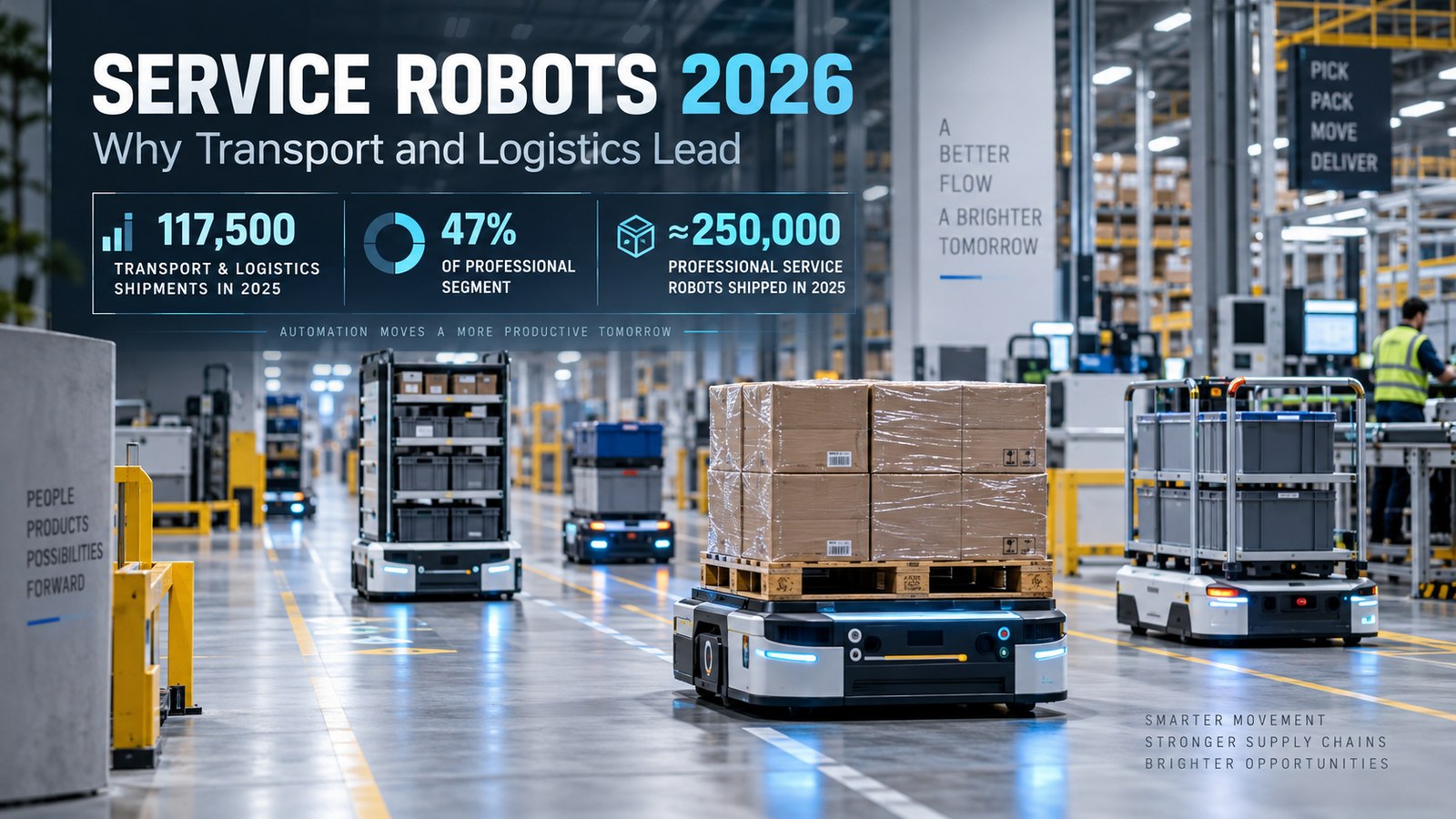
In brief: The International Federation of Robotics (IFR) reports almost 250,000 professional service robots sold in 2025, up 24%, with transport and logistics leading. These are reported survey figures, not an extrapolated census of the entire industry. They describe activity in a statistical category, not proof that a particular mobile robot will work at your site.
As of October 2026. The figures below come from the IFR press release of 30 September 2026 on its World Robotics 2026 Service Robots report. The report was published in 2026; the data it measures are for 2025. The release was re-read on 12 October 2026.
What the release reports
IFR reports almost 250,000 professional service robots sold in 2025, an increase of 24% in its reported figures. Transport and logistics accounts for 117,500 units, rounded to 117,000 in the release headline: up 21% and representing 47% of the professional segment. Medical and consumer service robots are separate segments. The public World Robotics 2026 presentation states that the service-robot sample covers 238 manufacturers out of 1,001 identified manufacturers and is not extrapolated to the whole industry. Its composition changes between editions, so IFR cautions against comparing different survey waves as though they were a fixed-panel market census. Retain these methodological limits when quoting the release’s growth rates.
A shipment figure is not a fleet count
These figures are units sold in one year within a statistical category. They are not the number of mobile robots in operation, and they say nothing about how many of the units run reliably over several shifts. The release does not mention AMRs or AGVs. Anyone who presents the transport and logistics figure as the size of the AMR market is adding a definition that the release does not give.
Why transport is a plausible first application
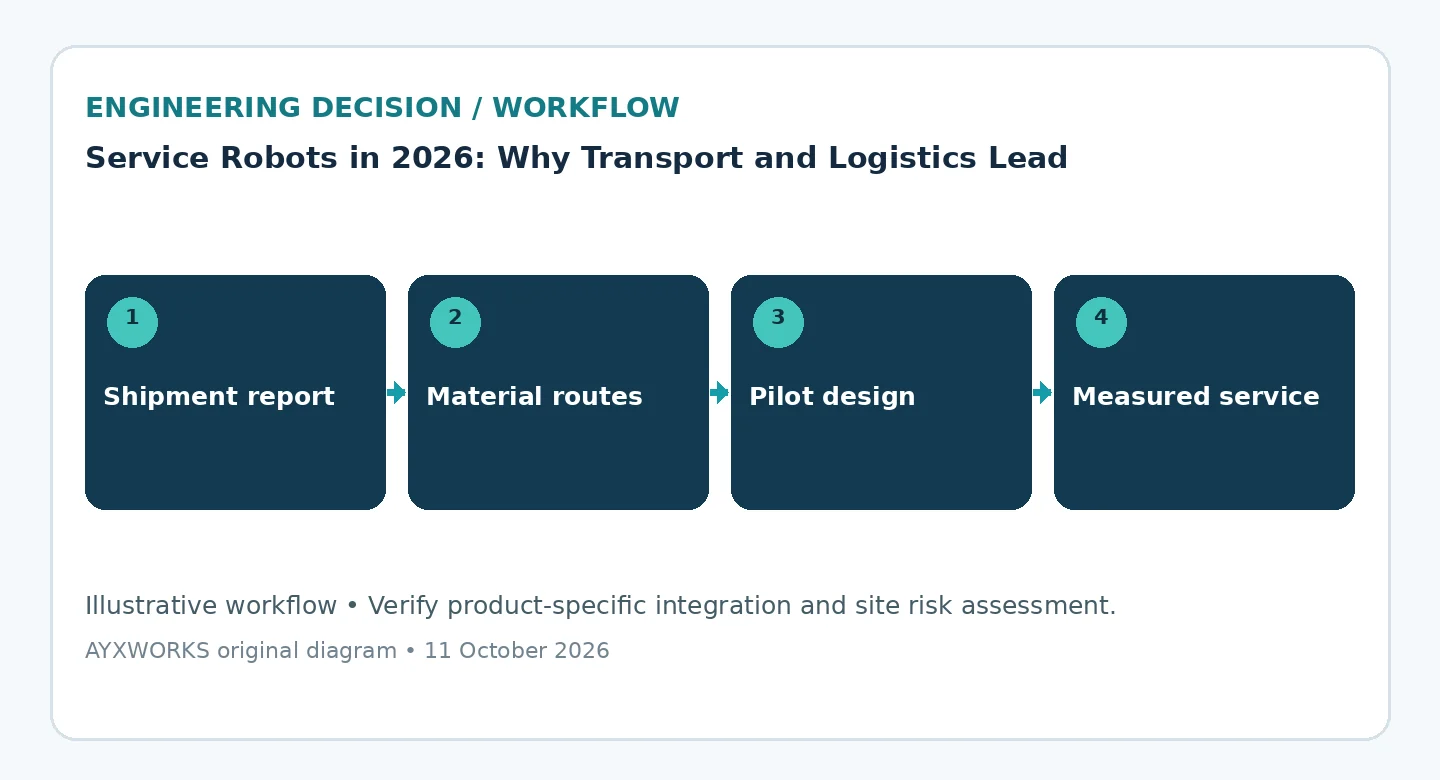
The release does not explain why transport leads. One engineering reading, which is the author’s interpretation, is that a transport task can be written down completely: source, destination, route, load, frequency and the conditions at each transfer point. The difficult part is the service around the vehicle: congestion, traffic shared with forklifts and pedestrians, charging, and the handover at each station. Those are properties of the site, not of the robot.
Humanoids: a small number, with IFR’s own caveats
The release also reports about 7,000 full-size humanoid robots sold worldwide in 2025, and it adds its own caveats: most current applications remain specialised and often require human teleoperation, and the lack of a strong business case, particularly in industrial settings, is one of the factors that still limit wider adoption. For a factory buyer in October 2026, humanoids are something to follow through pilot projects, not equipment to plan a line around.
From the statistic to a site decision
A site where forklift priorities change, aisles are blocked or loads are set down wherever there is space will struggle with any vehicle. Start with one route. Measure the real transport demand at the peak hour, the aisle widths and what happens at each end of the route. Compare AMR and AGV options against those facts, and define the acceptance test before the order: the route under normal traffic and in planned exceptions, such as a blocked aisle, a missing load or a discharged battery.
Checklist before quoting the figures or committing budget
- State both dates: the report was published in 2026, the data are for 2025.
- Quote the figures as annual shipments in a category, not as robots in operation or as the size of the AMR or AGV market.
- Map one route with its peak demand, aisle widths and transfer points.
- Define an acceptance test that includes a blocked aisle, a missing load and charging.
- Name who is responsible for traffic rules, safety and maintenance after handover.
What this guide does not establish
This article uses the IFR press release and the methodology notes in its public World Robotics 2026 presentation, checked on 14 October 2026. AYXWORKS has not reviewed the paid Service Robots report or its underlying dataset. Figures and categories remain IFR’s, with survey coverage and comparability limits. Nothing here evaluates a specific supplier or site, or replaces the risk assessment, safety design and acceptance tests for an installation.
Sources and further verification
- IFR — Global Sales of Professional Service Robots Surge 24% (press release on the World Robotics 2026 Service Robots report; 2026-09-30; accessed 2026-10-12).
- IFR — World Robotics 2026 public presentation: survey methodology (page 28) (2026-10-14).
Next useful step
Choose one transport route in your plant and write down its loads, its frequency at the peak hour and what happens at each transfer point. Then compare those requirements with the application areas on the Robotics & Automation page. Projects that start there are scoped and delivered through Eurobots/ReBots, and they begin with feasibility, not with an assumed turnkey installation. The AYXWORKS portfolio shows the engineering background behind these guides.
Image credit: ayxworks — Original / rights held.