On this page
A “35 best” list cannot tell you which board game will work for every family. Two players, a group of six, a preschooler who cannot read yet and a competitive teenager have very different needs. The best choice is a game your group will understand, enjoy and want to bring back to the table. This is a practical selection framework, not an AYXWORKS family play-test ranking.
Quick answer
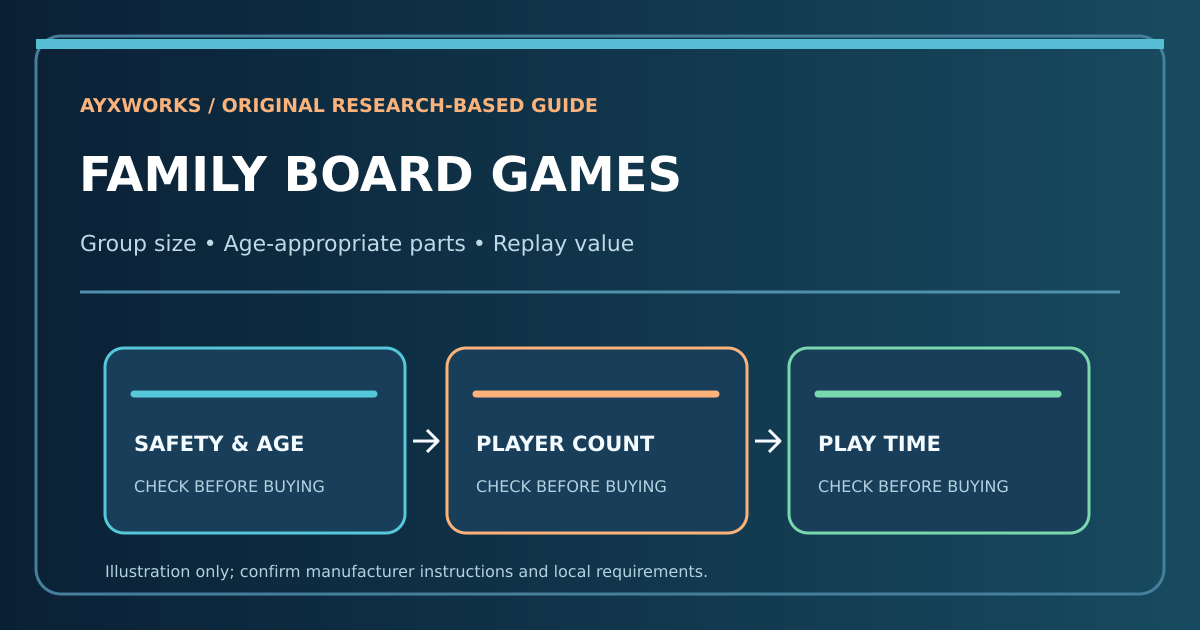
Start with the youngest player’s abilities and the real number of participants. Then compare average playtime, reading required, game style, setup effort and component safety. Verify the local-language edition and the manufacturer’s recommended minimum age before purchasing.
Match the game to the group
| Family situation | Look for | Watch for |
|---|---|---|
| Preschooler joining a family | Short turns, simple visual rules, robust pieces | Tiny loose components, long waiting times and text-heavy instructions |
| Different school-age levels | Flexible teams, turn assistance or cooperative objectives | Younger players being excluded by a large skill gap |
| Two players | A game that truly supports two and stays interesting | Publishers listing two as a nominal but weak player count |
| Four to six people | Clear pacing and a manageable table footprint | Excessive downtime or many components to track |
| Adults and older teens | Greater strategic depth if the group enjoys it | Games that need hours of rules learning before becoming fun |
These are planning categories, not universal age ratings. A parent’s supervision does not eliminate the hazard of small game pieces around a younger sibling.
Safety and age labels come first
Board-game pieces can be choking hazards for children under three. The US Consumer Product Safety Commission advises keeping toys with small parts away from children under three and checking toy age guidance. EU buyers should also check the relevant product’s warnings and applicable regional markings. Do not override a manufacturer’s age warning because an older child understands the rules.
If a family has a toddler and older children, consider where the game is set up and stored, especially if tokens, dice, marbles or button-cell batteries are present. A game is not automatically safe as soon as an adult joins the table.
Cooperative or competitive play?
In cooperative games the group solves a common problem, which can encourage talking through options and reduce the focus on an individual winner. In competitive games, strategy, friendly rivalry and learning to lose can be part of the appeal. Neither style suits every child. Choose based on the group’s preferences and ability to finish a round in good spirits.
A game that supports repeated practice may be a better purchase than one that offers a dramatic unboxing and then stays unused. If uncertain, watch the official rules demonstration or try a copy at a library, community game group or shop before buying.
The purchase checklist
- Players: actual minimum and maximum that work well, not just the printed range.
- Age and accessibility: reading, memory, fine motor skills, color differentiation and component size.
- Time: include setup, explaining the rules, cleanup and likely interruptions.
- Language: check the edition; imported copies may have cards or instructions the household cannot read.
- Durability: card stock, board quality and replacements for missing pieces.
- Storage: whether the game fits the available space and can be tidied away safely.
- Budget: compare the base game before buying expansions, and check local availability.
How to read original tested lists
WIRED’s family board-game guide draws on Simon Hill and his family’s game experiences. Those results, images and preferences belong to WIRED’s authors, not AYXWORKS. The guide is useful as one informed perspective, not as educational certification or proof your children will enjoy the same titles.
Frequently asked questions
Do expensive board games provide a better experience? Not necessarily. Rules clarity, suitable challenge and people willing to play matter more than elaborate miniatures.
Should I buy the most popular game? Only after checking actual players, session length and safety. Online rankings can mix different age groups and versions.
How do I include a younger child? Prefer appropriate cooperative roles or a distinct age-suitable game rather than letting a toddler handle pieces meant for older players.
Takeaway: Buy for your family as it really plays, not for the headline ranking. Exact age guidance and component safety are non-negotiable checks.