On this page
In brief: The second Sharpless catalog is a numbered list of 313 nebulae, mainly regions of glowing hydrogen associated with hot stars. A complete photographic collection turns that reference list into a visual tour, but it is not a single view of one giant cloud. Catalog numbers identify objects; they do not rank their size, age or scientific importance.
The night sky has more than one naming system. The same nebula may have a popular name, a number in a historical catalog and additional identifiers in modern databases. At first that looks unnecessarily complicated. In practice, the identifiers help connect photographs, measurements and research about the same region.
The Sharpless catalog is a good place to learn how that works because its objects are visually varied and some are already familiar from famous space images.
What the catalog contains
Stewart Sharpless published the second catalog in 1959. The CDS archive’s catalog documentation identifies its 313 entries and describes the recorded information. The commonly used prefix Sh2 refers to that second catalog.
A catalog is a structured reference, not a claim that every object in it has precisely the same origin. Selection methods and later understanding matter. Historical collections can include objects whose interpretation becomes clearer or changes as new observations become available.
Nor does “complete” mean the list contains every nebula in the universe. It means a particular list or collection has been covered according to its own definition. A complete set of 313 entries is a very different statement from a census of all interstellar gas clouds.
Think of a field guide to a defined selection of birds. Photographing every entry in the guide is an impressive achievement, but it does not mean the guide includes every bird on Earth or that the photographs were taken in one place.
What NASA’s complete-catalog feature showed
The 2 October 2026 Astronomy Picture of the Day highlights Bing Xin’s photographic collection of the 313 Sharpless objects. NASA describes observations from dark-sky locations in eastern China and Inner Mongolia, combining narrowband and broadband imaging.
The collection makes the catalog browsable in a different way from a table. You can move from recognizable showpieces to faint, sprawling regions and objects with very different shapes.
However, the arrangement of panels is not a literal photograph of the sky with every object at a common physical scale. Before comparing panel sizes or brightness, check how the collection was assembled and displayed. Equal-sized image boxes do not establish equal-sized nebulae.
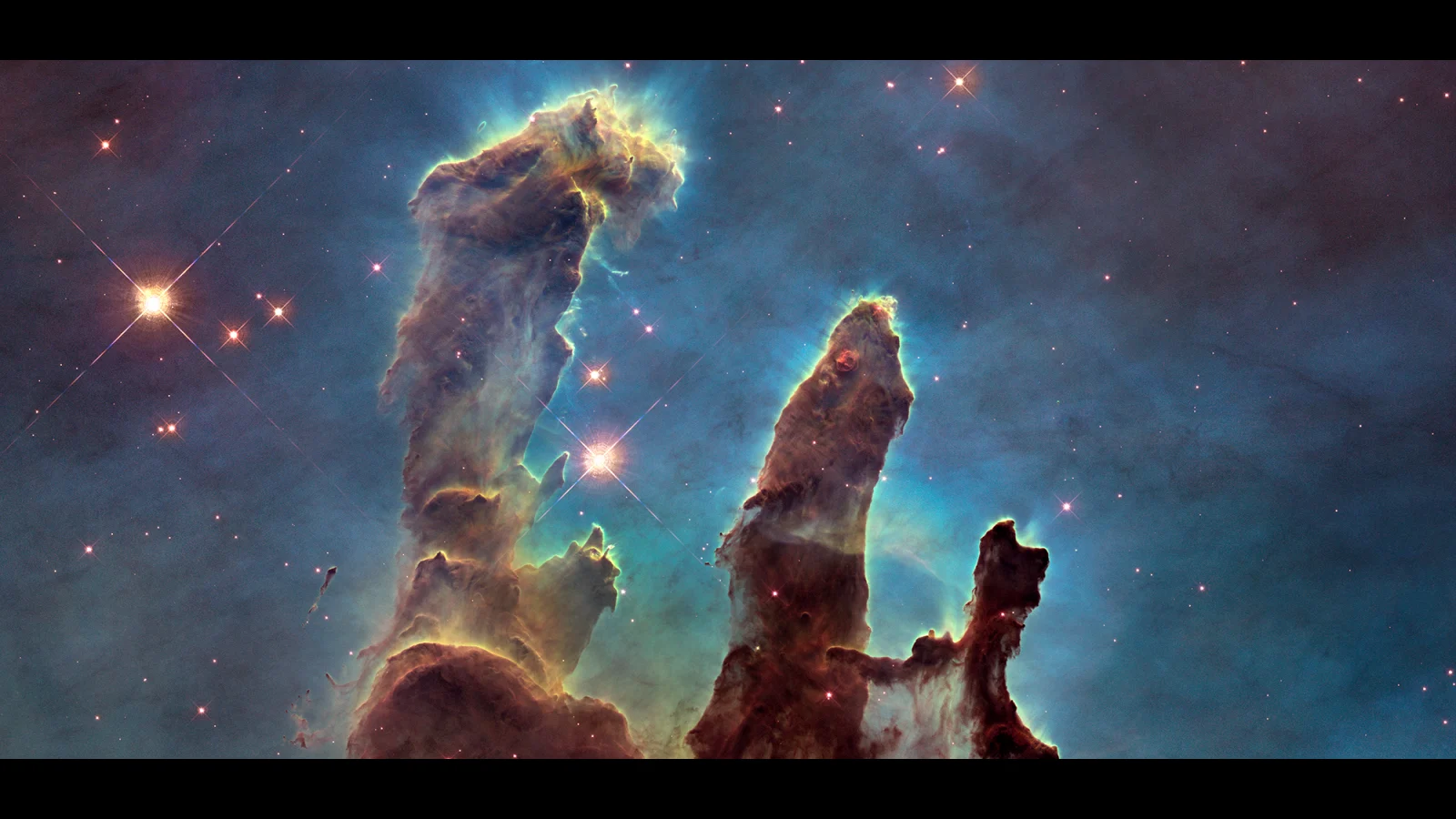
The original collection belongs to its credited photographer. This article links to it rather than presenting it as an AYXWORKS image. The featured picture here is a separate, credited Hubble view of the Eagle Nebula, one example represented in the catalog—not the complete 313-object mosaic.
What does H II mean?
H is the chemical symbol for hydrogen. In astronomical notation, H I refers to neutral hydrogen and H II to ionized hydrogen. The Roman numeral does not mean there are two hydrogen atoms joined together.
In an H II region, energetic radiation can remove electrons from hydrogen atoms. As the gas recombines and electrons change energy states, it can emit light at characteristic wavelengths. Hot stars provide an important source of the radiation that maintains these glowing regions.
The phrase “glowing hydrogen” is therefore about a physical emission process, not a red cloud being illuminated by a red lamp. A narrowband filter can select a small range around a particular emission line, helping an image reveal the associated structure.
The visual analogy of a glowing sign can help distinguish emitted light from reflected light. But a nebula is not powered and confined like a commercial sign. The scale, density and energy source are different, so the comparison should stop after making that one distinction clear.
Why the clouds have pillars, bubbles and filaments
A nebula is not a uniform bag of gas. Different densities, radiation fields and histories influence what becomes bright, what remains obscured and how material is shaped. Dense dust can stand out against luminous surroundings, while energetic stars alter the environment around them.
The Hubble Pillars of Creation image provides a striking example within the Eagle Nebula. It shows why a single catalog identifier can correspond to a region containing intricate internal structures rather than one simple blob.
Be careful with appearance-based names. A cloud resembling an animal or a pillar does not mean that the resemblance explains its formation. It is a memorable visual description; the physical interpretation requires measurements and models.
Likewise, a ring-shaped object in one image may have a different origin from a ring-shaped object elsewhere. Similar outlines can emerge from different processes and viewing angles. A catalog is a starting point for investigation, not a replacement for knowing the object’s classification.
Five entries that show the variety
| Identifier | Familiar name | What it illustrates |
|---|---|---|
| Sh2-49 | Eagle Nebula | A prominent star-forming region with well-known internal structures |
| Sh2-190 | Heart Nebula | A large glowing region whose popular name reflects its appearance |
| Sh2-281 | Orion Nebula | A famous nebula connected to a less familiar catalog identifier |
| Sh2-274 | Medusa Nebula | A planetary nebula, not simply another young-star nursery |
| Sh2-240 | Spaghetti Nebula | A supernova remnant with a different origin from a typical H II region |
These examples are identified in the NASA APOD account. They show why “mostly H II regions” is a better beginner’s description than claiming every entry represents an identical stage of star formation.
A planetary nebula is not a cloud made by planets. The historical name describes material shed during a star’s later evolution. A supernova remnant records a different kind of stellar event. Grouping attractive nebula images together should not erase those distinctions.
For broader context, NASA’s guide to stellar life cycles explains how different stellar histories produce different kinds of remnants and surrounding material.
What narrowband filters contribute
A camera can gather a broad range of visible light or select much narrower wavelength intervals. Narrowband imaging emphasizes particular emission features, such as hydrogen-alpha or emission from doubly ionized oxygen, often written [O III].
The benefit is not that a filter creates more nebula. It changes which part of the incoming light contributes to the measurement. That can make a faint structure easier to distinguish from other light in the field.
A useful comparison is listening to one instrument within a musical performance rather than hearing the whole ensemble at once. The isolated channel reveals something real, but it is not the complete performance. Similarly, different astronomical filters reveal different contributions to the scene.
When those channels are combined into a color image, the chosen palette matters. Two images of the same object can look different because they use different filters, exposure strategies or display mappings. A dramatic difference in color does not automatically mean the nebula physically changed between the observations.
A photographic panel is not a ruler
Suppose two nebulae fill two neighboring panels equally well. One could cover a large area on the sky and the other a much smaller one, photographed or cropped differently. Their distances could also differ substantially.
To compare physical size, you need information about angular extent and distance. To compare brightness, you need appropriate measurements rather than the appearance of separately processed images. A gallery is excellent for exploration, but it is not automatically a calibrated comparison chart.
The same caution applies to surrounding stars. A wider field can make a nebula look small; a close crop can make its internal detail dominate. Neither presentation is dishonest when described correctly. The problem arises when display choices are silently treated as physical measurements.
Read captions and metadata as part of the image. The instrument, filters, field of view and processing notes explain what kind of comparison is reasonable.
How to use a catalog number well
- Choose one entry. Start with a familiar object so you can recognize it under more than one name.
- Keep the exact identifier. Small differences in a catalog prefix or number can point to a different target.
- Check its classification. Is it an H II region, a planetary nebula, a supernova remnant or another kind of object?
- Compare the observing information. Note field of view, wavelength and scale before comparing two photographs.
- Follow one scientific question. Ask what powers the glow, what shapes a feature or which observation supports an age estimate.
This approach is more rewarding than trying to memorize hundreds of labels. An identifier becomes useful when it connects a visual impression with a reliable record and a question you can investigate.
It also makes your notes easier to share. “The red nebula from that gallery” is ambiguous; a specific catalog identifier gives another reader a place to start.
What a complete collection does not establish
Photographing every catalog entry does not mean every target is equally well understood. It does not imply that all observations used identical conditions, or that the collection supplies a new physical classification for each object.
Nor is a nebula catalog a map of objects all lying at the same distance. The apparent sky is a projection containing foreground and background structure. A collection can be visually coherent while representing a wide range of locations and histories.
Those limits do not diminish the achievement. They help identify what the collection is especially good at: orientation, comparison of visible forms and encouraging readers to explore objects they might otherwise overlook.
A simple exercise for your next space-image session
Open the original APOD collection and choose three contrasting entries: one well-known star-forming region, one faint diffuse object and one remnant. Write down one visible feature for each before reading the description.
Then compare your first impression with the classification. Did a similar color hide a different physical origin? Did a popular name draw attention to only one small part of the region? Did the catalog number make it easier to find reliable information?
The takeaway: the Sharpless catalog is a way to connect objects, not simply a checklist of beautiful photographs. Its 313 entries become more useful when you distinguish the label, the image and the physical system behind both.
Revised 14 October 2026. Catalog history and identifiers are grounded in the CDS documentation and NASA APOD account linked above. The old unrelated galaxy cover and internal-link planning text have been removed. The representative Hubble cover is not Bing Xin’s complete-catalog mosaic.
Featured image: NASA, ESA, and the Hubble Heritage Team (STScI/AURA). Original image and context. Usage terms. Full source frame fitted within a 16:9 canvas without cropping; resized and converted to WebP. The Eagle Nebula is one catalog example; this is not the complete Sharpless mosaic.