On this page
In brief: NGC 4698 looks like a fairly orderly spiral galaxy, but its central structure is unusually misaligned with the surrounding disk. NASA’s Hubble account describes a bulge extending at roughly a right angle to that disk and central stars and gas rotating in a perpendicular arrangement. The mismatch offers clues to the galaxy’s history; the image alone does not prove exactly which interaction caused it.
A galaxy can look peaceful in a photograph while carrying evidence of a complicated past. In NGC 4698, the revealing detail is not a spectacular explosion or an obvious collision. It is that the center and outer structure do not fit the same simple picture.
To understand why that matters, separate what the image shows—brightness, dust and shape—from what other observations tell astronomers about motion. The distinction is the difference between enjoying a photograph and reading it as evidence.
Start with the familiar spiral-galaxy ingredients
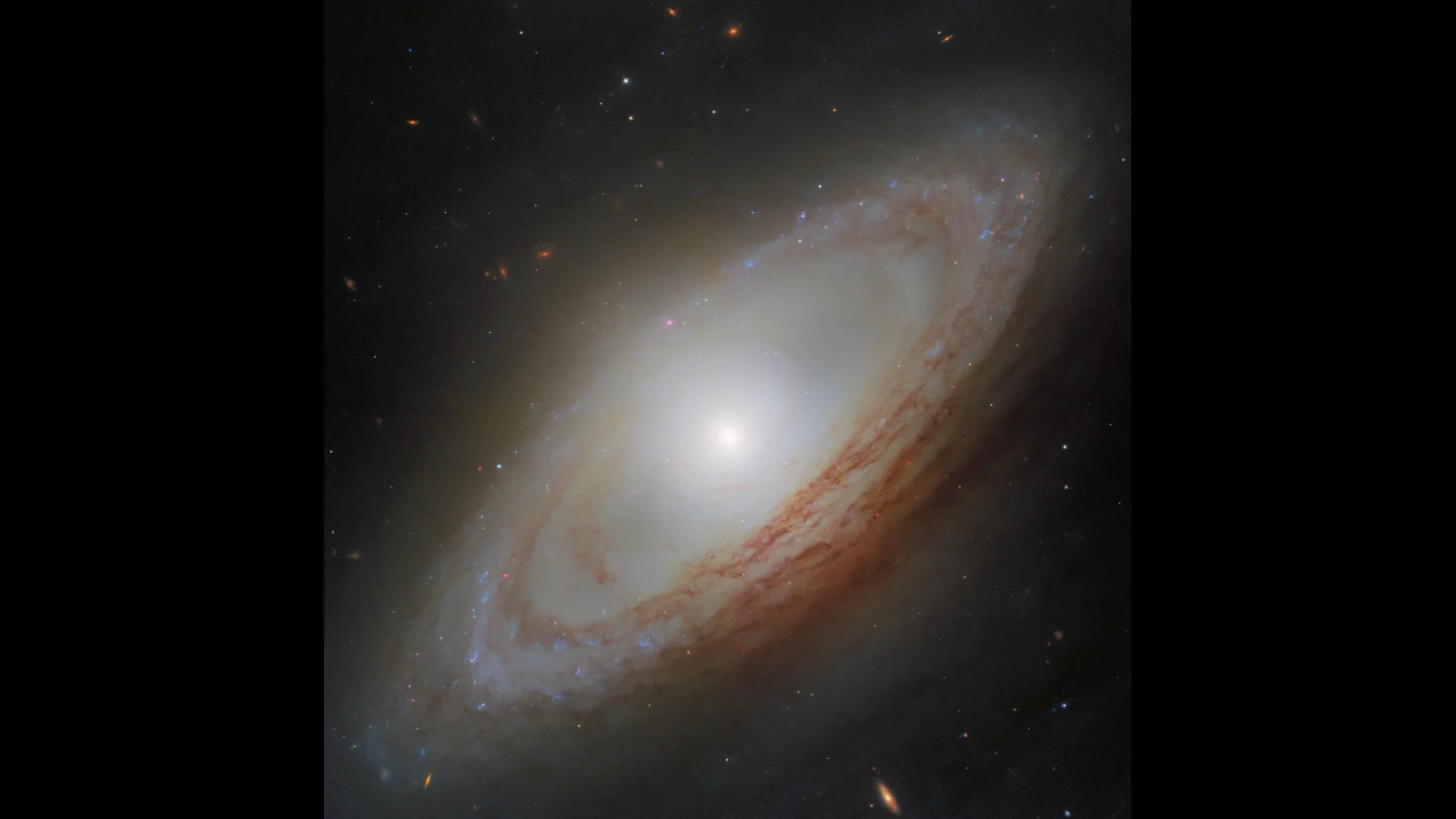
The Hubble view contains a bright central region, a flatter disk, curved outer structures and dark dust lanes. Blue-looking stellar groupings dot portions of the outer disk. These ingredients make it recognizable as a spiral galaxy rather than a single nebula or a star cluster.
NASA’s expanded Hubble feature on NGC 4698 places it in the Virgo Cluster, about 55 million light-years away. Its short image article highlights the unusual way the outer spiral arms appear to form a ring around the bright central area.
A light-year is a distance: how far light travels in one year. The quoted distance is therefore not the galaxy’s age or a prediction of how long it will remain in its present form. It tells us that the light carries information from a very distant system.
The image is also a projection. A three-dimensional arrangement of stars, gas and dust has been compressed into a two-dimensional view, and the angle from which we see it influences its apparent shape.
What is a galactic bulge?
A bulge is a central concentration of stars within a galaxy. It is not necessarily a solid ball, a planet-like object or a bright shell surrounding one giant star. The diffuse light comes from many stars whose individual contributions blend in the view.
In NGC 4698, NASA describes the central glow as coming from a population that differs from the prominent massive blue stars in the outer disk. But color should still be read with care: a processed image is not enough to assign an exact age to every bright patch.
For an analogy, think of photographing a city from far away. A dense central glow can represent many separate lamps that are no longer resolved individually. The brighter area is not one enormous lamp. Similarly, a galactic center can look like a smooth source while containing a vast collection of objects.
The comparison explains blended light, not a galaxy’s physical scale or structure. It is useful because beginners can otherwise mistake a bright center for something fundamentally different from the surrounding stellar system.
The unusual part is the mismatch in orientation
NASA describes NGC 4698’s elongated bulge as extending approximately perpendicular to the disk. It also reports that the stars and gas nearest the center rotate perpendicular to the rest of that disk.
These are related but distinct statements. One concerns the orientation of a structure. The other concerns motion. A photograph can provide evidence about shape, but a convincing account of rotation requires more than looking at a bright region and imagining which way it spins.
Picture a broad, nearly flat ring laid on a table, then a smaller ring placed upright through its center. This is not a precise model of NGC 4698, but it gives a starting image of two structures that do not share the same plane.
Do not interpret the analogy as two rigid mechanical parts turning together on bearings. A galaxy contains enormous numbers of stars and gas moving under gravity. The rings represent orientations, not literal hoops in space.
How can astronomers know the motion from so far away?
Images record where light arrives from. Spectroscopic measurements separate that light into wavelengths, where identifiable features can help reveal motion along the line of sight through Doppler shifts.
The everyday sound analogy is a siren changing pitch as its source moves relative to you. Light has a related shift in wavelength, although the detailed analysis of a galaxy is not the same as listening to a passing vehicle.
Measurements from different parts of a galaxy can be compared with a model of its orientation and motion. The pattern is more informative than a single shifted feature from the entire object blended together.
This explanation does not reproduce the analysis used for NGC 4698. It explains why an article can legitimately discuss motion that is not visible as movement in a still photograph. The conclusion draws on a wider body of observations, while the image helps show the structure to which those observations refer.
How an outside encounter could leave an inside clue
The NASA feature describes external gas acquisition and a possible minor merger as explanations for the misalignment. A short hydrogen tail is among the observations discussed as a clue to an earlier interaction.
The basic reasoning is that material arriving from outside need not share the existing galaxy’s orientation. If that material is captured and evolves within the system, its history can differ from that of the original disk. A misaligned component is therefore something to explain, rather than a detail to smooth away.
However, “could explain” is not the same as “the exact event has been reconstructed.” A final state can be compatible with more than one history. Additional observations and modeling are needed to assess which histories fit all the evidence.
Think of finding muddy footprints in a room. They show that something happened, but their existence alone may not establish exactly who entered, when they arrived or which route they took outside. The appropriate conclusion depends on the complete set of clues.
Why a merger does not mean stars crash like billiard balls
When galaxies interact, gravity can change the motions and distribution of stars and gas over very large scales. The popular word “collision” can encourage the wrong mental picture of a tightly packed solid object smashing into another one.
A galaxy is not solid. Its components and the spaces between them must be considered. Gas can interact in ways that differ from the behavior of individual stars, so a one-material analogy quickly becomes misleading.
For this story, the useful point is not to imagine a single explosive impact visible in today’s photograph. It is that a galaxy’s structure can retain consequences of its interactions. Apparently orderly forms do not require an uneventful past.
Nor should the word “chaotic” in a headline be read as a claim that the whole galaxy is flying apart. The specific issue here is the misaligned central structure and motion. Naming that issue is more informative than treating the galaxy as generally mysterious.
The dust lanes help explain the view
Dark lanes across a luminous galaxy often trace material that obscures background light. Their darkness does not necessarily mean there are no stars behind them. The view depends on both the distribution of emitting sources and the material between those sources and us.
This makes the near-versus-far arrangement within the galaxy important. A dust lane in front of a bright region can stand out strongly, while a similar amount of dust behind it may be less obvious in that image.
The same visual principle appears in the LH 95 nebula explainer: dark structures can represent obscuring material rather than holes. The objects are different, but the need to separate emission from obstruction is shared.
When looking at NGC 4698, trace the visible lanes and outer arms first. Then return to the central glow. That sequence helps distinguish the more obvious disk pattern from the subtler question of the bulge’s orientation.
Why the surrounding cluster matters
A galaxy is not isolated from its environment simply because an image frames it as a single object. NASA explains that the Hubble observing program examines Virgo Cluster galaxies to investigate their structures and how their environments relate to their evolution.
The cluster context changes the kinds of questions worth asking. What interactions might a galaxy have experienced? How is its gas distributed? Which observations can distinguish a local feature from a consequence of its broader environment?
That does not mean the cluster itself is proven to have caused every detail in NGC 4698. Environment is part of the investigation, not a universal explanation to paste onto every unusual shape.
A good scientific account keeps that difference visible. It can describe a plausible mechanism and the evidence supporting it while still acknowledging that a specific causal history remains under investigation.
A three-level reading of the Hubble image
- Describe: identify the bright center, ring-like outer arms and obscuring dust without assigning an entire history to them.
- Measure: ask which properties come from imaging, spectroscopy or other observations. Shape and motion require different evidence.
- Interpret: compare explanations for the unusual arrangement, keeping “suggests,” “supports” and “proves” distinct.
This approach prevents two opposite mistakes: assuming the photograph tells the whole story, or assuming that nothing useful can be learned because the history is uncertain. Evidence can be strong about one feature and incomplete about its cause.
Questions worth taking away
Is the bright center itself a black hole?
The visible central glow is not a direct picture of a black hole’s interior. It includes light from stars and other material. Claims about a central black hole rely on the relevant observational evidence, not merely the presence of a bright spot.
Can we watch the galaxy rotate in this photograph?
No. The photograph is a still view. Rotation discussed in the source is inferred from observations and analysis, not from a visible turn of the galaxy in the displayed image.
What is genuinely surprising?
A system with a familiar spiral appearance can contain a center whose structure and rotation are strongly misaligned with its disk. The mismatch points toward a history that a quick look at the outer shape would miss.
The takeaway: NGC 4698 is interesting because appearance, motion and history do not reduce to one simple picture. The Hubble image shows a scene; the scientific investigation asks how that scene came to be.
Revised 14 October 2026. Galaxy-specific findings are attributed to NASA’s Hubble accounts linked above. The analogies explain the reasoning; AYXWORKS has not independently analyzed the observations or reconstructed a merger history.
Featured image: ESA/Hubble & NASA, D. Thilker, the MAUVE-HST Team. Original image and context. Usage terms. Full source frame fitted within a 16:9 canvas without cropping; resized and converted to WebP.