On this page
In brief: The Lighthouse pulsar is a rapidly spinning neutron star surrounded by energetic particles and glowing structures. NASA’s IXPE measured the polarization of X-rays from this system. That information lets researchers infer how magnetic fields are oriented, helping explain why some particles form a long, narrow filament instead of spreading evenly through space.
A photograph can show where a nebula is bright. But how do you investigate an invisible magnetic field threading through it? You look for information carried by the light itself—not just how much light arrives, but how its electric-field vibrations are arranged.
That extra measurement is the central idea behind the Lighthouse result. It turns a striking space image into a test of how particles travel through an extreme environment.
A pulsar is the compact object, not the entire cloud
A neutron star is a dense stellar remnant. Some neutron stars are observed as pulsars because their rotating emission pattern produces regular pulses in our direction. The familiar lighthouse analogy concerns a beam sweeping past an observer; it does not mean that the star is repeatedly switching on and off like a flashing bulb.
The specific object here is PSR J1101−6101. NASA reports that it rotates about 16 times per second. The surrounding Lighthouse Nebula contains extended emission associated with particles from the pulsar. Keeping the star and its environment separate is important: a measurement of the surrounding emission is not a close-up photograph of the neutron star’s surface.
Imagine a harbor light illuminating mist. The lamp and the illuminated surroundings are related, but they are not the same object. Similarly, the pulsar powers phenomena over a much larger region than the compact remnant itself. The comparison explains the distinction, not the detailed physics.
What IXPE adds to an ordinary image
IXPE stands for Imaging X-ray Polarimetry Explorer. Its distinguishing measurement is polarization: information about the orientation of light’s electric-field oscillations. NASA’s report on the Lighthouse observations explains how researchers used this property to investigate the nebula’s magnetic structure.
Light can carry several kinds of information at once. Brightness tells you how much radiation reaches a detector. Wavelength or energy helps distinguish kinds of emission. Polarization adds information about orientation and the physical processes that produced or modified the radiation.
An everyday comparison is a crowd seen from above. Counting people tells you something, but seeing which direction they face adds a different kind of information. A crowd of the same size could be orderly, scattered or arranged into several groups. Polarization is not literally a crowd direction, but the analogy shows why brightness alone can miss structure.
Crucially, the electric-field orientation of the arriving light is not simply a drawn arrow pointing along every magnetic field in the nebula. Researchers interpret the measurement using the physics of the emission process. A magnetic-field result is supported by that relationship and analysis, not by directly seeing invisible lines as colored threads.
Why magnetic fields matter to fast particles
Charged particles interact with magnetic fields. In an energetic astrophysical environment, their trajectories and radiation can therefore carry clues about the surrounding field. The geometry of a glowing structure is one clue; polarization provides a way to test whether that geometry is consistent with a proposed field arrangement.
The distinction between a clue and a test matters. A long, thin feature might tempt you to draw a field line along it and declare the problem solved. The observation becomes more informative when an independent property of the light supports that interpretation.
This is a recurring pattern in science. First notice a shape, then propose a mechanism, then identify a measurement that should behave differently if the mechanism is wrong. The strongest part of the story is not that a feature looks like a stream. It is that the researchers found a way to investigate what guides it.
The filament and the trail are different parts of the system
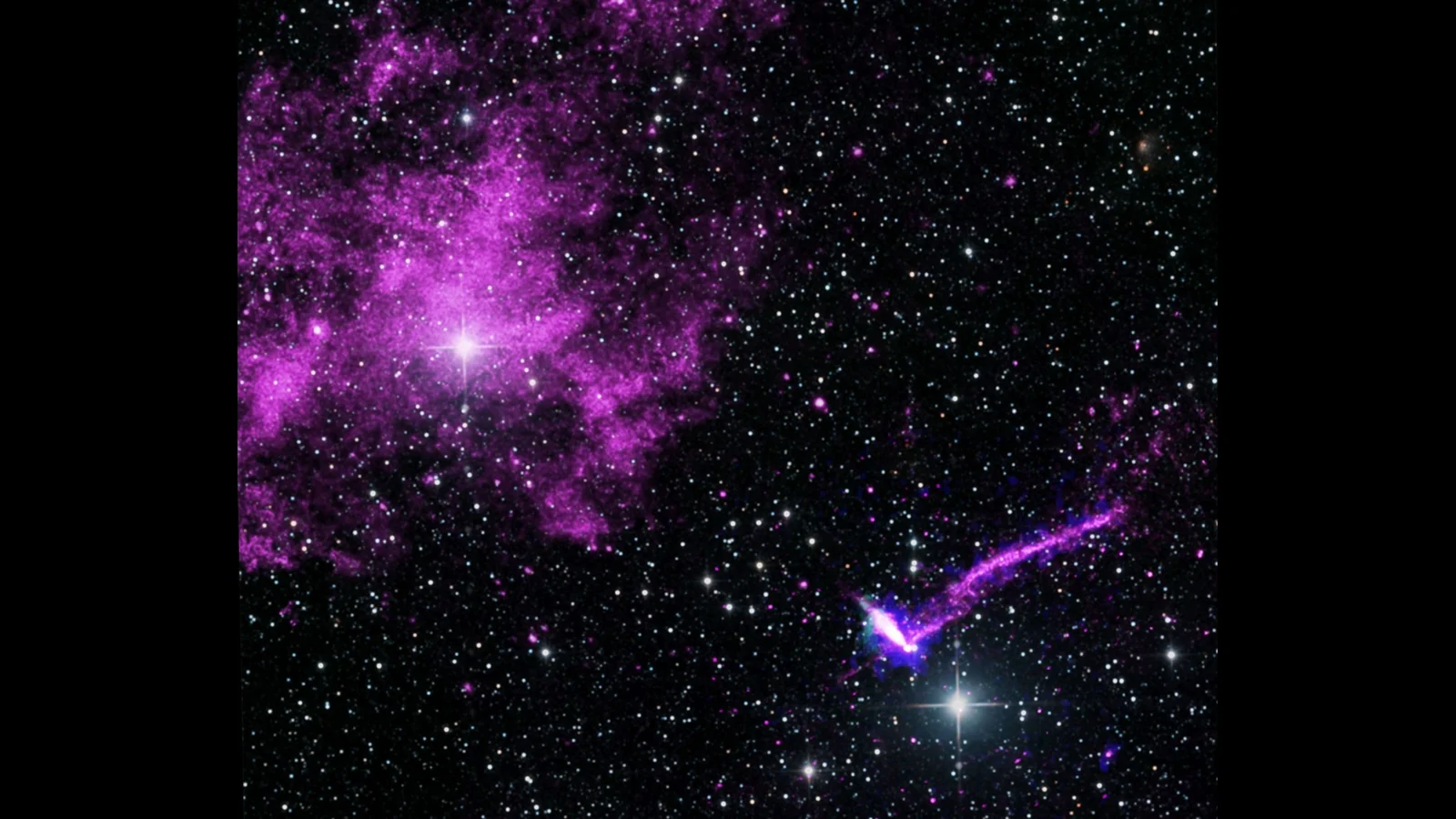
NASA describes two narrow X-ray features: a longer filament and a shorter trail. The pulsar’s interaction with surrounding material creates a bow-shock environment, often compared with the disturbance ahead of a moving boat.
In the interpretation discussed by the researchers, very energetic particles can escape into the surrounding interstellar environment and travel along the galaxy’s magnetic field, contributing to the long filament. Other particles remain associated with the disturbed region behind the pulsar.
Do not stretch the boat analogy too far. Space here is not a pool of water, and the particle speeds and magnetic interactions have no ordinary boating equivalent. The comparison is useful for understanding why a moving source can have a front-facing disturbance and a trailing region with different conditions.
It also helps explain why the entire nebula should not be treated as one uniform container. Different structures can sample different populations of particles, fields and interactions. A single label on an image can hide several related physical questions.
What the observations established—and what remained surprising
IXPE observed the Lighthouse Nebula for nearly 18 days in June 2025. The results were described in NASA’s July 2026 feature. These are different dates: the later publication did not mean the telescope had just completed a new 18-day exposure that month.
According to NASA’s account, the analysis supported magnetic-field alignment with the filament’s particle flow at greater than 99% confidence. The measured polarization was also high enough to challenge models requiring stronger magnetic turbulence. Confidence in one result did not mean that every part of the system became fully understood.
Another finding made that especially clear: radio and X-ray observations of the trail indicated different field orientations. The researchers interpreted this as evidence of structure associated with particles of different energies, rather than one simple arrangement describing everything.
That is an important scientific outcome, not an embarrassment. A measurement can support a central idea while showing that its simplest version needs refinement. “The theory was tested” is more useful than either “everything was proved” or “scientists were wrong.”
What polarization can tell you about order
Consider many tiny regions contributing radiation to one measurement. If their polarization orientations differ strongly, combining them can reduce the overall degree of alignment. If the orientations are more consistent, the combined signal can retain stronger polarization.
This is why a high polarization degree can constrain how disordered an emitting region is. But turning a measured value into a description of turbulence requires a model of the source and the measurement. It is not a universal gauge with “calm” at one end and “chaotic” at the other.
A useful thought experiment is to draw arrows on several transparent sheets. If the arrows mostly share a direction, the stacked pattern looks organized. If their directions vary, there is no single clear orientation. Real polarization calculations are more precise, but the exercise explains why combining many contributions can hide—or preserve—an underlying pattern.
The lesson is to ask which region and which radiation were measured. An organized X-ray signal from one feature does not establish that every field everywhere around the pulsar is equally organized.
How to read the featured composite
The featured image combines observations from more than one instrument and wavelength range. Display colors make different measurements visible together. They are not a promise that a person looking out of a spacecraft window would see the nebula in those colors.
Start by distinguishing the compact source, extended structures and surrounding star field. Then read the image caption to determine which observatory contributed which part. A bright feature in an X-ray layer answers a different question from a star visible in a background survey.
Combining layers is useful because it provides context, but alignment on the screen alone does not establish that two signals come from identical particles or precisely the same physical volume. The contrasting radio and X-ray results are a good reminder of that limitation.
The full credit below retains the contributing missions and image processors. The website version has been resized with the complete frame retained. It is a published scientific composite, not an AYXWORKS simulation or a newly generated magnetic map.
Three questions to ask when a headline says “mapped”
- What did the instrument measure directly? Here the key measurement was X-ray polarization, together with imaging and other observational information.
- What physical interpretation connects the measurement to the claim? The emission physics links polarization to the magnetic structure being investigated.
- What remains unresolved? Differences between regions and wavelengths can reveal additional structure rather than a single finished picture.
This approach works beyond astronomy. A thermal camera, an air-quality satellite and a medical scanner all turn measurements into interpretations. The interesting question is not whether interpretation occurred—it always does—but whether the relationship is understood and its limits are stated.
Common questions
Is the Lighthouse pulsar a black hole?
No. It is a neutron star observed as a pulsar. A neutron star and a black hole are different possible compact remnants, with different properties.
Did IXPE photograph magnetic lines?
Not as visible wires or painted lines. It measured radiation whose polarization provides information about the magnetic field associated with the emitting particles.
Why observe for so long?
The source is faint, and collecting more useful measurements helps distinguish a signal from uncertainty. A long observation is part of the measurement strategy, not evidence that the source is physically large on a camera sensor.
What should I remember?
Light can reveal more than shape and brightness. In the Lighthouse Nebula, its polarization helped test how an invisible magnetic environment guides energetic particles—and exposed complications that an image alone could not settle.
Related reading: the LH 95 star-nursery explainer describes another case where understanding the physical source of the light changes how a space image reads.
Revised 14 October 2026. Research findings remain attributed to the NASA account and the scientific paper linked from it. This article explains the measurement; it does not independently reproduce the analysis or its confidence estimates.
Featured image: X-ray: Chandra: NASA/CXC/Stanford Univ./J.T. Dinsmore et al.; IXPE: NASA/MSFC/J.T. Dinsmore et al., Radio: CSIRO/ATNF/ATCA; Optical: 2MASS/UMass/IPAC-Caltech/NASA/NSF; Image processing: NASA/CXC/SAO/L. Frattare. Original image and context. Usage terms. Full source frame fitted within a 16:9 canvas without cropping; resized and converted to WebP.