On this page
In brief: A refurbished robot can be a sound engineering purchase when its provenance, controller, software options, mechanical condition and acceptance test match the intended duty. The price of the arm settles very little of that.
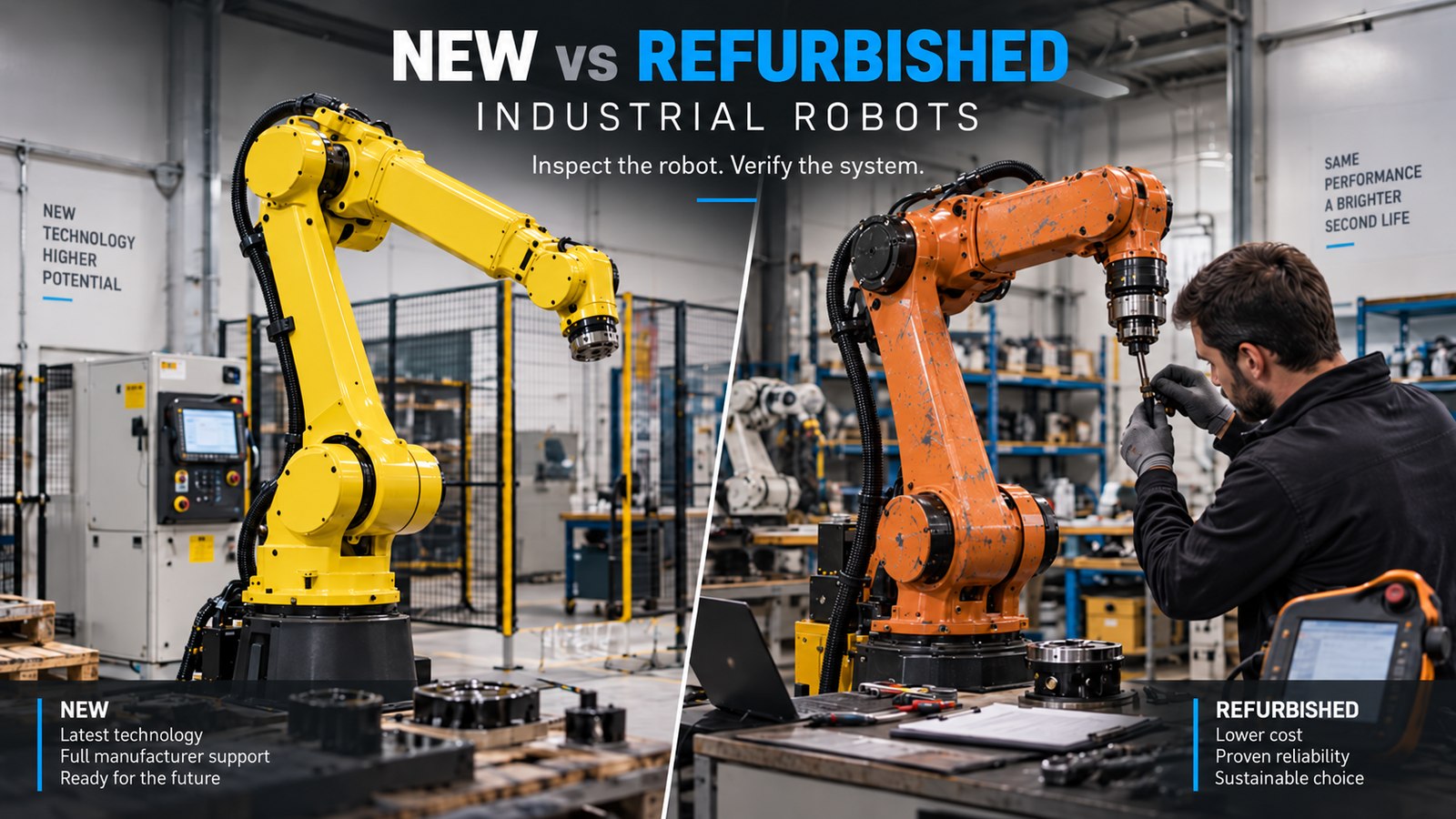
New and refurbished robots are usually compared on price, and that comparison misleads, because the arm is only one line in the cost of a working cell. What separates a good used robot from a bad one is evidence: what is really installed in the controller, what the mechanics have been through, and who answers when a part fails. The same questions apply to a new robot; only the answers differ.
Compare complete installations, not arms
The purchase price leaves out tooling, transport, mounting, cables, software options, safeguarding, programming, spare parts and the cost of downtime. Build two lifecycle scenarios for the same application and the same risk assumptions: one with new equipment, and one with the refurbished unit as it would really be delivered and supported. A lower arm price is soon absorbed if a missing option, an obsolete fieldbus card or a long wait for a spare part has to be solved during commissioning.
Inspect the whole control system
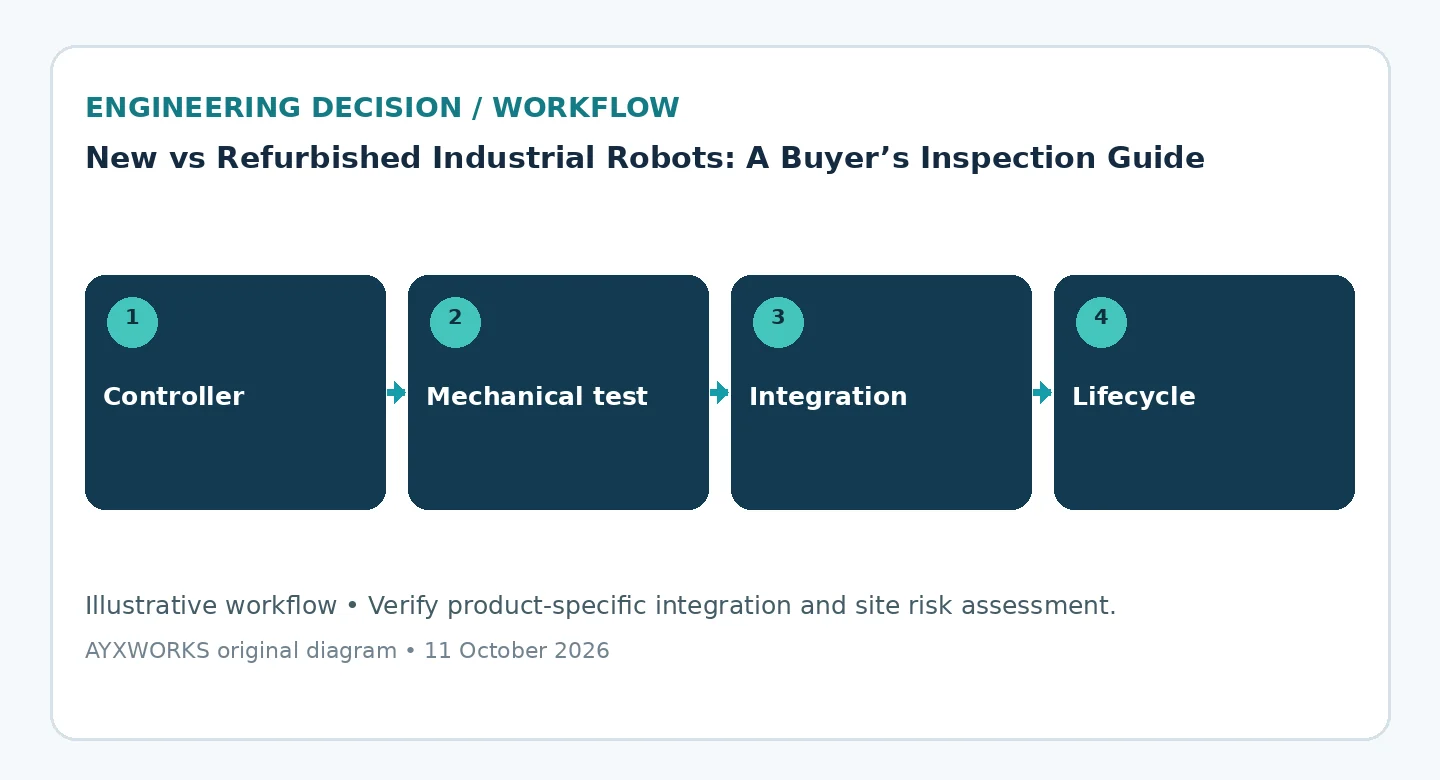
A robot is an arm together with a specific controller generation, teach pendant, drive hardware, firmware and set of licensed options. Ask for the exact identification of each, and check that they belong together and suit the process: the fieldbus your PLC uses, the application software and any safety-rated options. Ask for a controller backup and the original documentation. An option listed on a sales sheet is not evidence that it is licensed, activated or suitable. A demonstration of the option running on that controller is.
Ask for a repeatable mechanical acceptance test
Ask for the maintenance records and for what the refurbishment consisted of: which parts were replaced, which were only inspected, and what was merely cleaned and painted. Have qualified people check backlash or repeatability where it can be measured, abnormal noise, seals, brakes, the dress pack and the condition of the cables, and witness a motion test with a representative load. Do not infer remaining life from fresh paint or from a single operating-hours counter: hours say little about the loads, speeds and environment the robot worked in.
Settle who carries the remaining risk
Put in writing the acceptance test, the delivery condition, the warranty and its exclusions, spare-part availability and who integrates the robot into the cell. In the EU, check the regulatory position as well. Regulation (EU) 2023/1230 on machinery, which applies from January 2027 and replaces Directive 2006/42/EC, treats whoever carries out a “substantial modification” of machinery as its manufacturer, and its recitals state that second-hand products imported from a third country are covered. Whether a particular refurbishment or re-integration falls under those provisions is a question for the parties and their compliance advisers. A refurbished arm can suit a well-bounded handling task and still be a poor match for a critical process that needs guaranteed parts availability.
Checklist before committing budget or scope
- Controller, teach pendant and arm identified and documented as a matching set.
- Required software, fieldbus and safety options demonstrated on that controller.
- Refurbishment scope in writing: replaced, inspected or cosmetic.
- Mechanical inspection and a witnessed test with a representative load.
- Spare-part and support horizon recorded.
- Responsibility for integration, risk assessment and conformity named.
What this guide does not establish
This guide is a planning aid. It does not rank suppliers, state prices or predict the remaining life of any robot, and it is not a test report, a product certification or a guarantee of performance. The remark on EU law points to the text of the regulation; it is not legal advice. Hardware selection, functional safety, machinery compliance and commissioning have to be verified on the real system by suitably qualified people. The ISO standards listed are paywalled and are not summarised clause by clause.
Disclosure: the author is CTO of Eurobots, a company that sells new and refurbished industrial robots. This guide is written to help buyers inspect any offer, including Eurobots’.
Sources and further verification
- EUR-Lex — Regulation (EU) 2023/1230 of the European Parliament and of the Council on machinery (2023-06-29; accessed 2026-10-12).
- ISO — ISO 10218-1:2025, Robotics — Safety requirements — Part 1: Industrial robots (2025-02; accessed 2026-10-11).
- ISO — ISO 10218-2:2025, Robotics — Safety requirements — Part 2: Industrial robot applications and robot cells (2025-02; accessed 2026-10-11).
Next useful step
If you are weighing a new robot against a refurbished one, bring the application, the payload and reach you need, the controller options and fieldbus your line requires and the support you expect to the Robotics & Automation page and solution finder. Projects taken on from there are scoped and delivered through Eurobots/ReBots, and they start with feasibility and responsibility boundaries, not with an assumed turnkey installation. The engineering background to these guides is in the AYXWORKS portfolio.
Image credit: ayxworks — Original / rights held.