On this page
In brief: Factory acceptance (FAT) and site acceptance (SAT) are only worth the travel if they test the process the contract describes, including what the cell does when something goes wrong. A robot repeating one clean motion in the supplier’s workshop demonstrates very little.
What acceptance is for
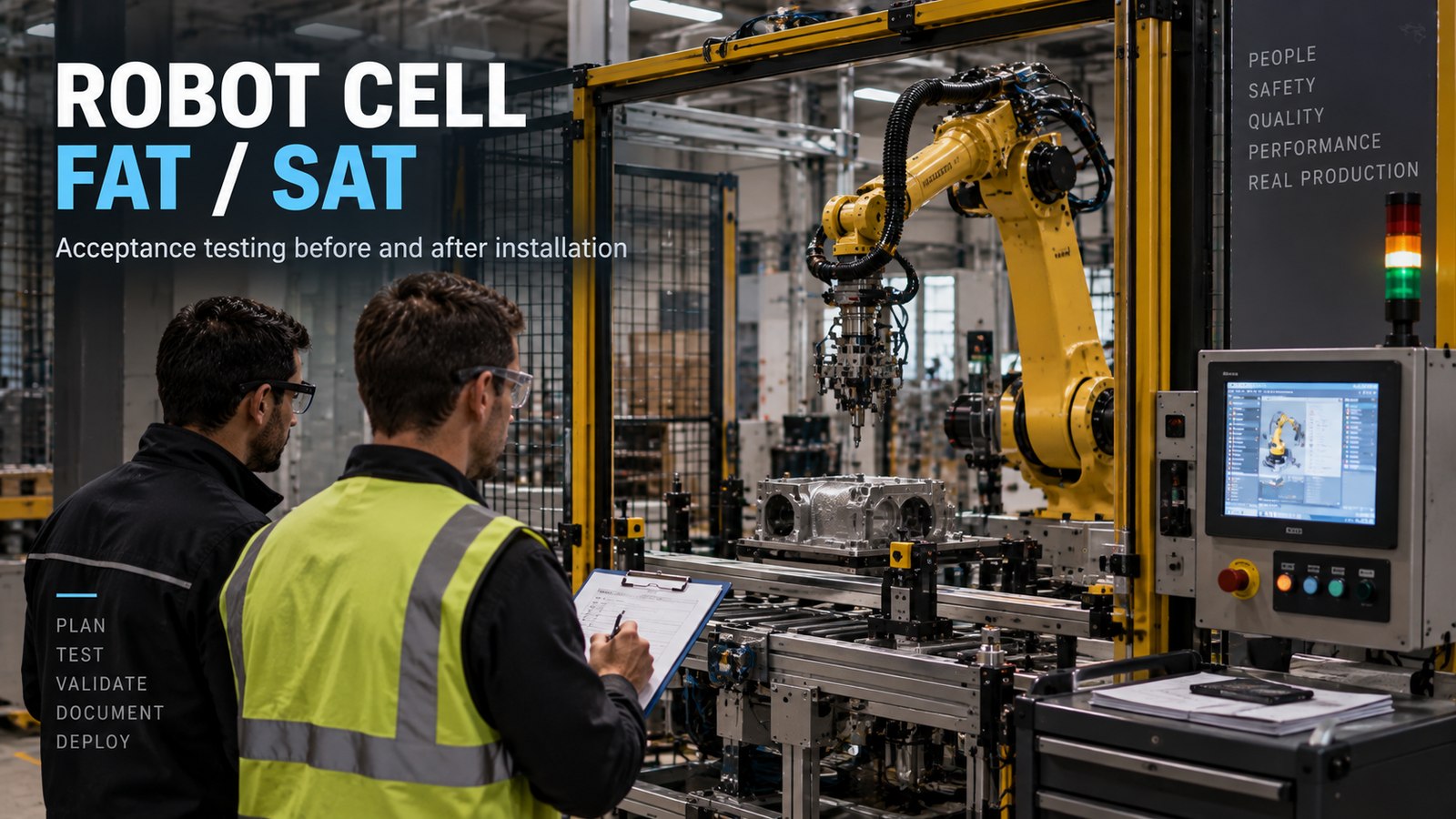
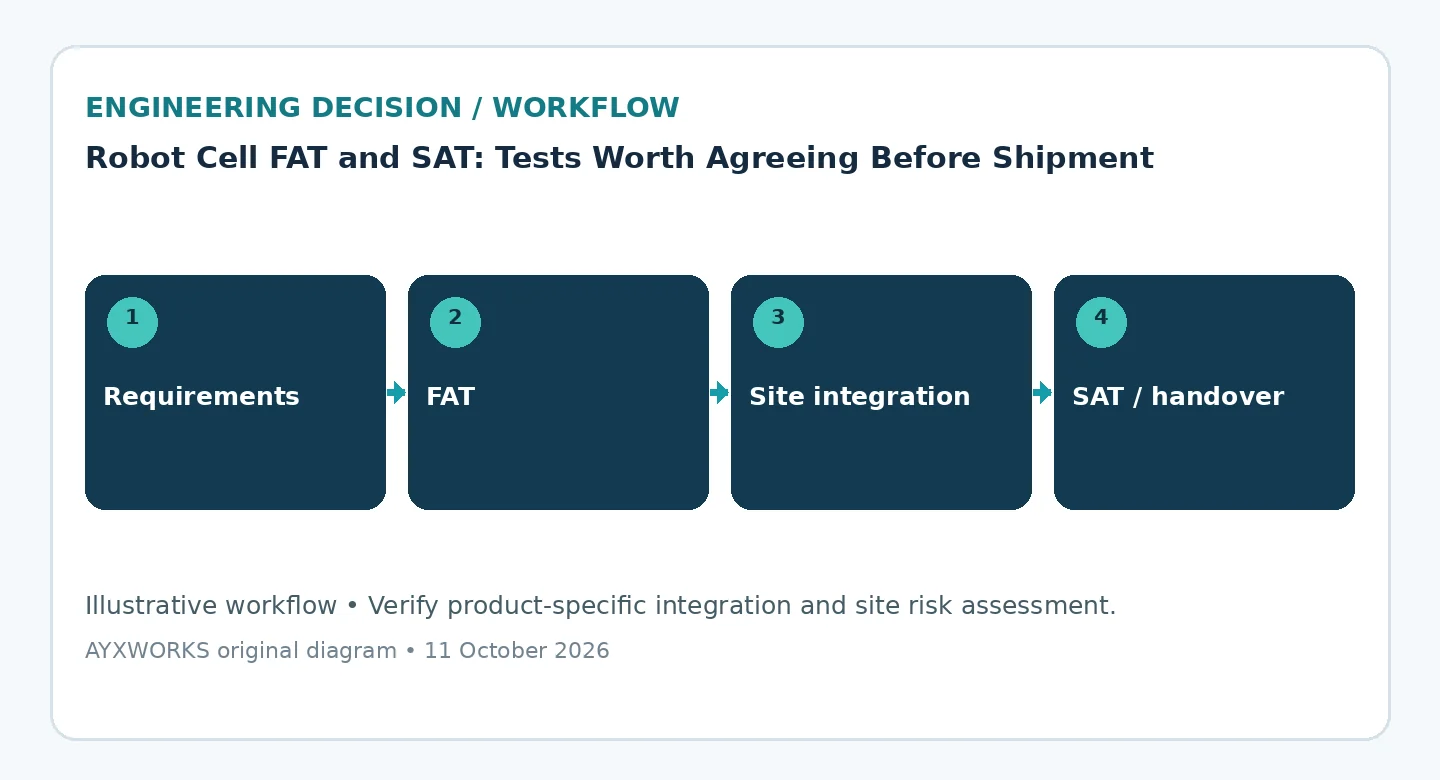
Acceptance is the point at which risk, and usually payment, moves from supplier to buyer. If the tests are vague, that transfer happens on impression instead of evidence. FAT asks whether the cell as built does what was specified, before it is dismantled and shipped and while faults are still cheap to correct. SAT asks whether the installed cell does it in your plant, with your utilities, your neighbouring equipment and your operators. The content of both is whatever the contract says, so it has to be written before the order, not negotiated on the test day.
Make every requirement observable
Give each line of the purchase specification a test method, an expected result, a tolerance and a named witness. “Works correctly” cannot be failed, so it cannot really be passed either; “runs the agreed number of consecutive parts without operator intervention, at or below the agreed cycle time” can. Keep the groups of requirements apart (throughput, part quality, safeguarding, operator interface, communications, documentation) so that a good result in one cannot hide a gap in another.
What FAT can and cannot show
At the supplier’s site, check what travels with the cell: tooling and gripper set-up, the robot and controller options actually installed, I/O mapping, normal sequences, the documented reaction to faults and the recovery from them, and the draft manuals and training material. Use representative parts that both sides have approved, including parts near the tolerance limits, because a FAT run on hand-picked samples proves only that hand-picked samples work. Record every deviation with an owner, a due date and the evidence that will close it. FAT cannot show anything that depends on your site: floor and fixings, power and compressed air, the real line interface and the guarding as finally installed.
What SAT must add
SAT repeats the critical tests on the installed system and adds those that were impossible earlier: real communication with the line, synchronisation with upstream and downstream equipment, behaviour on emergency stop and in abnormal conditions, and a sustained production run with normal staffing. Any change made between FAT and SAT should be listed and retested, not silently accepted. Validation of safeguarding and safety functions on the installed cell belongs to the safety work for the robot application, the subject of ISO 10218-2:2025; plan it as a separate item with its own responsible person. Testing is itself non-routine work, one of the conditions in which OSHA says many robot accidents occur, so the plan should also say how people are protected during the tests.
Passing with open items
A test can be passed with minor open items only if the contract allows it and the list gives each item an owner, a date and a consequence. A missing safety or process function is a blocker, not a punch-list item. Before final handover, obtain the program and parameter backups, the as-built drawings, the spare-parts list and the agreed training.
Checklist before committing budget or scope
- A requirement-to-test matrix with method, expected result, tolerance and witness.
- Approved representative parts, including limit samples, and a written throughput criterion.
- Fault and recovery tests listed one by one, not as “fault handling OK”.
- A FAT deviation list with owner, due date and closing evidence, and a log of changes between FAT and SAT.
- Safety validation planned as a separate item with a named responsible party.
What this guide does not establish
This is a planning aid. It is not a contract template, a test report or legal advice, and it reports no tests of any cell. Passing a FAT or a SAT is not a declaration of conformity and does not replace the risk assessment or the validation of safety functions, which must be carried out on the real system by suitably qualified people.
Sources and further verification
- ISO — ISO 10218-2:2025, Robotics — Safety requirements — Part 2: Industrial robot applications and robot cells (catalogue page; 2025-02; accessed 2026-10-11).
- OSHA — Robotics: overview page stating that many robot accidents occur during non-routine operating conditions, testing included (undated; accessed 2026-10-12).
Next useful step
If you are preparing an acceptance plan, start from your purchase specification and mark every line that has no test, then see the Robotics & Automation page. Projects that start there are scoped and delivered through Eurobots/ReBots, and an evaluation begins with feasibility and responsibility boundaries rather than an assumed turnkey installation. The engineering background behind these guides is in the AYXWORKS portfolio.
Image credit: ayxworks — Original / rights held.