On this page
In brief: Connecting a cobot to production software can improve visibility, traceability and diagnosis—but only when the underlying process and data are reliable. Keep machine control and safety in their validated systems, expose a small set of well-defined production events, and prove one useful decision before building a larger data platform.
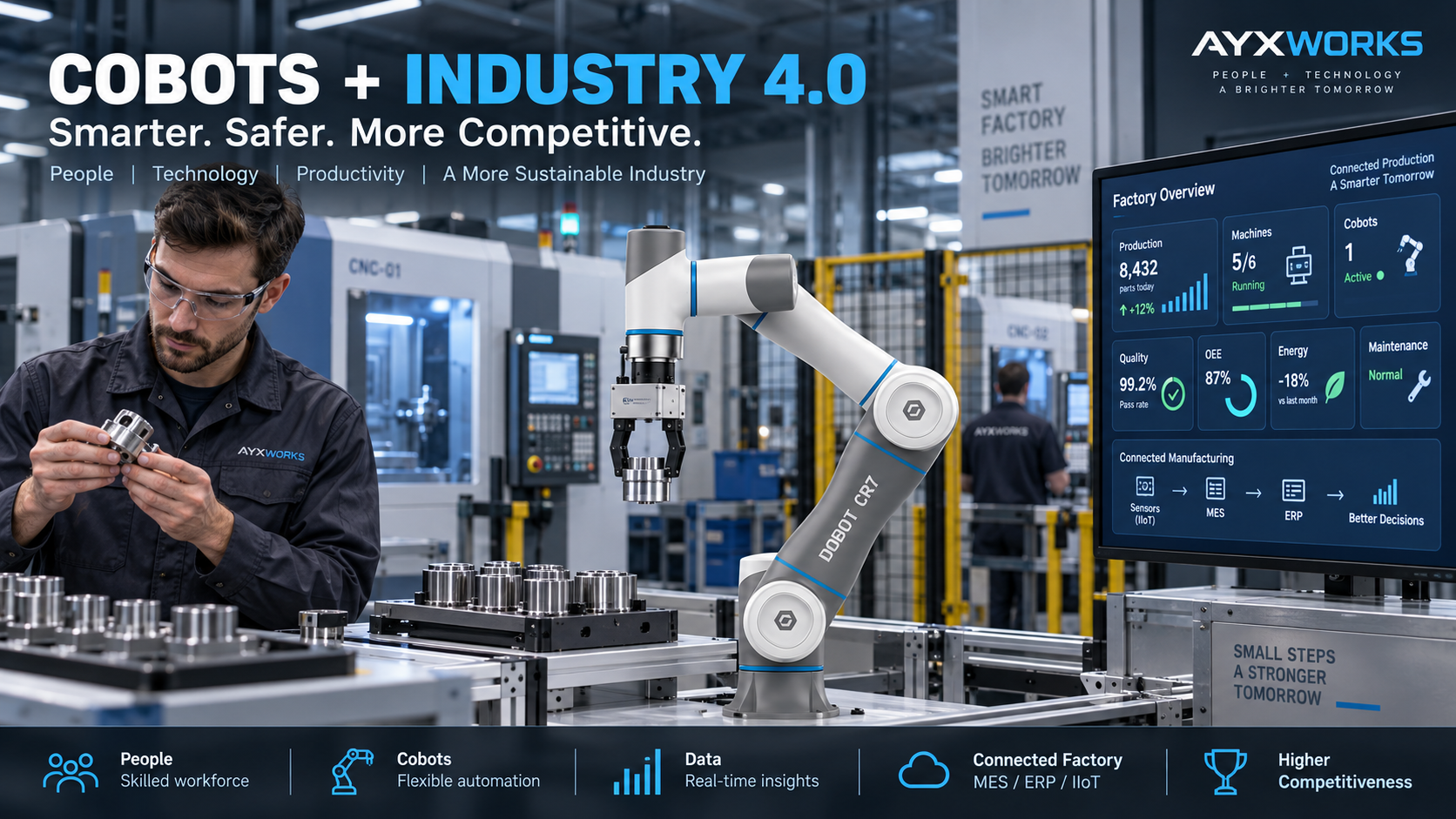
A dashboard can show a robot moving while the factory is producing no good parts. A green connection indicator can coexist with a blocked machine, an empty feeder or repeated manual recovery. The point of connecting a cell is not to collect more signals. It is to understand what the process is doing well enough to act on it.
The robot and the information system have different jobs
The robot and PLC execute the machine sequence. Higher-level systems organize orders, production records, quality information and business decisions. ISA-95 provides a framework for enterprise–control integration; it is not a requirement that every small cell must immediately acquire a large MES or cloud platform.
Define who owns each instruction. A production system may request a recipe or identify an order, but the cell must validate the request against its actual state. A web application should not gain unrestricted motion authority just because it can write a value to a server.
The industrial communication guide explains the different roles of cyclic control networks, OPC UA and MQTT. A shared Ethernet cable does not make their timing, semantics or failure behavior interchangeable.
Start with a small, explicit data contract
Choose the first decision you want to improve: identifying the cause of lost output, tracing a rejected part or measuring changeover. Then specify the data needed for that decision. Avoid exporting thousands of undocumented variables simply because the controller makes them available.
For each event or measurement, define its source, meaning, unit, timestamp, quality and identity. A counter called “parts” must distinguish attempted cycles from accepted pieces. A state called “running” must distinguish powered, ready, moving and actually producing.
| Useful record | Definition to settle |
|---|---|
| Completed part | Which event confirms completion, and whether the piece passed quality checks |
| Stop | Start, end, cause and whether the cause was reported or inferred |
| Recipe change | Requested and accepted recipe versions, with the responsible system |
| Measurement | Value, unit, acquisition time and valid/invalid status |
| Manual intervention | What occurred and how production was restored, without unnecessary personal data |
Use consistent event identifiers so reconnecting does not silently double-count an operation. Specify how the receiver handles duplicates, delayed messages and missing intervals. Successful network delivery is not proof that a physical operation occurred once or completed correctly.
Separate live control from observation
Begin with read-only monitoring wherever it meets the objective. Keep permissives, interlocks, motion sequencing and fault recovery in the systems designed and validated for them. A broker outage or unavailable reporting service should not create an uncontrolled restart or an undocumented fallback.
Where writing is justified, keep the command surface narrow. Authenticate the sender, authorize the operation, validate the payload and acknowledge acceptance separately from completion. Define rejection, timeout and retry behavior. Do not let a data-cleaning script become an accidental machine controller.
For example, a requested recipe number is not the same as a confirmed recipe change. Record whether the cell accepted it, which version it loaded and whether a cycle actually completed using that version. That is traceability; a timestamped request alone is not.
Make interruption and recovery visible
Test what happens when connectivity disappears, a gateway restarts or clocks differ. Decide whether records are buffered, discarded or marked incomplete, and how time is reconciled. Keep acquisition time separate from the time a delayed event reaches the reporting system.
A dashboard should indicate stale or invalid data rather than continue presenting the last value as live. Missing information may justify postponing a decision; it must not be silently converted into zero downtime or perfect quality.
Agree who maintains the interface after commissioning. Software upgrades, new recipe fields, replacement sensors and modified PLC logic can change the data contract even when the screen still appears to work.
A connected cobot is not automatically a safe application
ISO 10218-2:2025 addresses industrial robot applications and cells. The complete setup—including tooling, workpieces, layout and process hazards—needs the appropriate risk assessment and validation. A collaborative-capable arm does not make those requirements disappear.
Do not count predictive alerts, AI recognition or ordinary network messages as validated safety functions simply because they seem to detect a problem. Keep safety and cybersecurity responsibilities distinct while coordinating their design: preventing unauthorized access and preventing hazardous motion are related concerns, not identical proofs.
Keep the first security boundary understandable
Document which systems may communicate across the cell boundary, with what credentials and permissions. Separate production access from public-facing applications; use approved remote-support paths and revoke access when it is no longer needed. Avoid shared administrator credentials embedded in dashboards or scripts.
Use the controls supported by the actual products, and plan maintenance, updates, backups and recovery around production constraints. This is an engineering checklist, not a cybersecurity assessment or a claim that a short list makes a plant compliant.
Use AI only where there is an evaluation method
AI may help classify an image, summarize maintenance records or suggest a cause for a recurring stop. It does not automatically turn connected equipment into a self-improving factory. Define the task, permitted inputs, output consumer and consequences of an incorrect result.
The NIST AI Risk Management Framework organizes work around governing, mapping, measuring and managing risk. In a cell project, that means evaluating a candidate on representative data and deciding how uncertain output is handled before it influences operations.
Keep proposed changes separate from approved changes. A useful maintenance suggestion can be reviewed by a technician. Changing a robot trajectory, safety parameter or process setting demands its own engineering authorization and validation.
The first success should be one better decision
Pick one recurring production question and show that the new information answers it accurately. Compare before and after using the same definitions. Include data maintenance and operator effort in the result, not just the apparent elegance of the dashboard.
Then expand deliberately. Reusable naming, interface contracts, ownership and recovery are more valuable than adding another disconnected screen. The AYXWORKS robotics resources can help frame the application and integration questions before a feasibility discussion.
Editorial scope: this is a researched engineering guide, not a measured customer case or an AYXWORKS hands-on test. It promises no automatic safety improvement, installation timeline or return on investment. Actual Eurobots/ReBots scope and the responsibilities of the customer or integrator must be agreed separately.