On this page
Foldable solar panels promise a way to charge a power station away from the grid, but rated watts are not the energy you will necessarily harvest. Cloud, shade, alignment, heat, wiring and the receiving battery all affect the result. Before choosing a panel, verify its electrical compatibility with the exact power station. This is a research-based engineering checklist, not a report of years of AYXWORKS field testing.
Quick answer
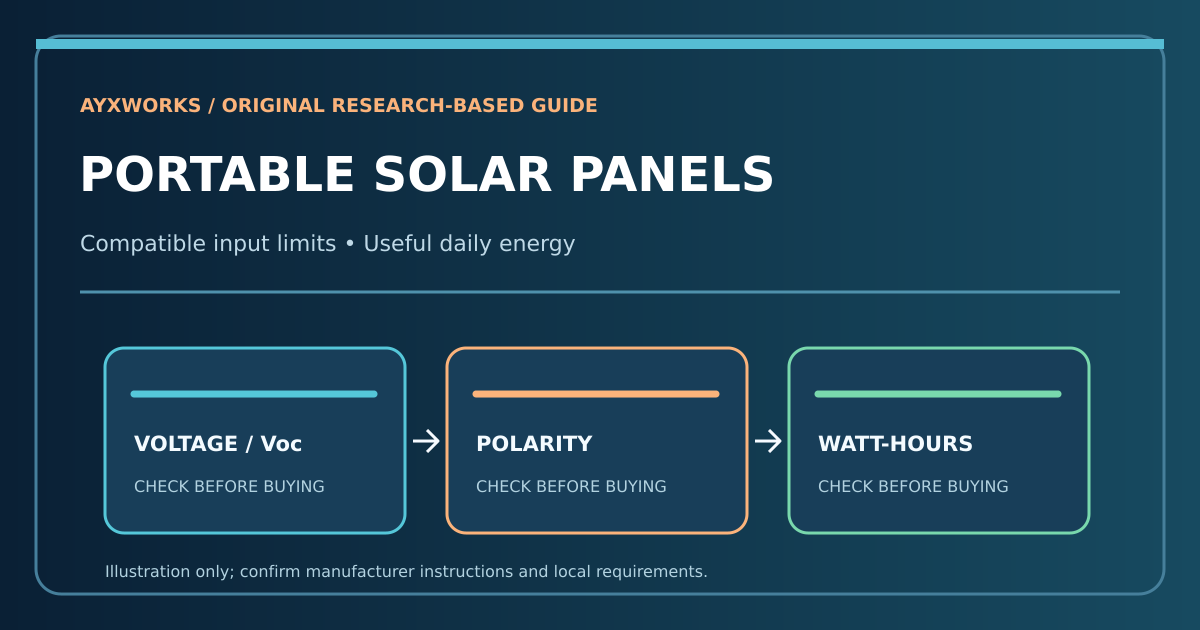
Start with the device you must charge. Check its published photovoltaic input limits, then compare the candidate panel’s open-circuit voltage, output current, connectors and intended configuration. Only after confirming the connection is safe should you choose power rating, folded dimensions, cost and weather tolerance.
Match panel and charging inputs first
Many portable power stations have an internal solar charge controller, but they do not accept unlimited solar voltage or current. Find the exact model’s allowed PV input range and maximum open-circuit voltage from the manufacturer’s manual. The panel label should provide its electrical ratings under specified test conditions.
A connector that physically fits is not proof of correct wiring, polarity or voltage. Do not assume that every MC4-style connection, adapter or USB connector is electrically interchangeable. In a series arrangement, voltages add; in parallel, available current can increase. Open-circuit voltage is temperature-sensitive and can rise in cold weather. Check the manufacturer’s limits and a qualified electrician’s advice before experimenting with multi-panel arrays or unknown adapters.
Use watt-hours, not only watts
Think of solar power as a flow of energy that varies through the day. A rated 200 W panel does not guarantee that it will deliver 200 W continuously. Actual useful energy depends on sunlight at the site, season, shading, placement, panel temperature and charge-controller behavior.
Estimate the energy your devices need over one day in watt-hours, then consider when the solar array can plausibly generate energy. A camping fridge, charging several devices and running a laptop continuously are very different workloads. Maintain a reserve for poor weather rather than designing a setup that works only on the best sunny day.
Plan where the panel will actually stand
Check the unfolded footprint, folded dimensions, mounting legs, wind stability and how easily it can be repositioned. A panel left facing the wrong direction or shaded by a tree can underperform a smaller one that is easier to deploy correctly. Keep connectors dry and protected according to their rated ingress protection; a weather-resistant panel does not make its power station or cables waterproof.
Transport includes carrying mass, packing the cable safely and protecting the solar surface from damage. For day trips, an easy-to-carry system you actually unfold may be more useful than a large setup that stays in the vehicle.
A simple compatibility checklist
| Question | Evidence to obtain |
|---|---|
| Will the charger accept this panel? | Power-station manual: input V, A, allowable Voc and supported configuration |
| Are the connectors correct? | Manufacturer pinout, polarity, adapters and cable ratings |
| Will the system supply enough energy? | Estimated daily demand, plausible sun hours and reserve |
| Can it stand safely? | Footprint, wind exposure, shading and support |
| Can it handle the environment? | Panel, junction-box, connector and power-station weather limits |
| Is the cost justified? | Current regional offer, warranty, replacement cables and transport requirements |
What independent tests tell you
WIRED reviewer Simon Hill’s portable-solar-panel roundup contains tests and observations of individual panels in his own conditions. Those results, photos and preferences belong to the original reporter. AYXWORKS has not replicated the tests and does not use their quoted prices as live offers.
If a maker cites efficiency, angle performance or a particular measured output, compare those figures only when the testing basis is explicit and comparable. Output recorded on one sunny afternoon does not establish year-round performance.
Common questions
Can I connect panels to any power station? No. Match voltage, current, polarity, control method and permitted connections for the exact model.
Does 400 W rated power mean two times the usable energy of 200 W? Not necessarily under real outdoor conditions. Shade, placement, temperature and charge-controller limits affect useful output.
What about connecting different panels in series? Avoid improvisation. Check the manufacturer’s approved configuration and ratings; mixing panels with different specifications can create additional electrical and performance problems.
Takeaway: Compatibility and electrical safety come first. Then size for actual watt-hour demand, practical setup time and the weather where the system will be used.
Reference
- WIRED — Simon Hill’s original portable-solar-panel guide, independent testing and selection context.