On this page
A 14-hour overnight flight with a toddler is rarely predictable. A useful plan does not promise that your child will sleep through it: it makes boarding, safety, food, sleep and changes of plan easier to handle. This is a research-based travel guide, not a report of an AYXWORKS family trip.
Quick answer
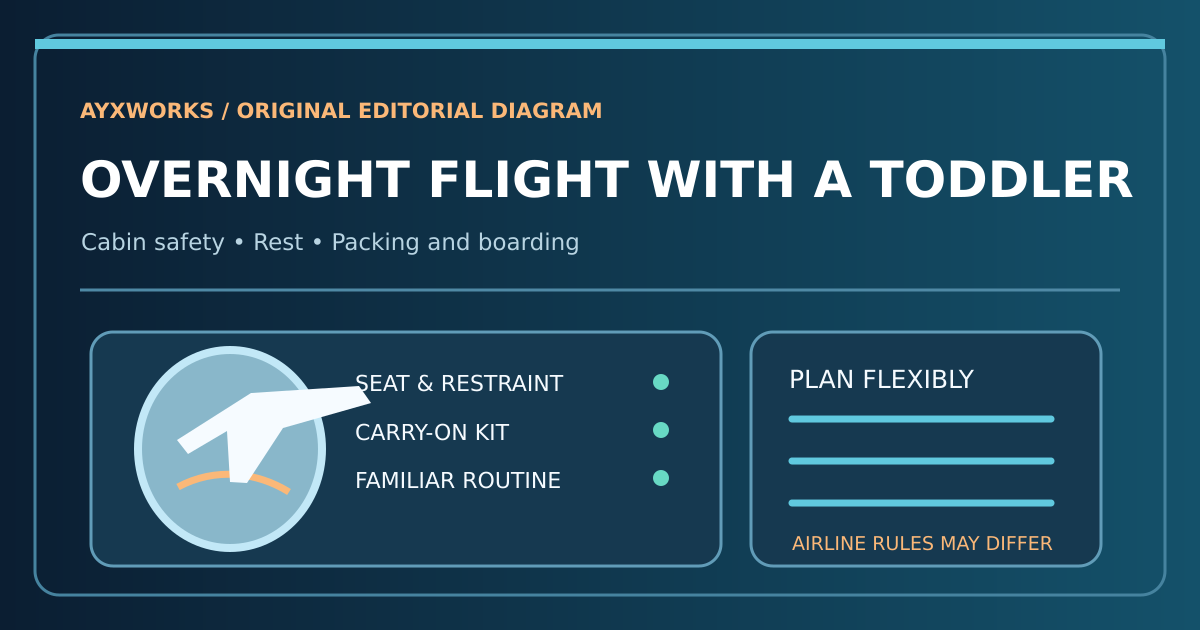
Prioritize a safe seating/restraint arrangement, essential items in the cabin, a familiar bedtime routine and realistic expectations. Check your airline’s infant-seat and baggage rules before booking. A toddler who sleeps less than usual, needs to walk when allowed or becomes upset during a long flight is not evidence that the trip has failed.
1. Decide on the child’s seat and restraint
In the United States, the FAA recommends a separate seat and approved child restraint system for children younger than two, rather than holding them on a lap during turbulence. The American Academy of Pediatrics also recommends exploring a separate seat with an aircraft-approved restraint. Check the actual airline, national regulator, aircraft and child restraint label before bringing a car seat: an ordinary child car seat is not automatically accepted on every route or airline.
A rear-facing child seat can require a window position so that it does not block other passengers’ exit. Exit-row seating is not suitable for young children. If the child will be on an adult’s lap under the applicable airline rules, follow crew instructions exactly, including when turbulence is expected. Do not treat a handheld child as equivalent to a properly installed restraint.
2. Pack a small, accessible cabin kit
Keep the items needed for a full flight and a possible delay in a carry-on rather than checked luggage.
- More nappies, wipes, spare outfits and resealable bags than the ideal flight schedule suggests. Put one small change kit in an easy-to-reach pouch.
- Familiar comfort item, a compact blanket or sleepwear and light layers suited to changing cabin temperature. Never cover a child’s face or obstruct a safety restraint.
- Familiar foods and snacks that match the child’s chewing ability, a spill-resistant cup and feeding supplies. Supervise eating while the child is properly seated to reduce choking risk.
- A handful of small quiet activities: stickers, board books, reusable drawing pads, simple sorting toys and a few favorite songs. Avoid small loose parts.
- Essential prescriptions and instructions in original packaging if required. Verify security and airline rules for liquids, formula and baby food in your departure and transit airports.
3. Make boarding and bedtime simple
Plan backward from the departure and arrival windows but do not try to engineer an exact nap. Use a familiar sequence—change clothes, story, cuddle, then dim the immediate environment when appropriate. Airlines differ on bassinets, child-seat policies and whether early boarding is useful. Confirm any bassinet weight or age limit rather than assuming availability.
During boarding, divide tasks if travelling with another adult: one handles bags and documents, the other checks the child’s seat setup. Make essentials available before takeoff, but keep aisles clear and obey cabin-crew requirements. A window seat can reduce accidental contact with service trolleys.
4. Handle takeoff, descent and changing ears
Swallowing can help some children with pressure changes. The AAP suggests age-appropriate drinking, nursing or a pacifier around takeoff and landing; do not force a drink while the child is distressed or while seatbelt restrictions make it unsafe. If the child has a recent ear infection, surgery or significant illness, ask their pediatrician whether flying is appropriate rather than treating discomfort with unverified remedies.
Do not give sedating medicines to make a toddler sleep unless their clinician has recommended the drug for the child and the specific circumstance. Trialling an unfamiliar medicine in the air is not a sleep strategy.
5. Divide the journey into manageable blocks
| Phase | Practical focus |
|---|---|
| Before leaving | Documents, infant seat approval, medication, food and one change kit within reach |
| Boarding and takeoff | Install the approved restraint, secure loose items, follow crew instructions |
| Early cruise | Snack, short quiet play, a walk only when the cabin is safe and the crew permits |
| Usual sleep window | Familiar bedtime cues, reduced light and stimulation, no pressure to sleep |
| Final hours | Fresh clothes and nappies, water, a few small activities, calm descent preparation |
| Arrival and delays | Keep essentials accessible, allow food and rest before a demanding onward transfer |
Quiet activities can work better in short rotations than opening every toy at once. If a child becomes upset, respond to discomfort, hunger, fatigue or overstimulation first. A short reset is usually more practical than trying to explain a long flight to a 20-month-old.
Common questions
Should we book a seat for a child under two?
The FAA strongly recommends an approved restraint in a separate seat on U.S. flights. Rules and product approvals differ elsewhere; verify the carrier and the child’s specific restraint before purchase.
Can a toddler walk the aisle?
Only when the seatbelt sign is off, crew instructions permit it and a supervising adult can keep the aisle clear. Always prioritize restraint when seated or during turbulence.
What if sleep never happens?
Prepare for shorter rest and a more flexible arrival day. Keep the next transfer and first evening as simple as possible instead of relying on a perfect flight-night schedule.
Are tablets or videos necessary?
They are optional tools, not a substitute for supervision. If used, download content before the flight, choose age-appropriate material and plan alternatives for when screens stop being useful.
Verified resources
- Federal Aviation Administration — Kids’ Corner: Flying with Children: U.S. rules and safety rationale for child restraints.
- American Academy of Pediatrics — Flying With Baby: child restraint, seating, ear comfort, health precautions and travel planning.
- American Academy of Pediatrics — Tips for Safe and Stress-Free Family Travel: child seat, packing and travel habits.
Takeaway: Safety, easy access to necessities and a flexible plan matter more than trying to make a toddler follow a perfect adult flight schedule.