On this page
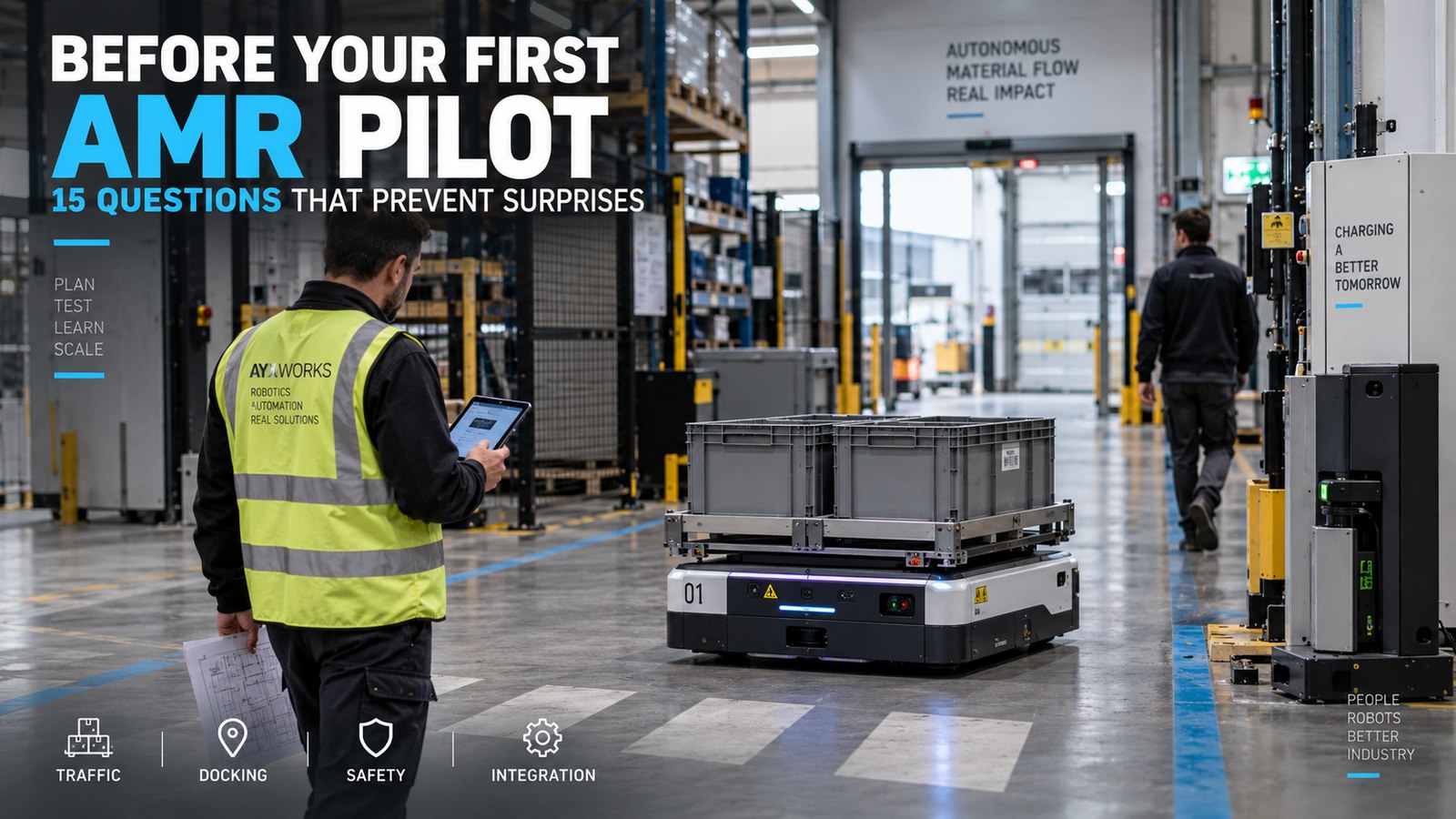
In brief: A first AMR pilot tests a transport service, not a vehicle: the building, the handover stations, the traffic and the people who recover a stuck robot all decide the result. The fifteen questions below are meant to be answered in writing before the vehicles arrive.
Why the questions come before the robot
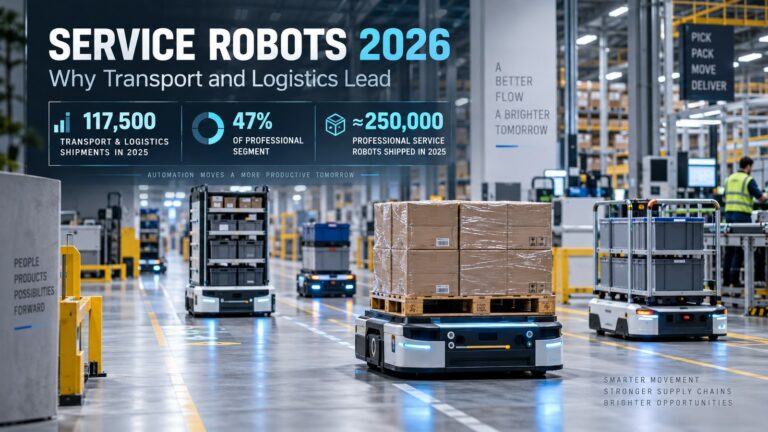
A supplier demonstration shows that a vehicle can navigate. It does not show that your loads arrive where they are needed during the busiest shift. On 30 September 2026 the International Federation of Robotics (IFR) reported about 117,000 transport and logistics service robots shipped in 2025, so these machines are no longer unusual; what remains uncertain is your site. Any question that cannot be answered yet is a risk to write down, not a detail to settle later.
Route and building: questions 1 to 5
- Which origin and destination pairs are in the pilot, and how many transports per hour does each need at peak?
- Has someone walked every route during a busy shift? Slopes, damaged floor, thresholds, debris and narrow turns rarely appear on the layout drawing.
- Does the loaded vehicle, including any load overhang, pass through every aisle, door and turn with the clearance the supplier requires?
- Where do pedestrians and forklifts cross the route, and who has priority at each crossing?
- Which automatic doors, lifts or fire doors lie on the route, and who owns their control signals?
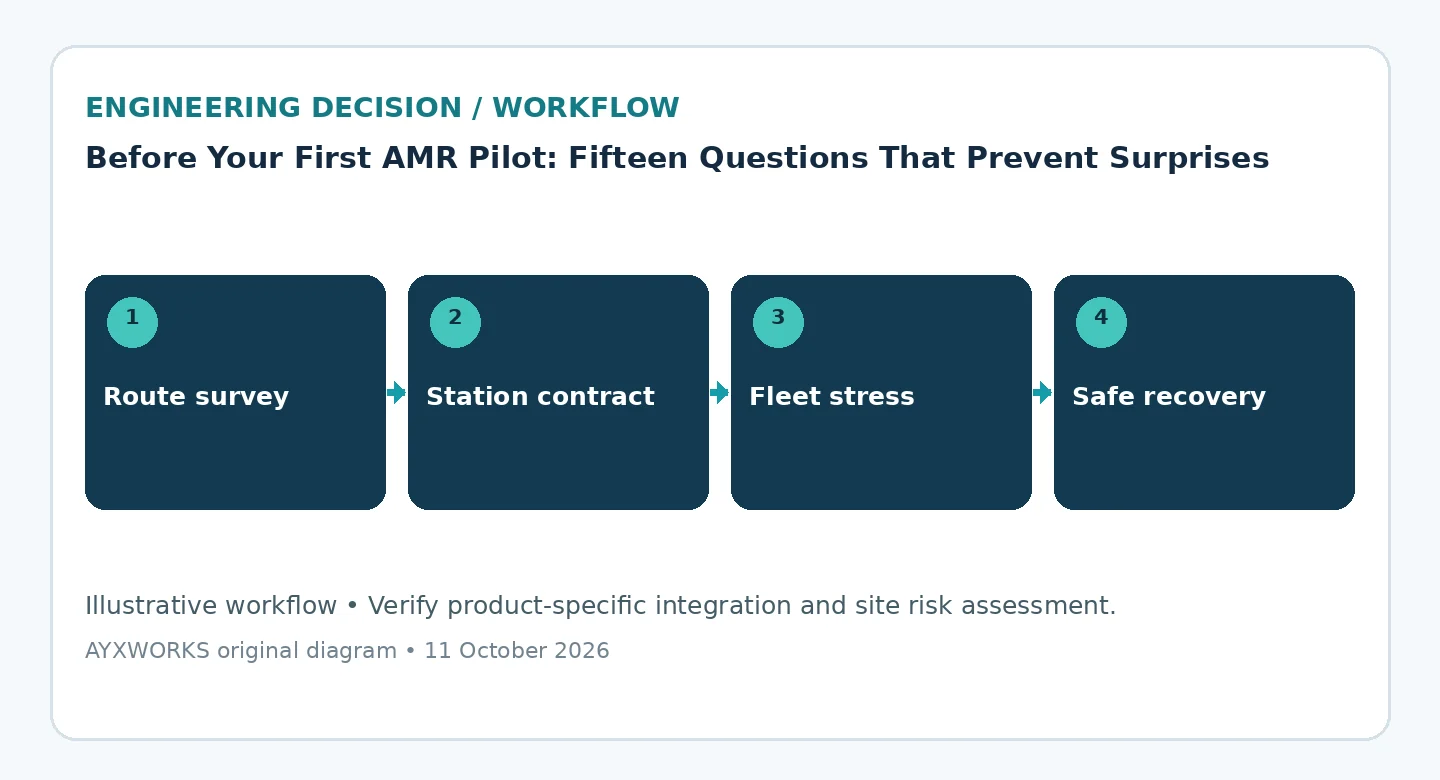
Handover and fleet: questions 6 to 10
Every mission has at least two handovers, a pick-up and a drop-off. Navigation can be flawless while the delivery still fails at one of them.
- What exactly is transferred at pick-up and drop-off: a pallet, a cart or a tote, at what height and with what position tolerance?
- Which signals confirm that the vehicle has arrived and that the load has really changed hands, and which side retries an incomplete transfer?
- How long does a complete mission take once queuing, loading, charging and interruptions are counted?
- Where will vehicles wait at bottlenecks and chargers, and what happens when two of them need the same aisle?
- What wireless coverage does the platform’s documentation require, and how does a vehicle behave when it loses the connection?
People, safety and recovery: questions 11 to 15
ISO 3691-4:2023 sets safety requirements for driverless industrial trucks and their systems, but a standard does not run your site. OSHA’s robotics overview, which is written about robots in general, notes that many robot accidents occur during non-routine operating conditions such as programming, maintenance, testing, setup or adjustment. Freeing a stuck vehicle is a comparable non-routine task.
- Who carries out the risk assessment of the application, and in which areas are the vehicles authorized to operate?
- What training, signage and traffic rules will the people who share the aisles receive before the first run?
- What is the written procedure for a blocked aisle, a stranded vehicle or a dropped load, and who is allowed to carry it out?
- Which results count as success or failure: completed missions, manual interventions, docking accuracy, recovery time?
- Who owns the maps, the maintenance and the software changes after the pilot, and what would it take to add a route?
Checklist before committing budget or scope
The answers should leave you with these documents:
- A route survey with photographs of every problem spot and crossing.
- An interface specification for each pick-up and drop-off station.
- A peak-demand table and a charging policy for the pilot fleet.
- A test plan for the network, doors and lifts, agreed with their owners.
- Exception drills with named roles and written acceptance criteria.
What this guide does not establish
These questions are a planning aid. They are not a test report, a product comparison or a compliance assessment, and they do not replace the risk assessment of your application. Numbers, tolerances and safety functions must come from the supplier’s documentation and from trials on your own site, verified by suitably qualified parties.
Sources and further verification
- IFR — Global Sales of Professional Service Robots Surge 24% (press release, 2026-09-30; figures for 2025; accessed 2026-10-12).
- ISO — ISO 3691-4:2023, Industrial trucks — Safety requirements and verification — Part 4: Driverless industrial trucks and their systems (published 2023-06; catalogue page, the full text is paywalled; accessed 2026-10-11).
- OSHA — Robotics: Overview (undated web page; accessed 2026-10-12).
Next useful step
Bring your route list, a floor plan, the load description and your answers to the fifteen questions to the Robotics & Automation page. The AYXWORKS portfolio shows the engineering approach behind these guides. Any project that follows is scoped and delivered through Eurobots/ReBots, and it starts with feasibility and responsibility boundaries, not with an assumed turnkey installation.
Image credit: ayxworks — Original / rights held.