On this page
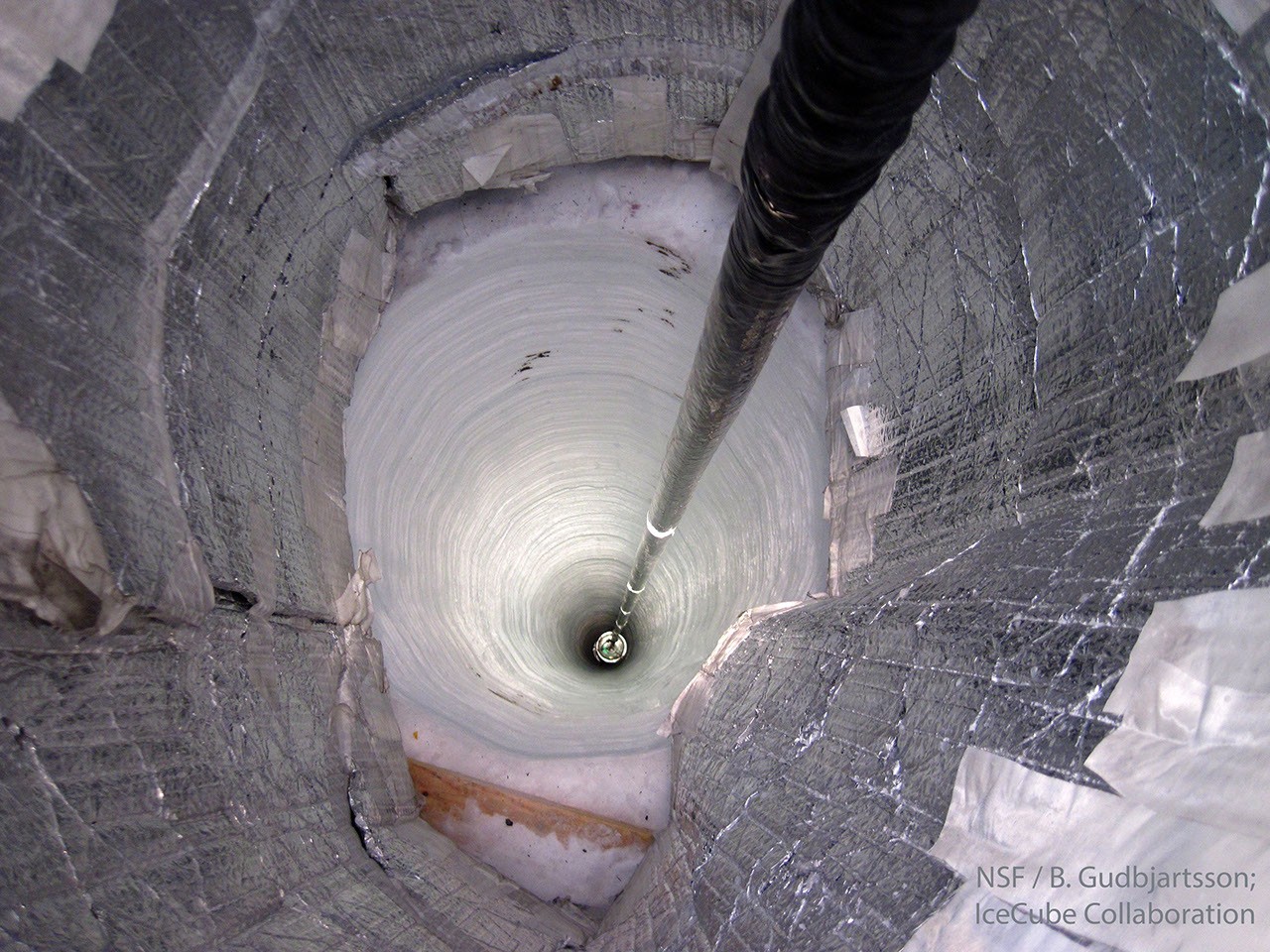
The Astronomy Picture of the Day for October 11, 2026 shows a striking scene: a long string of basketball‑sized light detectors being lowered into a freshly melted hole at the South Pole. This is the IceCube Neutrino Observatory, a cubic‑kilometer array that turns Antarctic ice into a giant telescope for the most elusive particles in the universe.
This APOD feature matters because it shows how Antarctic ice now serves as a neutrino telescope, catching particles from cosmic explosions that light cannot escape. For astrophysicists, each event narrows the search for the universe’s most powerful accelerators — objects that hurl protons to energies no Earth machine can reach. For the broader public, it signals that astronomy has moved beyond photons alone; neutrinos offer a direct probe of extreme environments around black holes and collapsing stars, letting us test physics under conditions that exist nowhere else. That shift changes how we map the violent cosmos.
How IceCube Detects Cosmic Neutrinos
Scientists melt nearly 100 vertical holes, each about 2.5 kilometers deep, and lower a cable strung with digital optical modules. When a neutrino interacts with an ice nucleus, it creates a cascade of charged particles that travel faster than light in ice, emitting a cone of blue Cherenkov radiation. The modules record the arrival time and intensity of this light, allowing researchers to reconstruct the neutrino’s direction and energy.
Why This Matters
Neutrinos travel virtually unimpeded through matter, so they carry pristine information from the most violent cosmic engines — supernovae, gamma‑ray bursts, and active galactic nuclei. By detecting them, IceCube opens a new window on the high‑energy universe that complements traditional photon‑based astronomy.
- IceCube is the largest neutrino detector ever built, instrumenting a cubic kilometer of clear Antarctic ice.
- It has identified dozens of high‑energy astrophysical neutrinos, some likely originating from distant blazars.
- The observatory operates year‑round, with data transmitted via satellite to researchers worldwide.
The Nobel Recognition
Earlier this week the Nobel Committee announced that a founding leader of the IceCube Collaboration will receive the Nobel Prize in Physics for pioneering neutrino astronomy. The award underscores how a bold idea — turning a polar ice sheet into a particle detector — has matured into a cornerstone of multi‑messenger astrophysics.
What to Do Next
If you want to follow the latest neutrino alerts, sign up for the IceCube real‑time notification service. You can also explore the public APOD archive for daily cosmic images, or dive into the IceCube website for interactive event displays and educational resources.
Tip: Use the IceCube “Event Viewer” to see a 3‑D reconstruction of a recent high‑energy neutrino candidate — no download required.
Related NASA Imaging Projects
NASA’s James Webb Space Telescope recently released a “Cosmic House of Mirrors” image showing a galaxy cluster warping background galaxies. While Webb captures photons, IceCube captures neutrinos; together they illustrate how multi‑wavelength and multi‑messenger observations enrich our cosmic picture.
Understanding Neutrino Astronomy
Neutrino astronomy is still young. Each detected event adds a data point to a map of the high‑energy sky. Future upgrades — such as the IceCube‑Gen2 extension — aim to increase the detector volume by a factor of ten, promising a flood of new sources and tighter constraints on cosmic ray origins.
Note: The APOD explanation notes that the water in each drilled hole refreezes, permanently locking the optical modules in place for decades of observation.
Want more practical guides? Explore more Ayxworks insights and save this article for later.
Ice Fishing for Cosmic Neutrinos Explanation: Scientists are melting holes in the bottom of the world.
In fact, almost 100 holes melted near the South Pole are now being used as an astronomical observatory.
Astronomers with the IceCube Neutrino Observatory lowered a long string knotted with basketball-sized light detectors into each vertical lake.
The detectors attached to the strings are sensitive to blue light emitted in the surrounding clear ice .
Such light results from fast-moving secondary particles liberated when high-energy neutrinos emitted by powerful processes out in the universe collide with ice molecules.
IceCube has now detected many illuminating neutrinos.
Pictured in 2010, one of the last of IceCube’s detector strings is lowered into the freezing abyss , making IceCube the largest neutrino detector ever created.
Tomorrow’s picture: Moons Planet Date: October 11, 2026 Credit: NSF , B.
Gudbjartsson, IceCube Collaboration Authors & editors: Robert Nemiroff, Jerry Bonnell, Cecilia Chirenti, Keighley Rockcliffe A service of: ASD at NASA / GSFC , NASA Science Activation & Michigan Tech.
FAQ
What is the IceCube Neutrino Observatory?
IceCube is a neutrino detector embedded in a cubic kilometer of Antarctic ice at the South Pole, using over 5,000 optical sensors to capture Cherenkov light from neutrino interactions.
How are the detector strings deployed?
Researchers melt vertical holes with a hot‑water drill, then lower a cable with attached digital optical modules. The water refreezes, securing the sensors in the clear ice.
Why are neutrinos important for astronomy?
Neutrinos rarely interact, so they escape dense astrophysical environments and travel across the universe without being absorbed or deflected, delivering direct information about their sources.
What does the recent Nobel Prize mean for the field?
The prize validates neutrino astronomy as a mature discipline and highlights the impact of IceCube’s discoveries on our understanding of cosmic accelerators.
Where can I see the APOD image for October 11, 2026?
The image and its explanation are available on NASA’s APOD page for that date, linked in the External Sources section below.
Can I visit the South Pole site?
Access to the Amundsen‑Scott South Pole Station is limited to scientific personnel and support staff; public visits are not offered.