On this page
Apple has finally entered the foldable-phone race with the iPhone Duo. It looks polished, runs a redesigned version of iOS, and promises the familiar Apple experience on a pocket-sized device that opens into a 7.6-inch screen. But there is a catch: Samsung already makes a substantially lighter foldable, OPPO has pushed camera and battery hardware further, HONOR has made endurance a priority, and Huawei has built phones that fold into something closer to a tablet. So which foldable is actually worth buying in 2026?
Editorial disclosure — October 9, 2026: This is an independent, evidence-based comparison, not an AYXWORKS hands-on test. We checked official product specifications and launch announcements, read independent lab reviews of available Android models, and reviewed published creator coverage and videos. Apple’s battery, durability and performance figures are manufacturer claims until independent post-release tests can confirm them. Prices and availability depend on country and date; no affiliate links are used in this version.
The verdict: Apple is entering a race it doesn’t lead on hardware
Foldables used to be impressive engineering demonstrations with obvious compromises. By 2026, that description is outdated. The best models are thin enough for a pocket, have large batteries, feature increasingly sophisticated hinges and support genuinely useful large-screen software. Apple arrives with excellent ecosystem integration, but no automatic claim to the best hardware.
Our recommendation is to buy for the experience you actually need, not the novelty of the mechanism. Apple deserves serious consideration for existing iPhone owners who want a larger canvas without leaving iOS. Samsung is easier to recommend for an Android productivity user. OPPO and HONOR are compelling hardware challengers; Huawei is unusually ambitious but requires a much closer look at regional software and service support.
AYXWORKS shortlist: Best for Apple ecosystem: iPhone Duo (pending independent battery and durability tests). Best mainstream Android productivity: Galaxy Z Fold8. Most intriguing camera-and-battery package: OPPO Find N6 (where officially sold). Best battery-first challenger: HONOR Magic V6. Most experimental device: Huawei Mate XTs. Best Google-first software option: Pixel 11 Pro Fold.
Foldable phone comparison: the specifications that matter
The table focuses on directly comparable, manufacturer-published hardware facts. Screen measurements are diagonals, weights are manufacturer’s nominal values, and battery capacities are not identical to battery-life test results. Some models have regional variants.
| Device | Inner / cover screen | Weight | Battery | Standout | Buying caveat |
|---|---|---|---|---|---|
| iPhone Duo | 7.6 / 5.4 in | 254g | Capacity not stated by Apple | iOS 27, IP68, MagSafe, Pencil planned | Preorder only; €2,339 in Spain |
| Samsung Galaxy Z Fold8 | 7.6 / 5.5 in | 201g | 4,800mAh | Lightness, DeX, multitasking | No dedicated telephoto |
| Galaxy Z Fold8 Ultra | 8.0 / 6.5 in | 215g | 5,000mAh | 200MP main camera, larger screens | Higher pricing than standard Fold8 |
| OPPO Find N6 | 8.12 / 6.62 in | 225g | 6,000mAh | 200MP main, 50MP telephoto, 80W charging | Limited official availability |
| HONOR Magic V6 | 7.95 / 6.52 in | Varies by model / market | Up to 6,660mAh in advertised variant | Large silicon-carbon battery | Check local SKU and service terms |
| Huawei Mate X7 | 8.0 / 6.49 in | ~236g | 5,600mAh global spec | Triple rear camera with true telephoto | Google-service compatibility by market |
| Huawei Mate XTs | 6.4 / 7.9 / 10.2 in modes | ~298g | Check regional configuration | Tri-fold, laptop-like canvas | China-centric distribution and software |
| Google Pixel 11 Pro Fold | 8.0 / 6.5 in | ~239g | 4,806mAh typical | 5× telephoto, Gemini, Qi2 | Thicker/heavier than Samsung Fold8 |
Primary references: Apple Duo specifications, Samsung Fold8 range, OPPO Find N6, HONOR, Huawei Mate X7, Huawei Mate XTs, and Google Pixel 11 Pro Fold. Huawei XTs is a three-fold device, so it is not directly equivalent to a book-style foldable.
iPhone Duo: what Apple actually brings to the fold
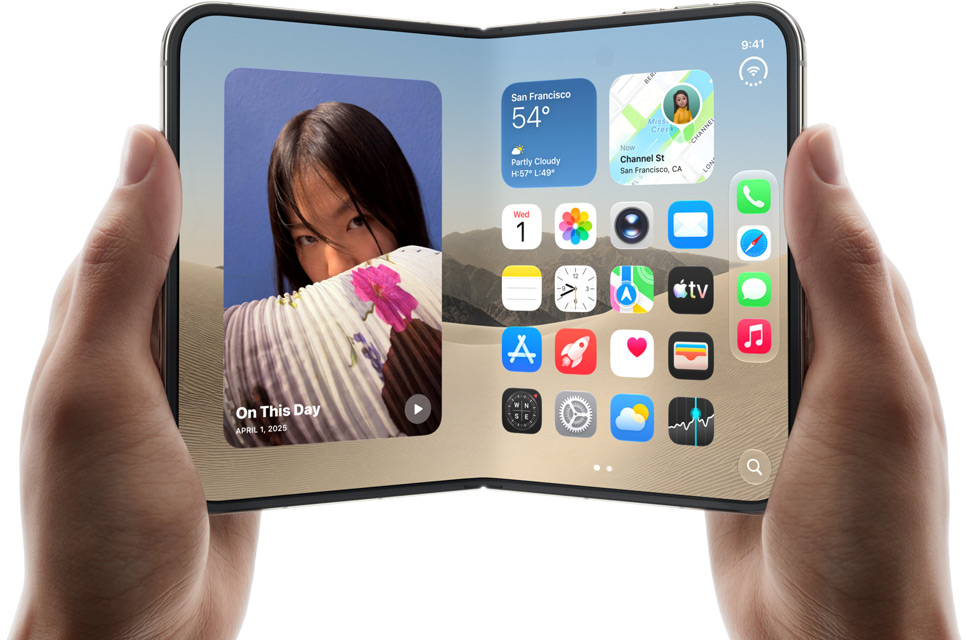
The Duo is Apple’s first foldable iPhone, announced September 9, 2026, with preorders starting October 16 and deliveries beginning October 23. It starts at $1,999 in the US and €2,339 in Spain. The key design decision is a compact, passport-like shape rather than a tall conventional phone: a 5.4-inch cover display opens into a 7.6-inch inner OLED. Both support ProMotion up to 120Hz and Apple’s advertised peak outdoor brightness of 3,000 nits.
Apple has added a nano-textured cover layer to the folding display to diffuse reflections and make the crease less visually intrusive. That could be a genuine advantage for reading and multitasking under overhead lighting. It could also affect the glossy appearance buyers expect from premium OLED. Hands-on impressions such as The Verge’s launch-day report found the crease difficult to notice, but those impressions do not establish scratch resistance after a year of use.
The engineering trade-off is weight: at 254g, Duo is heavier than most of the mainstream two-panel rivals here, including a striking 53g advantage for Samsung’s 201g Fold8. It is 11.3mm thick when closed and 5.2mm open, excluding any extra camera protrusion. Apple’s titanium construction is attractive, but thinness and mass are separate purchasing decisions.
Durability: IP68 is promising, not a guarantee
Apple gives Duo an IP68 rating and details its hinge support, layered flexible display, Ceramic Shield outer protection and AppleCare service options. Compared with the Fold8’s IP48 rating, Apple’s dust-ingress specification is stronger on paper. IP classifications are laboratory tests under defined conditions; neither rating means the inner flexible screen is invulnerable to grit, punctures or drops. The hinge, adhesives, flexible cover layer and expensive internal screen remain the ownership risks to watch.
The cameras are good on paper—but are not Pro Max cameras
Duo uses 48MP main and 48MP ultra-wide rear cameras. Apple advertises a 2× optical-quality crop from the main sensor, not a separate telephoto lens. It supports 4K/120fps Dolby Vision recording on the main camera and makes clever use of the second screen for rear-camera selfies, dual previews and hands-free shots.
At this price, missing a dedicated telephoto camera is a serious limitation for travel portraits, wildlife and distant subjects. Apple’s specification sheet makes the 2× mechanism clear. Buyers who care more about optical zoom than opening the phone should compare it with Samsung’s Fold8 Ultra, OPPO Find N6 or Huawei Mate X7—and also with the non-folding iPhone 18 Pro Max.
Performance, battery and charging: wait for comparable tests
Apple’s A20 Pro has a custom vapor-chamber cooling system, and Apple’s official claims include up to 31 hours of playback on the inner screen, 44 hours using the outer screen and 24 hours in mixed use. Those are not directly comparable with Samsung’s video-playback estimate, a 6,000mAh OPPO battery or GSMArena’s Active Use Score. The relevant tests will be mixed screen-on usage, sustained gaming, camera recording, 5G navigation and idle drain across both displays.
Apple claims approximately 50% charge in 20 minutes under its specified charging conditions and offers magnetic MagSafe / Qi2 wireless charging. The Duo is eSIM-only worldwide and uses Touch ID in its side button rather than Face ID. Those choices matter for travelers, people carrying multiple SIMs and users accustomed to facial authentication.
The real fight: iOS continuity vs Android multitasking
Foldable hardware only pays off when software changes how you work. Apple has adapted iOS 27 with side-by-side apps, saved app pairs, different orientations, a redesigned Dock and interface transitions that respond to the device opening or closing. Compatible Apple Pencil (USB-C) support is planned for later in 2026, so buyers should verify it is actually enabled by the version they receive rather than counting it as an out-of-box feature.
Samsung has been refining Android foldable software over multiple generations. Split windows, floating apps, taskbar workflows, DeX desktop-style usage and mature external-display integration make it more flexible for technical users who genuinely juggle multiple apps. More windows are not always better, but an Android foldable can often replace some laptop-style workflows that iOS still treats more conservatively.
For practical decisions, test three tasks rather than counting advertised windows: (1) reading a PDF while making notes, (2) working in email/Slack alongside a browser or spreadsheet, and (3) moving material between apps without losing your place. An excellent hinge cannot compensate for a workflow that forces constant app switching.
Google’s Pixel 11 Pro Fold takes a different route: Gemini-centered tools, Google’s native apps, Pixelsnap Qi2 accessories and a 5× optical telephoto. It is a sensible shortlist entry if you value Google services and computational photography over the lightest chassis.
iPhone Duo vs Samsung Galaxy Z Fold8 and Fold8 Ultra

Samsung’s strongest advantage is maturity. Galaxy Z Fold8 launched months before the Duo and has a real track record in stores and independent testing. Its 7.6-inch, 4:3 main screen and 5.5-inch cover screen put it in the same broad passport-format class as Apple. Yet it weighs just 201g and measures 9.7mm folded, making it much less burdensome in daily carry.
Samsung’s official Fold8 page lists a 4,800mAh battery and up to 26 hours of video playback, but do not compare that directly with Apple’s marketing video hours. Crucially, Samsung has DeX and more extensive multitasking. On the negative side, the standard Fold8 also has no dedicated long-range telephoto camera and does not offer the Duo’s claimed IP68 dust-protection level or magnetic MagSafe-style accessories.
Fold8 Ultra: the more direct competitor for camera enthusiasts
Galaxy Z Fold8 Ultra steps up to an 8.0-inch internal display and 6.5-inch outer panel, with a 200MP main camera and dedicated telephoto hardware. It weighs approximately 215g, still considerably less than Duo, and uses a 5,000mAh battery. It is physically larger and carries a higher list price than the standard Fold8. For buyers who expect advanced photography and tablet-style work from an ultra-premium foldable, it is a more meaningful comparison than the entry Fold8 alone.
Independent creator coverage provides useful context. In MKBHD’s Galaxy Z Fold8 review, the focus is the appeal and compromises of living with Samsung’s new hardware. Brian Tong also published a direct Duo vs Fold8 specification comparison after trying both. These sources are complementary: short event hands-ons should not be confused with months-long durability reports.
Choose Samsung if: you want an available foldable today, need desktop-like multitasking, prioritize one-handed carry, or find a Fold8/Ultra at a real discount. Choose Duo if: iOS, Apple services, AirDrop, Apple Watch integration, magnetic accessories and the stronger paper dust rating outweigh Samsung’s lighter build.
OPPO Find N6: the hardware benchmark Apple needs to catch
OPPO’s foldable family is called Find N, not Find X Fold. Its latest flagship, Find N6, launched in March 2026. It has an 8.12-inch inner display, 6.62-inch outer display, Snapdragon 8 Elite Gen 5, 225g listed weight and an exceptionally slim 8.93mm folded profile. Those specifications are not just impressive for a foldable; they challenge mainstream premium phones.
OPPO calls its hinge and display system “Zero-Feel Crease.” That is marketing language, not evidence that the fold line physically disappears. However, GSMArena’s hands-on review found the indentation very difficult to feel and the hinge implementation unusually accomplished. The important questions are how this holds up after thousands of cycles and whether the protective layer can be repaired affordably.
Photography is another major distinction. Find N6 combines a 200MP main sensor with a 50MP periscope telephoto and 50MP ultra-wide camera, co-branded with Hasselblad. It offers real telephoto optics rather than relying only on a 2× main-sensor crop. Its 6,000mAh silicon-carbon battery supports up to 80W wired and 50W wireless charging using compatible equipment. GSMArena’s lab section provides independent performance context instead of relying on the advertised charging wattage alone.
ColorOS 16 also includes Free-Flow Window multitasking, a compatible AI Pen and note-taking features. Compared with iPhone Duo, OPPO offers a larger internal canvas, more versatile camera focal lengths and a higher stated battery capacity at significantly lower weight.
The catch is distribution. OPPO uses “global launch” language, but independent reporting identifies limited retail availability in markets such as Southeast Asia. Before importing one into Spain or elsewhere in the EU, confirm your exact regional variant, local cellular bands, warranty logistics, software region, repair network, return rights and compatibility with your carrier. A remarkable foldable without convenient local repairs may be a poor long-term purchase.
For real-world impressions, see Android Authority’s OPPO Find N6 review and Tech Spurt’s longer-term use and camera discussion. Their central tension is persuasive: excellent engineering, difficult availability.
HONOR Magic V6: battery-first foldable, with European appeal
The HONOR Magic V6 addresses one of the most frustrating aspects of foldables: battery size. HONOR announced a silicon-carbon battery reaching 6,660mAh in its promoted configuration, alongside approximately 7.95-inch inner and 6.52-inch outer LTPO OLED displays. Battery and device specifications vary by country and SKU, so verify the actual unit offered by a local retailer.
This is a particularly relevant alternative for European buyers: unlike OPPO’s patchier official distribution, HONOR maintains official country-specific sales and support pages, including Spain. Its large-screen workflow, MagicOS features, charging and pen-related capabilities are worth evaluating alongside the price of equivalent Samsung and Apple models.
In his global Magic V6 review, Tech Spurt discusses sustained everyday use, gaming, cameras and battery rather than simply reading a spec sheet. The lesson is that silicon-carbon capacity is an advantage, but your actual screen brightness, 5G use and application mix will still determine endurance.
HONOR is especially attractive to buyers who open the inner screen frequently, browse for hours and value longer time between charges. It deserves more attention than it receives in Apple-versus-Samsung coverage.
Huawei Mate X7: a camera-focused folding flagship

Huawei’s Mate X7 demonstrates how far folding hardware has developed outside the US market. The international product specification lists an 8-inch 120Hz inner display, 6.49-inch cover screen, roughly 236g weight, 5,600mAh battery and a camera system featuring a 50MP main sensor with variable aperture, 40MP ultra-wide and 50MP telephoto macro camera with approximately 3.5× optical zoom.
Those optics make the Mate X7 potentially more flexible for travel photography than Duo’s dual-camera, 2× optical-quality crop configuration. GSMArena’s full review and lab tests are worth consulting for actual dynamic range, battery endurance and camera behavior, because lens count and megapixels alone cannot establish image quality.
The central caveat is not the hinge: it is software and services outside China. Chinese Mate X7 variants use HarmonyOS, while international variants may ship with EMUI. Google Play certification, individual banking apps, contactless payments, Android app compatibility and work-profile requirements must be confirmed for the exact regional model. Workarounds are not equivalent to guaranteed native compatibility. For a buyer using a Google-dependent workflow, that can outweigh excellent hardware.
Huawei Mate XTs: what happens when two folds are not enough?

Huawei’s Mate XTs Ultimate Design is a different class of product: a tri-fold phone with 6.4-inch single-panel, 7.9-inch dual-panel and 10.2-inch fully unfolded modes. Rather than fitting the usual phone-to-small-tablet model, it starts to approach a compact work tablet.
At approximately 298g and 12.8mm when fully folded, it sacrifices some portability for an unusual display area. The three-panel design invites useful possibilities—large documents, complex multitasking, creative work and occasional keyboard use—but introduces additional mechanical and service complexity. This is not a simple drop-in alternative to a book-style Fold8 or iPhone Duo.
The official Chinese specification page lists a Kirin 9020 and HarmonyOS software. The globally available earlier Mate XT is a different product, with different specifications. Do not confuse Huawei Mate XT, Mate XTs and Mate X7 when comparing listings or import prices.
For an independent look at the tri-fold concept, see Rozetked’s Huawei Mate XTs review, including design, software, cameras and productivity. This is the most innovative category in the article, but it comes with the greatest need to check regional availability, repair expenses and software suitability.
Pixel 11 Pro Fold: the Google-first alternative
Google’s Pixel 11 Pro Fold combines an 8-inch inner display with a 6.5-inch cover screen, Tensor G6, 16GB RAM, Qi2 Pixelsnap magnetic charging and a dedicated 5× telephoto camera. Google lists a typical 4,806mAh battery. It brings the familiar Pixel camera and Google AI experience to a folding layout.
Its appeal is practical: it offers Android with direct Google ecosystem integration, long software support and a more familiar service proposition for users who do not want to import a region-limited OPPO or Huawei. It is not the lightest device in this comparison, so pocket comfort should be tested in person. If Pixel camera processing and Google’s assistant features are your priorities, this model merits a direct comparison with the Samsung Fold8 Ultra.
Which foldable has the best camera?
There is no responsible universal camera winner without equivalent side-by-side photos and videos. As a hardware starting point, the Duo and standard Galaxy Z Fold8 each rely on a main and ultra-wide system without a dedicated long-range telephoto. Oppo Find N6 has a 200MP main, 50MP periscope and 50MP ultra-wide; Huawei Mate X7 and Pixel 11 Pro Fold provide dedicated telephoto optics; Samsung Fold8 Ultra adds a more ambitious camera package.
A sensible comparison should test: faces in mixed indoor light; moving children or pets; a 3×–5× subject at dusk; ultrawide edges; portrait hair detail; stabilization while walking; and transition consistency between focal lengths during video recording. Megapixels are only one variable among sensor size, optics, processing and software.
Early buying call: Prioritize the OPPO Find N6, Huawei Mate X7 and Fold8 Ultra if camera flexibility is critical; consider Pixel for Google computational photography; buy Duo primarily for the foldable iOS experience rather than maximum optical zoom.
Which foldable has the best battery life?
OPPO’s 6,000mAh and HONOR’s advertised 6,660mAh battery capacities offer a clear specification advantage over the standard Samsung Fold8’s 4,800mAh. Yet silicon-carbon chemistry, chip efficiency, display area, standby drain and software optimization matter just as much. Apple’s Duo does not have a manufacturer-listed mAh figure in its official tech sheet, making simplistic capacity tables especially misleading.
Independent reviewers have had time to assess the Android models. GSMArena’s measured Find N6 battery and charging section and Mate X7 tests are meaningful evidence. By contrast, claims that Duo is the battery champion are premature before October 23. Apple’s separate playback scenarios should not be presented as evidence of winning a uniform battery-life test.
Look beyond the number: compare hours on the inner screen, external-screen-only use, 5G video calls, navigation heat, sleep drain, full charging time, wireless charging availability and battery replacement pricing. A folding phone’s battery is a daily-life feature, not a marketing contest.
Creases, water, dust, repairs and total ownership cost
Foldable durability has several independent dimensions. An IP rating describes specific lab resistance to water and solid particles; hinge-cycle claims measure one mechanical test; scratch resistance addresses the outer protective material; and a repair warranty governs your financial exposure if something fails. Passing one category does not prove the others.
Apple advertises IP68 and a reinforced internal stack, Samsung Fold8 IP48, and OPPO Find N6 IP56/IP58/IP59. These ratings use different test conditions and should not be reduced to one overall “toughness score.” OPPO’s crease engineering has already attracted positive hands-on coverage, while Apple’s nano-texture display is promising but awaits long-term verification.
Before purchasing any premium foldable, obtain written answers about the cost of replacing the inner panel, factory protective layer, hinge and battery. Ask whether screen protectors are user-removable, what excludes warranty coverage, where the device is serviced, and whether accidental damage cover includes the folding screen. For an imported phone, repair logistics can be a larger risk than the spec sheet suggests.
What independent creators and reviewers actually add
Launch press releases establish the products’ official claims; independent creators reveal usability issues, ergonomic surprises and field performance. Their coverage is useful when the device and review date are clearly identified. A launch-event impression of Duo should not be treated as an extended battery, hinge-wear or long-term ownership review.
| Creator / outlet | Coverage | Why it matters |
|---|---|---|
| MKBHD | iPhone 18 Pro / Duo impressions | Early hardware experience and Apple’s product trade-offs |
| MKBHD | iPhone Duo follow-up | Nuances overlooked during the reveal |
| MKBHD | Galaxy Z Fold8 review | Real use of Samsung’s available competitor |
| Brian Tong | Duo vs Fold8 spec battle | Size, weight, display, camera and value breakdown |
| Android Authority | OPPO Find N6 review | Crease, camera and limited availability |
| Tech Spurt | OPPO Find N6 review | Real use, battery and camera impressions |
| Tech Spurt | HONOR Magic V6 global review | Battery, software and performance after extended testing |
| Rozetked | Huawei Mate XTs review | What living with a tri-fold actually involves |
| GSMArena | Find N6 lab review | Measurements, photography and charging evidence |
| GSMArena | Mate X7 lab review | Real test results and regional limitations |
For two complementary starting points, watch MKBHD’s Duo hands-on and Android Authority’s Find N6 review. They illustrate the central story: Apple is seeking to make foldables feel familiar, while OPPO is pushing the physical hardware boundaries.
Watch: MKBHD — iPhone 18 Pro/Duo Impressions · Watch: Android Authority — OPPO Find N6 Review.
Price and availability: the trap in global foldable comparisons
Apple lists Duo at $1,999 in the United States and €2,339 in Spain for the entry 256GB configuration. Samsung’s standard Fold8 launched at $1,899.99 US and the Ultra at $2,099.99 US, but discounting has already made some Samsung configurations substantially cheaper in early October. These prices cannot be equated directly across currencies, taxes, storage tiers or carrier bundles.
OPPO’s hardware value can look exceptional until you account for the limited markets in which authorized sales, warranty repairs and parts are available. Huawei’s domestic Chinese launch prices are not a reliable guide to what an imported model will cost after taxes and service risk. HONOR and Samsung are relatively straightforward to check through official European retailers. Pixel availability must likewise be verified for your country.
The recommended buying comparison: Price each model at the same storage tier in your own market. Add a protective case, reasonable accidental-damage cover, any required charger or pen, and the likely cost of service. A €2,000 foldable with reliable local support can be better value than a seemingly cheaper import that takes weeks to repair.
Which foldable should you buy? A five-step decision framework
- Choose your ecosystem first. If you rely heavily on iMessage, FaceTime, Apple Watch, iCloud and Mac continuity, Duo is the low-friction choice. If you use Google services and prefer customizable workflows, compare Android options.
- Define the inner-screen job. Documents and multitasking favor mature windowing and wide aspect ratios; video and reading may prioritize reflections, crease visibility and posture.
- Check cameras with your actual subjects. If you need 3×–5× optical telephoto, remove Duo and standard Fold8 from the top of your camera-first shortlist.
- Consider daily carry and battery honestly. A 53g weight difference is noticeable. A large battery is useful only when supported by efficient software and reliable charging.
- Verify repairs and the final cost. Particularly in Spain or elsewhere in the EU, confirm an authorized service route, required apps, return policy and regional model number before importing.
Our early recommendation: Existing iPhone owner? Wait for the first independent Duo battery, screen-durability and camera tests after October 23 unless your current device is failing. Android power user? Shortlist Fold8 and Fold8 Ultra first, then check local HONOR pricing. Hardware enthusiast willing to import? Find N6 is especially tempting, but account for after-sales support. Photography and experimental form factors? Research Mate X7 and Mate XTs, while accepting their software/repair caveats.
Frequently asked questions
Is the iPhone Duo released yet?
No, not as of October 9, 2026. Apple announced it September 9, opens preorders October 16 and begins availability October 23 in initial markets, including Spain.
How much does the iPhone Duo cost in Spain?
Apple’s announced Spanish starting price is €2,339 for the 256GB model. Prices for higher capacities and accessories differ.
Is the iPhone Duo better than the Samsung Galaxy Z Fold8?
Not universally. Duo offers iOS, MagSafe, Apple Pencil compatibility planned for later in 2026 and an IP68 specification. Fold8 is considerably lighter, thinner when folded and has more developed multitasking. The better option depends on ecosystem and actual daily workflows.
Does the iPhone Duo have a telephoto camera?
It has no separate telephoto lens. Apple offers a 2× optical-quality crop from its 48MP main camera, alongside a 48MP ultra-wide camera.
What is the OPPO foldable called: Find X Fold or Find N6?
The official name is OPPO Find N6. OPPO’s flagship book-style foldables belong to its Find N series.
Is the OPPO Find N6 sold in Europe?
Official retail coverage is region-dependent and limited. Verify country-specific official sales, warranty and repair support before importing; a global announcement does not mean every European market has authorized stock.
Does Huawei’s Mate X7 have Google Play?
Do not assume so. Software differs by region, and Huawei’s international and Chinese models do not necessarily have the same Google-service support. Confirm certification and the exact apps you require before purchase.
What is the difference between Huawei Mate X7 and Mate XTs?
Mate X7 is a conventional book-style foldable with an 8-inch internal display. Mate XTs is a tri-fold design that expands to 10.2 inches and targets a more experimental large-screen experience.
Which foldable has the best battery life in 2026?
OPPO Find N6 and HONOR Magic V6 have strong capacity and independent-use evidence. Apple Duo’s full mixed-use battery performance has not yet been independently established because the phone is not commercially available. Compare results from the same controlled testing protocol, not incompatible manufacturer estimates.
Should you preorder the first foldable iPhone?
Preordering makes most sense if you are committed to iOS and comfortable paying an early-adopter premium. For most buyers, waiting for independent camera, battery, repairability and long-term screen tests is the more rational choice.
Final verdict: Apple’s arrival is important, but the winner depends on your priorities
The iPhone Duo may turn out to be the foldable that brings the category to a broader group of Apple customers. Its attention to interface transitions, resistance specifications and ecosystem integrations could matter more in daily use than another millimeter of thinness. But right now it is also a heavy, expensive first-generation product with no dedicated telephoto lens and no independent retail-era endurance record.
Samsung has the clearest advantage in available, refined Android productivity. OPPO appears to set a particularly high bar for hinge feel, cameras and battery but loses points on where it can be bought. HONOR is an underrated high-end alternative for long-lasting battery use. Huawei continues to explore both powerful camera hardware and genuinely novel tri-fold form factors, though software compatibility remains the critical qualification for international buyers. Google offers the most straightforward Pixel-centric option.
Our advice: Don’t preorder a foldable because it is new. Buy the one that lets you do a job that your current phone cannot, while keeping the compromises—cost, battery, portability, camera and repairability—under control.
Still deciding? Save this comparison and revisit it after October 23 when independent iPhone Duo battery and durability testing begins. Meanwhile, compare the precise configurations and local warranties of the Galaxy Z Fold8, HONOR Magic V6 and any officially supported alternative in your region.
For more research-driven technology guides, read the AYXWORKS Reviews archive.
Primary specifications and independent sources
- Apple Newsroom — iPhone Duo announcement and availability
- Apple — iPhone Duo official technical specifications
- Apple Spain — local release and pricing
- Samsung — Galaxy Z Fold8 and Fold8 Ultra product information
- Samsung Newsroom — Fold8 family launch
- OPPO — Find N6 specifications and capabilities
- GSMArena — independent OPPO Find N6 review
- HONOR — Magic V6 MWC 2026 announcement
- Huawei — Mate X7 international specification
- Huawei — Mate XTs China product specification
- GSMArena — independent Mate X7 review
- Google — Pixel 11 Pro Fold specifications
- The Verge — iPhone Duo first hands-on impressions
- MKBHD — iPhone Duo first impressions on YouTube
- Android Authority — OPPO Find N6 review on YouTube
Image credits: Four independently photographed Wikimedia Commons images are embedded, with creator attribution and CC BY-SA 4.0 license links alongside each image. Brand names and logos belong to their owners. Editorial analysis is independent and does not imply ownership or hands-on testing of every device. If your WordPress editor strips external image links, upload appropriately attributed copies to the Media Library and substitute local URLs. No photographs have been retouched in this HTML.
What would make you switch to a foldable: a much better camera, genuinely useful multitasking, a near-invisible crease, or a lower price? Share your biggest deal-breaker in the comments.