On this page
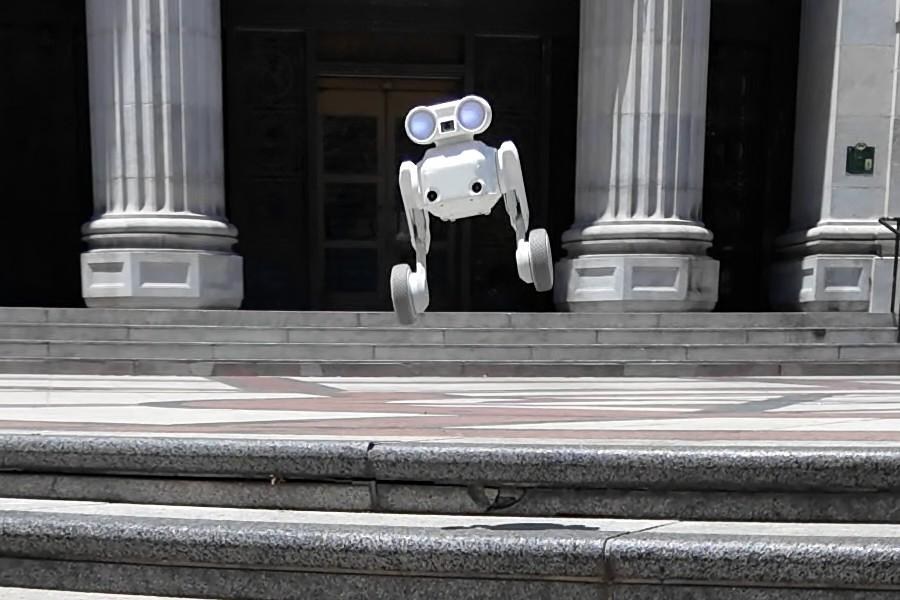
In brief: Beni is Mondo Robotics’ small, two-legged wheeled camera robot, designed to follow a subject and film from ground level. The hardware concept is appealing, but tracking reliability and production-unit performance matter more than a jumping demonstration. As checked on 14 October 2026, Mondo lists it as a preorder, with estimated dispatch starting on 10 November 2026—not guaranteed delivery on that date.
A tripod stays where you put it. An action camera goes where you carry it. Beni proposes a different arrangement: let a camera move alongside the activity while the person being filmed stays in the shot. That is a clear use case, provided the robot can keep the subject framed without needing constant rescue.
What Beni is designed to do
The official product page describes automatic following, manual control with a wrist-worn Motion Tracker, obstacle avoidance, jumping and self-recovery after a tumble. It also describes hybrid mechanical and electronic camera stabilization. These are manufacturer claims, not measurements made by AYXWORKS.
The low viewpoint could be useful for creative movement shots, sports practice or filming a dog. It is not a direct replacement for every camera or drone: a ground robot has a different view, encounters obstacles at floor level and shares space with people and animals. Each proposed use needs an appropriate location and supervision.
The specifications worth comparing
| Item | Manufacturer’s published specification |
|---|---|
| Video | 4K at 30 fps; 3K at 60 fps; 1080p at 100 fps |
| Battery life | 1.5 hours per battery; the longer advertised duration uses additional batteries and swaps |
| Storage | 32 GB internal storage plus a microSD slot |
| Weight | 1.75 kg |
| Maximum jump | 25.4 cm |
| Follow and film processing | Described as running on the device |
A video resolution is not an image-quality verdict. Exposure, motion blur, stabilization artifacts, low-light performance and compression all affect usable footage. Likewise, a maximum jump specification does not establish reliable stair climbing or safe clearance around obstacles in every setting.
Price and delivery: distinguish the current offer from the launch preview
On 14 October 2026, Mondo’s dollar-priced product page lists the Standard Combo at US$749 and the Explore Combo at US$899. These are a dated snapshot of that store page, not a quotation for Spain or another market. Destination eligibility, final taxes, shipping charges and terms must be checked for the actual order.
The page describes an estimated start of dispatch on 10 November 2026 and says orders may ship in batches. Dispatch is not delivery, and an estimate is not evidence that production units are already available from stock. Earlier crowdfunding or preview prices should not be presented as today’s offer.
Compare kit contents before comparing totals. The Standard kit includes one battery; the Explore kit lists three, a charging hub and off-road wheels in addition to its other contents. Extra batteries extend total shooting time by exchanging packs, not by making one pack last longer.
What the early preview can tell you
The Verge’s original hands-on preview is useful context for the product’s early behavior. It described an entertaining, resilient robot, while also showing that following and obstacle handling still needed scrutiny. That was the reviewer’s experience, not an AYXWORKS test.
A preview unit and a finished production unit are different evidence stages. Later software may improve behavior, but improvement needs to be demonstrated. Equally, a successful short preview cannot establish long-term durability, reliable support or performance in an unfamiliar buyer’s environment.
The tests that would change the buying decision
For filming, look for original footage from a production unit in the conditions you actually use: walking, faster direction changes, backlighting and dimmer scenes. Check whether the camera keeps the intended subject and how it responds when that subject is briefly hidden.
For the robot, look for obstacle-handling tests that include narrow turns, floor transitions and nearby people. Ask whether stopping is predictable when tracking is lost, rather than assuming that automatic following is a safety function. Keep clear of roads, drop-offs and situations where a collision could hurt someone.
Mondo’s product FAQ says Beni should not be submerged or used in heavy rain. An outdoor demonstration is therefore not proof of weather resistance. Match wheels and surfaces to the actual instructions, and do not treat promotional footage with pets or children as permission for unsupervised use.
Ownership is more than the first recording
Confirm how recordings are exported, whether core functions require an account or phone, how firmware is updated and what happens if the app or online service becomes unavailable. On-device following is useful information, but it does not by itself explain the privacy of app accounts, uploads or optional editing features.
Check replacement batteries, wheels, protective parts and repair support. Review the seller’s cancellation, return and warranty terms for your order; manufacturer marketing is not a substitute for the contract or any applicable consumer rights.
Who should consider it—and who should wait
Beni may appeal to creators and robotics enthusiasts who specifically want moving, low-angle footage and accept the uncertainty of an early product. Anyone who needs dependable filming for paid work, a fixed delivery deadline or very little supervision has stronger reasons to wait for production-unit evidence.
The sensible comparison is not “robot or no robot.” It is Beni versus the simplest reliable way to obtain the shot: a phone, action camera, fixed mount or another person holding the camera. The robot earns its place only when the moving viewpoint is worth its setup and operating demands.
Evidence boundary: this is a research-based product assessment, not a hands-on review. Specifications, prices and dispatch expectations above are attributed to Mondo’s store as checked on 14 October 2026. The older preview is kept as historical evidence, not as proof of current availability or guaranteed autonomy.