On this page
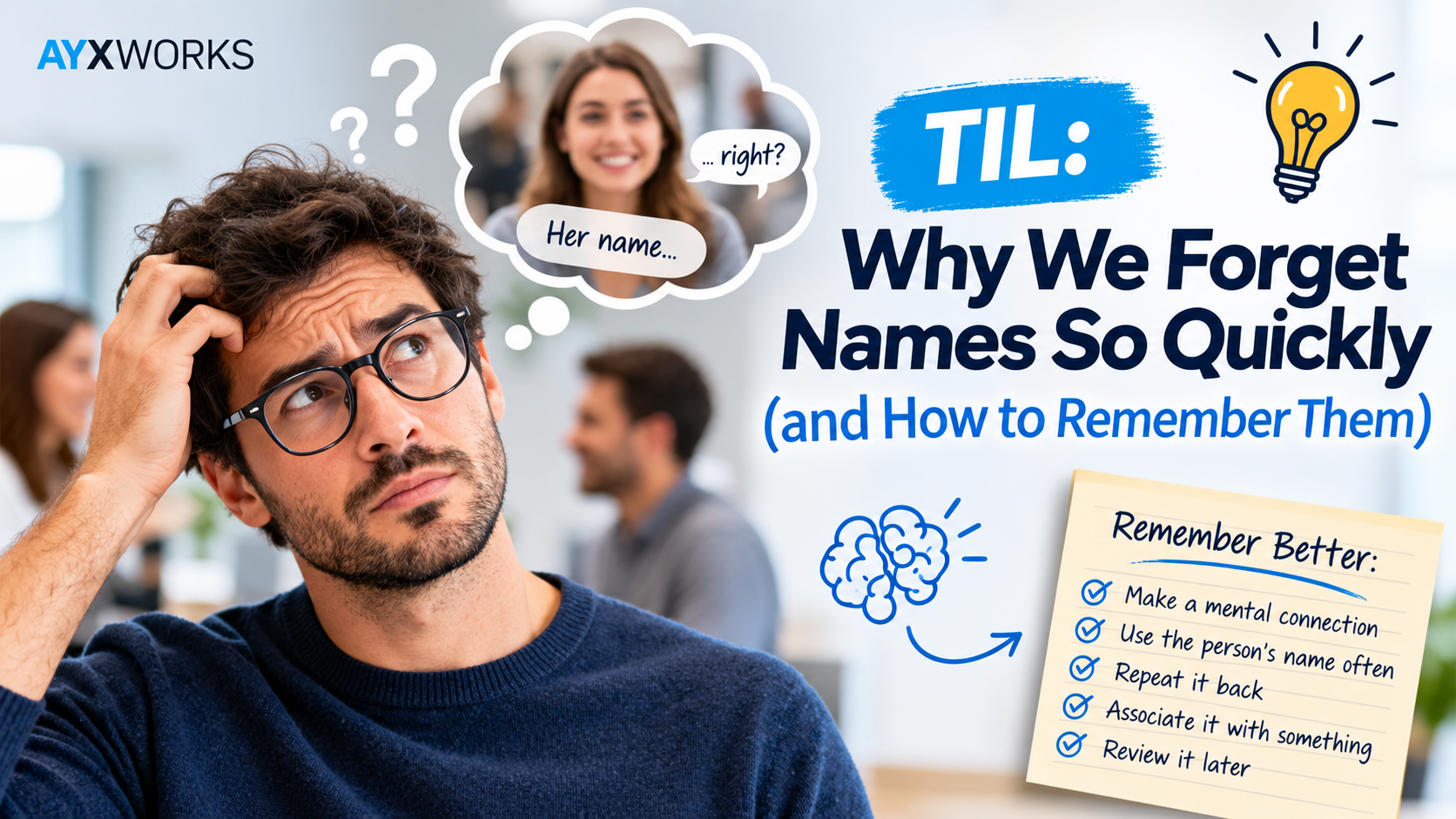
You meet someone, shake hands, hear their name and smile. Two minutes later, you remember their job, the conversation and perhaps even the coffee they ordered. But their name? Gone. If that sounds familiar, there is a surprisingly good reason—and a better way to handle the next introduction.
Quick answer: Why do we forget names so quickly? Personal names are often arbitrary labels with few clues about the person. We may also be distracted when we first hear them. Recognising a face is different from retrieving one exact name, so a familiar face can leave us searching for a word that will not come. Paying attention, making a meaningful connection and practising recall can help.
Today I learned: Forgetting a name is not quite the same as forgetting a person. You may recognise someone perfectly well while struggling to retrieve the particular sound of their name. And the fix is usually less about repeating a name over and over than about giving your brain a reason—and an opportunity—to retrieve it.
Why names are unusually hard to remember
Imagine you meet Maya, a designer who has just moved to your city. Later that afternoon, you can picture her face and recall that she works on accessible websites. You might even remember the project she mentioned. Yet you cannot produce the four letters of her first name.
That mismatch is central to the science of name memory. Psychologists have found that proper names are often harder to retrieve than ordinary words or facts about a person. A review of this research by Serge Brédart describes how person-naming depends on a complex set of cognitive processes rather than a single mental storage box. Read the research review.
1. A name usually tells you very little
If I say someone is a baker, the word suggests bread, ovens and a workplace. If I tell you the same person’s name is Baker, the name itself might have nothing to do with their life. First names such as Maya, Sam or Aisha usually give us no reliable description of the person.
That lack of built-in meaning matters. In experiments using fictional characters, arbitrary names produced more retrieval blocks than descriptive names. In everyday terms, your brain gets fewer clues to follow when it searches for an arbitrary label. See the study on name descriptiveness.
2. Introductions divide your attention
At a first meeting, you may be deciding what to say, wondering whether you have met before, scanning the room or trying not to look awkward. Listening to a name is only one task competing for attention.
If the name is not processed carefully at that moment, there may be little detail to retrieve later. That is an encoding problem: the information was not learned strongly enough in the first place. No clever memory trick can reliably recover a name you never properly heard.
3. Recognising a face is not the same as recalling a name
Here is the twist. It is tempting to conclude that humans simply remember faces better than names. But that compares two different tasks: you recognise a familiar face while you must recall a name without being shown any options.
In a 2019 study, researchers tested unfamiliar faces and unfamiliar names using the same kind of recognition task. Across three experiments, participants recognised names better than faces. The takeaway is not that names are always easier. It is that the way memory is tested changes the result. Read the face-versus-name study.
4. You need the exact label
If you cannot remember the word sofa, you can probably say couch instead. A person’s name does not work that way. If the person is called Elena, remembering that her name sounds European or begins with a vowel may not get you all the way to Elena.
This is why a name can feel so frustratingly close. Psychologists call the experience of knowing that a word is available but being unable to produce it a tip-of-the-tongue state. Research into name-recall failures finds that searching for details about a person does not always unlock the sounds of the person’s name. Explore the study on retrieval failures.
5. The connection between a face and a name can weaken
Remembering two things separately is not enough. You need to connect this face to this name and retrieve the connection when you see the person again. Over time, the clues that helped you learn a face–name pair may fade, especially if you never revisit them.
Studies of face–name learning across four weeks found that different parts of the memory—including the cues used to retrieve a name—can be forgotten at different rates. The practical implication is simple: do not rely on a single introduction to keep a name accessible for months. See the four-week study.
One new finding: some faces are easier to pair with names
A 2026 paper tested whether the memorability of a face affects what people remember about it. Across twelve experiments involving face–name and other image–name associations, names paired with highly memorable faces were more likely to be recalled in certain tests. This is an interesting clue about how associations form—not proof that someone’s appearance determines whether you will remember them, or that one technique works for everybody. Read the 2026 research abstract.
Seven ways to remember someone’s name
You cannot make names magically meaningful, but you can change what happens after you hear one. These techniques combine findings from name-learning research with low-effort habits that are easy to use in real conversations.
1. Give the name your full attention for one moment
When someone says, “Hi, I’m Maya,” briefly stop preparing your own response. Listen to the name. If the room is loud or the pronunciation is unfamiliar, ask politely: “Sorry, was that Maya?” Getting the name right is both more respectful and more useful than trying to memorise a guess.
Try this: In your next introduction, focus on hearing the name clearly before you introduce yourself or change topics.
2. Create one specific connection
Connect the person’s name to something distinctive that they actually told you. “Maya—accessible design” is a better personal cue than the vague label “someone from the event.” An existing association can also help: maybe you know another Maya, or the name has a rhythm you recognise.
The cue should make sense to you and be easy to remember. Avoid building it around an assumption about someone’s ethnicity, age or appearance. You are trying to learn a person, not reduce them to a stereotype.
Example: “Lena is leading the library redesign.” The name, role and conversation now belong to one small memory.
3. Use the name naturally once
Saying “Good to meet you, Lena” can encourage attention and confirm that you heard correctly. But there is no magic rule requiring you to say a person’s name three times. Repeating it mechanically throughout a conversation can feel forced—and repeating a sound is not quite the same as retrieving it from memory.
Try this: Say the name once when it fits. Then give yourself a chance to recall it without the person prompting you.
4. Test yourself instead of only repeating
A few moments into the conversation, quietly ask yourself: “What was their name?” See whether you can produce it without looking at a badge or contact card. This is retrieval practice: making your memory do the work rather than simply exposing it to the answer again.
In research on learning proper names, retrieval practice has outperformed simply restudying names. A broader review of memory research also finds that practising retrieval can slow forgetting across different kinds of material. See the name-learning experiments and the retrieval-practice review.
Try this: After discussing one topic, mentally recall the name before the conversation ends. If it does not come, ask again rather than practising the wrong name.
5. Bring the name back after a small delay
Immediately repeating a name can feel easy while it is still fresh. Remembering it later is a more useful challenge. After the meeting, picture the person and attempt to recall the name. Try again later that day and, if the person matters to your work or life, the following day.
These timings are a simple suggested routine, not a scientifically established schedule for every name. The evidence supports spacing learning and recall over time, but the ideal intervals depend on what and how long you want to remember. Read the review of spaced practice.
6. Make a short, respectful note when it matters
For work introductions, a line such as “Maya — product designer — discussed accessible forms at Tuesday’s meeting” can be enough. Review the note before the next interaction, then attempt to remember the name without reading it again.
Use notes as a memory aid, not as a secret dossier. Keep them limited to information shared appropriately, follow your workplace’s privacy rules and do not record faces, contact details or sensitive personal facts without a proper reason.
7. Make a second encounter count
When you see the person again, take one second to search your memory before checking the name on a calendar invite. If you can recall it, use it in a natural greeting. If you cannot, a quick reminder is better than avoiding them.
This last step matters because the goal is not to remember a list on the day of the party. It is to recognise and greet a real person next week.
The 30-second name-memory method
You do not need all seven steps during a busy introduction. Use this compact routine instead:
- Listen (5 seconds): Hear the name clearly and check pronunciation if necessary.
- Connect (10 seconds): Link it to one real detail from the conversation.
- Recall (10 seconds): After another sentence or two, produce the name in your mind without a prompt.
- Use or review (5 seconds): Say it naturally if appropriate, or make a brief mental note to test yourself later.
Example: You meet Omar, who is planning a cycling holiday. You listen: Omar. You connect: Omar—cycling holiday. A minute later you ask yourself, “What was his name?” and retrieve Omar. Later that evening, you try again without looking at anything.
This is a practical memory routine, not a measured “30-second cure.” Its most evidence-aligned feature is that you actively retrieve the name instead of relying only on repetition.
Does a funny mental image help?
Sometimes. You might picture a memorable scene that connects a name to a conversation. Imagery can be appealing, especially when it forms an easy association. But it is not automatically better than other techniques.
In a 2005 study that included people learning names at a real party, retrieval practice produced better later recall than the comparison conditions, while an imagery mnemonic did not outperform general instructions to learn names in that setting. The useful lesson is not “never use images.” It is do not spend so long inventing an elaborate image that you forget to listen and practise recalling. See the original study.
How to adapt the technique to different situations
At a conference or networking event
Do not try to memorise fifteen names at once. Focus on the people you have a real conversation with. Link the name to the topic you discussed; before leaving, recall the two or three people you most want to recognise next time. When appropriate, exchange contact details so you have a reliable backup.
On a video call
Participant labels make recognition easy, but they can hide whether you actually know the name. Before your next call with a colleague, try recalling the person’s name and role from memory, then check the meeting invitation. Be careful about guessing pronunciations from spelling alone.
When a name is unfamiliar to you
Ask how to pronounce it, listen to the full name and use the pronunciation the person prefers. A respectful clarification is more useful than silently replacing an unfamiliar name with an easier one. If the person offers a nickname, follow their lead rather than inventing one yourself.
When you meet several people in a row
Interference is the challenge: every new introduction competes for your attention. Try a short sequence—name, one shared detail, a moment of recall—before moving to the next person. You do not have to remember everybody flawlessly. You do need to give the people you want to know a fair chance to be remembered.
What to say when you have already forgotten a name
It happens. Pretending to know a name can make an ordinary mistake more awkward. Here are three simple ways to recover:
- Early in the conversation: “Sorry, I missed your name—could you tell me again?”
- When you remember the conversation: “I remember we talked about the new project, but your name has escaped me. Could you remind me?”
- When introducing two people: “Before I introduce you, could you remind me of your name? I want to get it right.”
Once they answer, pay attention to the sound, connect it to the situation and try to recall it a moment later. The important thing is what you do after the reminder.
A seven-day challenge to get better at names
Want to test the ideas without turning your social life into homework? Try this tiny experiment:
- Day 1: At your next introduction, pause and listen carefully to the name.
- Day 2: Add one real connection, such as a project or shared interest.
- Day 3: Quietly recall a name once, a minute after hearing it.
- Day 4: Recall yesterday’s name before checking a message or calendar.
- Day 5: Try the complete 30-second method with a new introduction.
- Day 6: Use a brief note for an important work contact and test yourself later.
- Day 7: Review: which names can you retrieve without hints, and which connections were actually helpful?
Judge success by improvement, not perfection. A useful goal is to remember one more person accurately at the next event—not to become a human phone book.
Is forgetting names a sign of a memory problem?
Occasionally forgetting a name is common and, by itself, does not establish that something is medically wrong. Memory lapses can also become more noticeable during stress, poor sleep or other demanding periods.
However, if memory changes are new, worsening or interfere with everyday tasks—such as repeatedly getting lost in familiar places or having trouble following normal routines—it is sensible to speak with a healthcare professional. The US National Institute on Aging explains the distinction between occasional forgetfulness and memory problems that affect daily life. Read the NIA guidance.
Frequently asked questions
Why do I forget someone’s name immediately after meeting them?
You may not have paid enough attention during the introduction, or the name may have lacked a meaningful cue. Later, you must retrieve one exact label while your memory is full of other details. Careful listening and a short recall attempt can help.
Why can I remember a face but not a name?
Recognising a familiar face and recalling a name are different memory tasks. You might recognise a person even when you cannot produce the name associated with them. This does not prove that your memory stores every face more strongly than every name.
Is repeating a name three times the best way to remember it?
There is no universal three-times rule. Natural repetition can support attention, but actively recalling the name after a brief delay has stronger support from learning research than simply hearing or rereading it repeatedly.
Can I train myself to remember more names?
You can practise more effective learning habits. Listen closely, build meaningful associations, attempt retrieval and revisit important names over time. Improvement is plausible, but no simple technique guarantees perfect recall.
Do memory tricks and funny images actually work?
They may help some people create connections, but their effectiveness depends on the task and the person. Direct research on proper-name learning has found benefits for retrieval practice, while elaborate imagery was not always superior in realistic settings.
Should I worry if I forget names more as I get older?
Occasional forgetfulness can occur with aging. Seek professional advice if memory problems are persistent, noticeably worsening or affecting normal activities. Forgetting a name alone is not enough to diagnose a condition.
The takeaway: remember the person, practise the name
The surprising part of forgetting names is how much else we can remember. The conversation sticks. The face looks familiar. The name disappears because it is often a weakly connected, exact label that we rarely practise retrieving.
At your next introduction, forget the pressure to be brilliant at memorisation. Listen carefully, make one connection and test yourself once. It takes little effort, respects the person in front of you and gives your memory something useful to work with.
Your next-step challenge: Use the 30-second method with the next person you meet. Then see whether you can recall their name later without a hint.
Which part is hardest for you—hearing the name, remembering it five minutes later or recalling it weeks afterward? Share your experience in the comments. If this was useful, explore more practical explainers in AYXWORKS.
Sources and further reading
This article summarises published research and practical memory strategies. It is not a firsthand clinical experiment or medical advice.
- Brédart, S. (2017). The cognitive psychology and neuroscience of naming people. Neuroscience & Biobehavioral Reviews.
- Burton, A. M., Jenkins, R., & Robertson, D. J. (2019). I recognise your name but I can’t remember your face. Quarterly Journal of Experimental Psychology.
- Morris, P. E., & Fritz, C. O. (2005). Strategies for learning proper names: Expanding retrieval practice, meaning and imagery. Applied Cognitive Psychology.
- McDermott, K. B. (2021). Practicing retrieval facilitates learning. Annual Review of Psychology.
- Cook, A. M., & Westerman, D. L. (2026). Do people forget your name? Your face might be the problem. Journal of Experimental Psychology: Learning, Memory, and Cognition, online ahead of print.
- National Institute on Aging. Memory Problems, Forgetfulness, and Aging.